

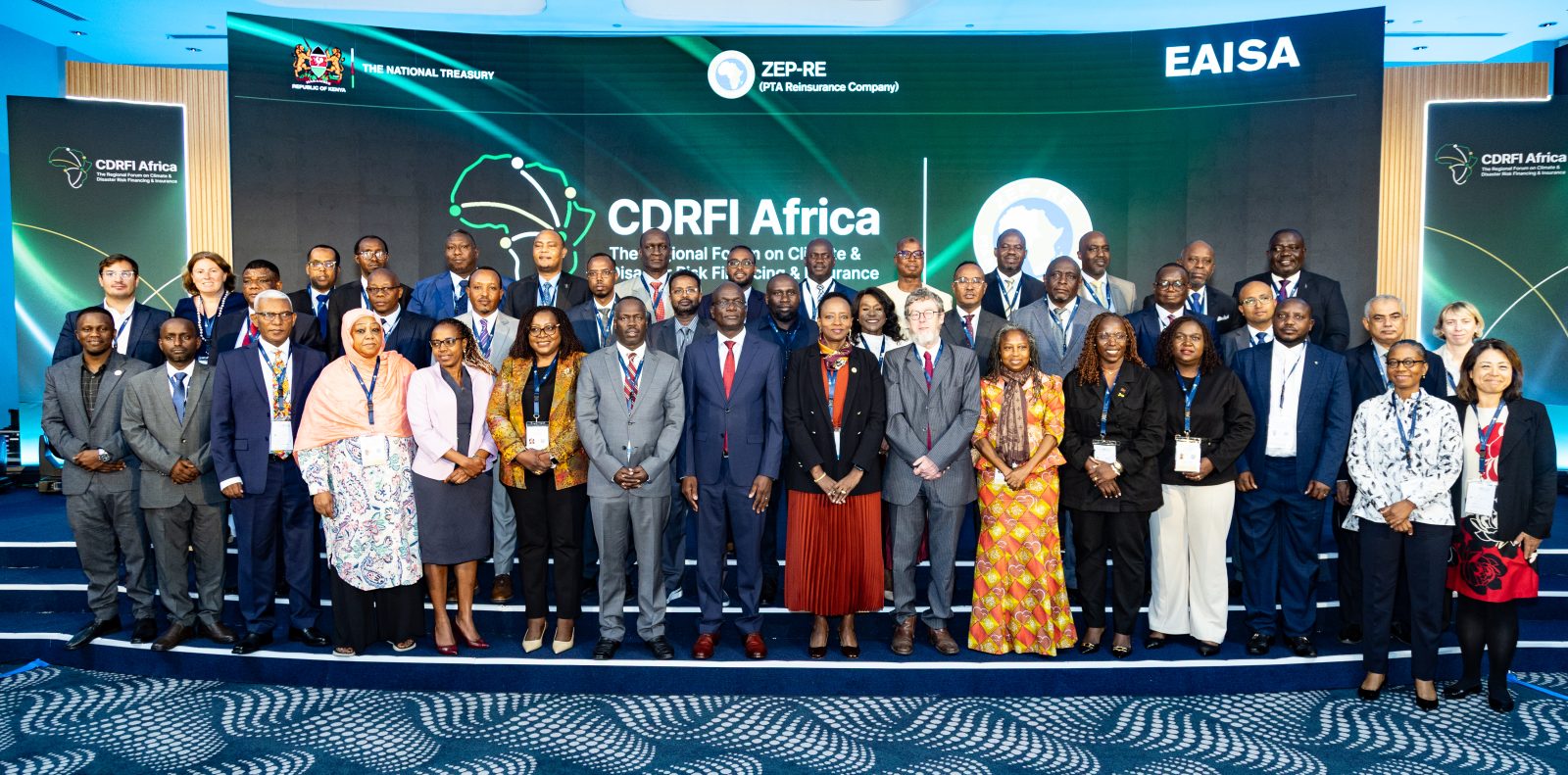
Africa insures only 3 to 5% of disaster losses, compared with about 40% globally, leaving governments to absorb more than 90%=of losses estimated at $7 to $15 billion, experts at the inaugural two-day CDRFI Africa Forum, said.
Themed “Increasing Insurability to Close the Protection Gap in Africa,” the summit majorly focused on financing resilient strategic and critical infrastructure.
The CDRFI Africa Forum is a ZEP-RE initiative, convened for the first time this year with the East Africa Insurance Supervisors Association (EAISA) and hosted by the Government of Kenya through the National Treasury.
It builds on the EAISA and ZEP-RE Strategic Forum, which has been convened annually for eight years, and brings Ministries of Finance into the dialogue following the 2025 Zanzibar Declaration adopted by EAISA.
It opened with a call for countries to identify assets exposed to disaster risks, strengthen risk information and put financing arrangements in place before shocks occur.
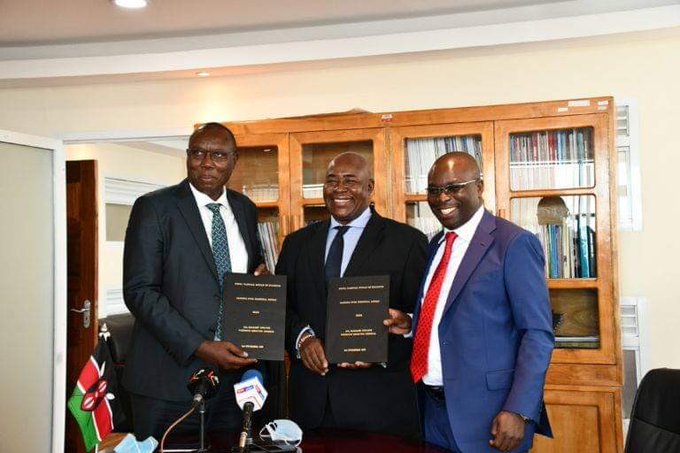
Representing the Guest of Honour, Felix K. Koskei, Chief of Staff and Head of the Public Service was Dr. Boniface Makokha, Principal Secretary for Economic Planning in Kenya’s
National Treasury, who stressed the importance of identifying assets exposed to disaster risks and determining in advance how their recovery would be financed.
“The question is no longer whether disasters will occur, but whether our countries are financially prepared when they do,” he said.
ZEP-RE Managing Director and Group CEO Hope Murera called for a shift from emergency expenditure towards proactive financial preparedness.
“Disasters should not become fiscal crises,” Murera said. “Resilience is not a cost. It is an investment in growth and stability.”
Commissioner of Insurance and CEO of the Insurance Regulatory Authority of Kenya Mr.
Godfrey Kiptum described closing the protection gap as a development priority. He called for regulation that protects policyholders while enabling innovation, citing the impending El Niño event as a reminder of the need to act before shocks occur.
EAISA Interim Chairperson Dr. Protazio Sande, Acting CEO of Uganda’s Insurance Regulatory Authority, linked insurability to investment.
“If it is not insurable, perhaps it is not investable,” he said.
The Secretary General of the Insurance Development Forum Ekhosuehi Iyahen, said the challenge is one of insurability, not insurance alone.
“Prediction has improved faster than protection,” Ms. Iyahen said. “A protection gap is rarely just an insurance gap. It is almost always a development gap.”
She also highlighted Shock-Resilient Loans, an emerging area of work exploring whether
sovereign lending can be designed so that risk transfer mechanisms provide governments with automatic fiscal breathing space following a major shock.
Emiko Todoroki of the World Bank Group’s disaster risk finance practice called for financing strategies that are matched to each country’s risk profile.
Governments could combine budget reserves, contingent financing, insurance and investment in risk reduction to address different levels of risk and strengthen financial preparedness before disasters occur.
Stakeholders identified three priorities: protecting public assets as a feasible and immediate development priority rather than a long-term ambition; recognising that no single financial instrument can address every risk, making risk layering essential; and strengthening government leadership alongside regulatory support.
The summit also brought out the importance of identifying and prioritising assets and, where possible, pooling risks regionally to create scale. And, closing the gap through insurance, data and innovation.










































![Pula Co-Founders and Co-CEOs, Rose Goslinga & Thomas Njeru. Pula provides agricultural insurance and digital products to help smallholder farmers manage climate risks, improve farming practices and increase their incomes. [ Photo / Courtesy ]](https://businesstoday.co.ke/wp-content/uploads/2021/01/Pula-Co-Founders-and-Co-CEOs-Thomas-Njeru-Rose-Goslinga.jpg)















































Leave a comment