

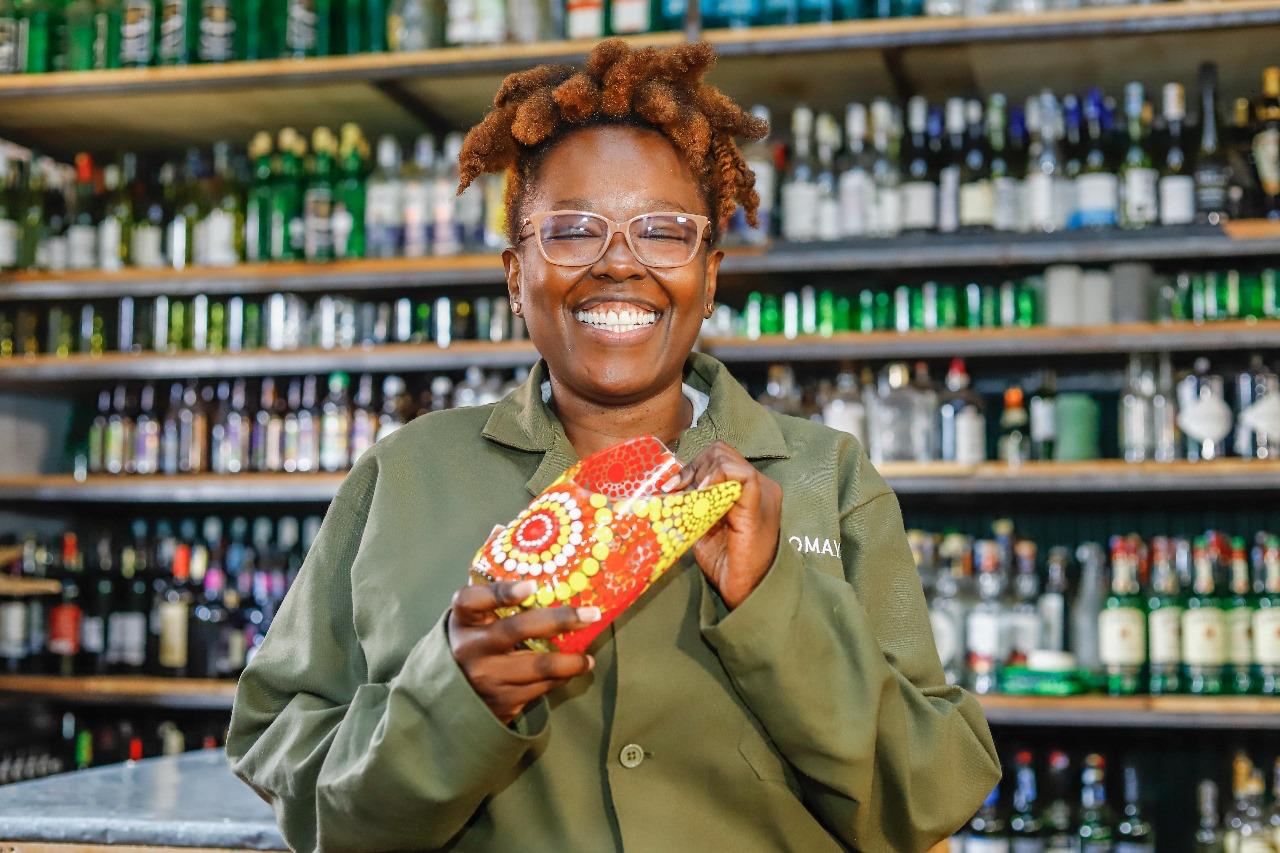
In 2020, at the height of Covid-19 pandemic, Ms Nyandia Kamawe, the founder of a handcrafted products’ firm, Mokomaya, was busy cutting bottles and painting them.
At the time, service-oriented businesses, particularly those in the retail and wholesale space, were most affected. But Ms. Kamawe says she was able to flourish and expand her business at a time when many people and organizations struggle with glass disposal. Removing glass from the waste cycle can significantly reduce disposal costs for homes, restaurants, and sporting clubs.
The name “MokoMaya” means “these hands” in the Kikuyu language and speaks to the hands-on approach to everything that Kamawe’s company produces. The start-up took off during the pandemic period – a time when the proportion of Micro, Small and Medium-sized Enterprises (MSMEs) making less than Sh100,000 recorded a marked increase of 43.8 percent from 20 percent pre-pandemic, according to a survey by Kenya Bankers Association.
Mokomaya is now thriving on sustainably created home, office, and garden items like drinking glasses, flower vases, bowls, and platters. In this interview Ms Kamawe talks about turning glass waste into beautifully hand-crafted home pieces, what she attributes her growth to, and how she has advanced through the years. She has a chat with Victor Adar:
Tell us about your glass bottle upcycling business…
Our business is contributing to building resilient supply chains, productive communities, and a healthy environment by diverting glass bottles from ending up in landfills. When we upcycle glass bottles, we are reducing depletion of natural resources because making of a new glass requires limestone, soda ash and silica all which have to be mined. We also are able to save on the energy resources required in making new class very creating products using existing glass waste. Our business also offers a customer the opportunity to customize the products that they desire. Our business offers various home office and garden items, for instance, drinking glasses, carafes, flower vases, platter, bowls, etc.
What inspired you to start the business?
The business began during Covid without a real plan, but I am a creative with a degree in fine arts and so at a time when we were all stuck at home, I began to tinker with bottles as I always had, and it gradually evolved into what we know today as Mokomaya
What do you attribute the success of your business to?
What I attribute to my current success is being able to tap into available resources especially free learning resources. I also have a design degree so I was able to bring the knowledge from that in to product design and creation. I would also say that being brave to try even when things don’t quite work out, has been a contributor to the success in this journey.
You started the business in 2020 at the height of Covid-19. How has it grown?
When we started during Covid, I didn’t quite have a clear plan. During the beginning, I focused a B2C customers who we targeted through pop up markets., Today we are focused heavily on B2B opportunities with extended producer responsibility partnerships as well as corporate gift customers who have been a great revenue driver for us. I have also gone from being the only employee to have a staff that supports the business from production, waste aggregation, administrative… Creating jobs in our community has been one of the really big successes for me.
Any challenges you have encountered so far?
Some of the challenges have been a lot in the area of mindset. As a society, we are used to buying new and so we are constantly having to prove that our products are good and can compete and sometimes beat the quality of new glassware. there’s also the reality of cash as you grow. You need to invest in your business and so that will always be a constant balance between what you need and what you have. up cycling Bottles is also not very mainstream and so there’s very few local learning resources tools that allow you to have a fair starting point and so there’s a lot of failure because we use fabricated equipment and has taken a while to get it right.
What are the prices for the glass bottle products you sell? Are they budget glasses?
Our products range from Sh750 all the way to Sh15,000. There’s an array of available options, and so, typically, customers of all the budgets in that bracket will find something that they can purchase.
Does the business guarantee you return for investment?
I would say our business has a good return on investment, especially now that we’ve understood better what we are trying to do and who we are doing it with. Being able to have corporate partners has been a huge revenue driver.
How many pieces do you sell in, say, a week, or in a month? Payment options for buyers?
This is a number we don’t measure on a daily or weekly basis because more recently we have found ourselves working on contracts that have daily obligations so less daily pay days. Our other customers are not consistently predictable so there are days when you sell 10 pieces and there are days when you sell none. Also, as we approach our busiest season of the year (Christmas) those numbers spike quite high as we have become a gift source over the years for a lot of our B2C customers.
Mokomaya is located in Kabiria, Nairobi. What inspired the choice of the location?
There was no reason or strategy behind the choice of location. It just kind of worked out that way, and has turned out to be a good choice for us.
How do you distinguish Mokomaya from many other upcycling companies you have seen in Kenya?
One of our key distinguishers is the decoration we add to the items we sell and we are able to create pieces that are designed with hand-made painted colour. We also work with artisans to add wood brass and sometimes beads to add value to our pieces. MokoMaya is also very invested in our process being sustainable and not just the actual product so we are keen on making sure we use and reuse resources in our production process and packing as well. We are constantly learning how we can improve our process so that we are able to reduce waste and run a true circular business.
What are you proud of?
One of the things am really proud of recently has been going through a validation process with Climate KIC which sought to ascertain the extent to which a start-up has a circular business model and the extent to which their product or service is circular. It also assesses the circularity of materials used, reviews the energy use and focuses on certain complementary environmental and social aspects. We scored really well and having this global standard validation report really sets us apart in the market place especially at a time when there is a rush to demonstrate sustainability.









































![Pula Co-Founders and Co-CEOs, Rose Goslinga & Thomas Njeru. Pula provides agricultural insurance and digital products to help smallholder farmers manage climate risks, improve farming practices and increase their incomes. [ Photo / Courtesy ]](https://businesstoday.co.ke/wp-content/uploads/2021/01/Pula-Co-Founders-and-Co-CEOs-Thomas-Njeru-Rose-Goslinga.jpg)






































Leave a comment