


The Ethics and Anti-Corruption Commission (EACC) has revealed that key ministries and government agencies in Kenya remain hotspots for corruption and unethical behaviour.
In its latest National Ethics and Corruption Survey (NECS) 2024 released on Tuesday, August 5, 2025, the EACC identified the Ministry of Interior and National Administration, Ministry of Health, Ministry of Lands, and the National Treasury as the top national government institutions where Kenyans are most likely to encounter bribery, favouritism, abuse of office, and other forms of corruption.
The Ministry of Interior and National Administration topped the list, with 47.8 per cent of respondents citing it as the most corruption-prone, followed by the Ministry of Health (19.7 per cent), the National Treasury – specifically the Pensions Department (5.8 per cent), the Ministry of Lands, Public Works, Housing and Urban Development (4.7 per cent), and the Ministry of Education (4.1 per cent).
“The Survey sought to find out national government ministries and departments/agencies, and county government departments and services perceived to be most prone to unethical conduct and corruption in the country,” the survey read in part.
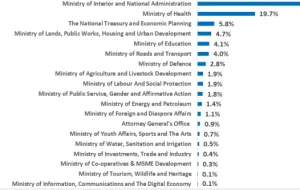
Corrupt departments
In the same report, the Kenya Police emerged as the most corrupt government department or agency, with nearly half of respondents (48.2 per cent) pointing to the police as their most frequent encounter with unethical conduct. Other government entities cited include the Directorate of Immigration (5.1 per cent), National Registration Bureau (4.4 per cent), Traffic Police (3.6 per cent), and the Civil Registration Department (3.4 per cent).
County governments were not spared. County health services were flagged as the most corruption-prone at the devolved level, with 45.1 per cent of Kenyans reporting unethical practices in the sector. County transport (9.1 per cent), agriculture (7.9 per cent), administrative units (4.8 per cent), and public service boards (4.7 per cent) also ranked highly in cases of corruption and abuse of office.
The survey, which collected views from 5,960 respondents across all 47 counties, further examined how different professional groups are involved in unethical conduct. Police officers topped the list at 27.6 per cent, followed by Kenya Revenue Authority (KRA) officers (17.3 per cent), Chiefs (16.2 per cent), County Inspectorate officers (14.6 per cent), and lawyers (14.1 per cent). County revenue officers (13.4 per cent) and land surveyors (13.3 per cent) also featured prominently.
On the other end, professionals such as teachers (24.5 per cent), journalists (22.8 per cent), university lecturers (19.4per cent), bankers (16.6 per cent), doctors and nurses (13.9 per cent), and economists (13.5 per cent) were reported to be the least involved in corrupt activities.
The EACC noted that the survey not only assessed the prevalence of corruption but also captured the level of public satisfaction with services provided by the national and county governments. It called for immediate action to rebuild trust and uphold integrity in public offices.
















































![Pula Co-Founders and Co-CEOs, Rose Goslinga & Thomas Njeru. Pula provides agricultural insurance and digital products to help smallholder farmers manage climate risks, improve farming practices and increase their incomes. [ Photo / Courtesy ]](https://businesstoday.co.ke/wp-content/uploads/2021/01/Pula-Co-Founders-and-Co-CEOs-Thomas-Njeru-Rose-Goslinga.jpg)






















































Leave a comment