

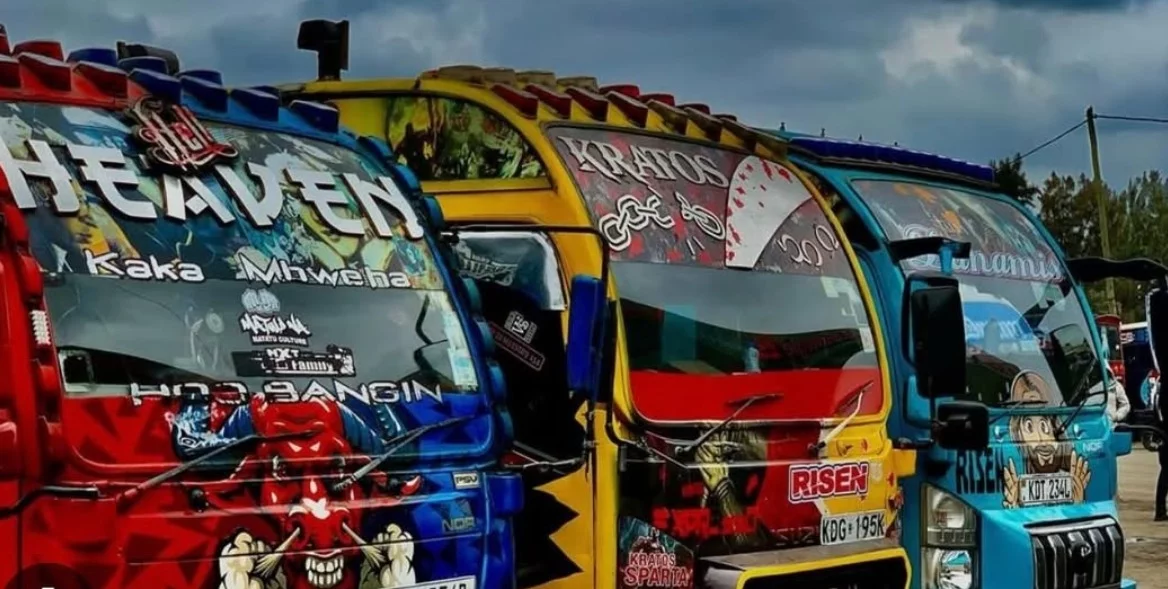
President William Ruto has intervened to block the National Transport and Safety Authority from enforcing a ban on colourful graffiti, decorative artwork and tinted windows long synonymous with the country’s public transport.
Speaking at State House in Mombasa on Friday, following late-night discussions with public service vehicle (PSV) operators, Ruto directed the NTSA to halt enforcement of the ban and instead work towards regulations that would allow “matatu culture to thrive within reasonable safety boundaries”.
“I have directed the NTSA to facilitate an enabling environment for matatu operators to continue utilising artwork and graffiti on their vehicles in a manner that upholds safety and respect for other road users,” the president said.
The decision delivers immediate relief to thousands of vehicle owners, graffiti artists, and young citizens whose livelihoods depend on the vibrant, entrepreneurial nganya culture that serves as the backbone of public transportation in Nairobi and beyond.
The standoff began in May 2025 when the NTSA, under Director-General George Njao, ordered all public service vehicles to remove exterior artwork, graffiti and aftermarket window tints. The authority warned of vehicle impoundments, licence suspensions and blocked access to its services for those who failed to comply.
NTSA justified the move on safety grounds, arguing that elaborate designs obstructed driver visibility, tinted windows hindered police monitoring, and decorative elements were covering mandatory markings such as SACCO names, route numbers and the signature yellow band that identifies PSVs.
Matatu operators mounted a strong legal challenge, arguing in the Milimani Law Courts that the directive infringed on constitutional rights to cultural and artistic expression, lacked proper public participation, and was not backed by evidence linking graffiti to increased road accidents.
In April this year, however, High Court Justice Bahati Mwamuye dismissed the petition, ruling that road safety concerns took precedence over artistic freedoms and that the authority had followed due process.
Despite the court victory for the regulator, intense lobbying from the transport sector prompted Ruto’s intervention. Addressing the issue directly, the president appeared bemused by the ban, remarking: “Matatu operators have told me they have been asked to remove graffiti, and I am asking myself, why?”
Ruto had met matatu owners and operators in Mombasa for talks to end the strike over fuel prices.







Leave a comment