

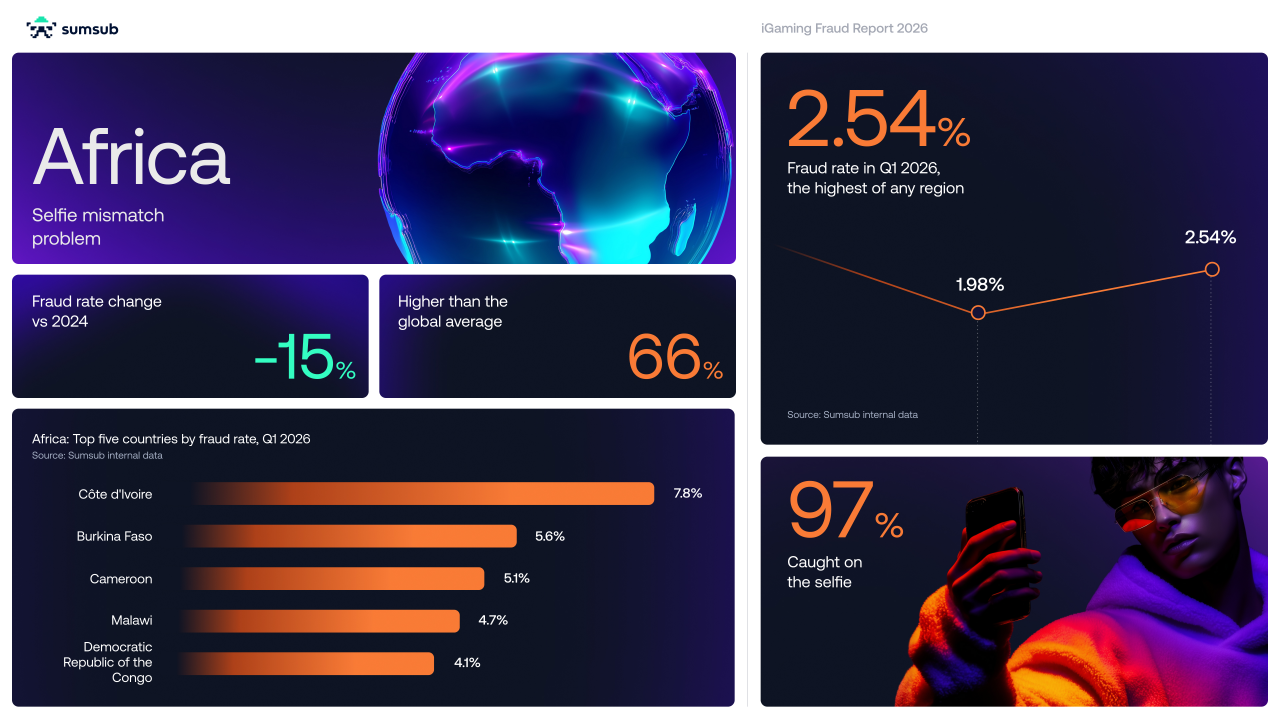
Africa has emerged as the global epicentre of iGaming fraud, according to Sumsub’s newly released iGaming Fraud Report 2026, with the continent recording the highest fraud rate of any region analysed worldwide. The findings highlight a rapidly evolving threat landscape in which fraudsters are increasingly using stolen identities, AI-assisted tools and coordinated fraud networks to target operators across African markets.
The report, based on analysis of more than three million fraud attempts and millions of identity verification checks conducted between 2024 and the first quarter of 2026, found that Africa’s iGaming fraud rate reached 2.54% in Q1 2026, significantly higher than Europe (1.14%), Latin America (1.14%), North America (0.44%) and APAC (1.92%).
While Africa experienced a temporary decline in fraud during 2025, the region rebounded sharply in early 2026 and became the single largest contributor to the global increase in iGaming fraud. Globally, fraud rates rose nearly 18% year-on-year, while the rate of suspicious transactions increased more than 4.5 times and the average suspicious transaction value climbed to more than $6,500.
“Africa’s rapid digital adoption, growing online gaming sector and expanding access to financial services have created enormous opportunities for operators, but they have also attracted increasingly sophisticated fraud actors,” said Jarryd Jensen, Regional Director for Southern Africa at Sumsub.
RELATED >> Kenya Records 3 Billion Cyber Attacks as As Businesses Face Rising Security Threats
Kris Galloway, iGaming Product Evangelist at Sumsub, a said the industry is seeing a huge amount of AI-generated or AI-assisted fraud content which includes synthetic faces, edited documents, templated identities, and mass-generated applications.
“Even when many of these attempts are low-quality individually, together, they create enormous operational pressure on verification systems, manual review teams, and fraud operations,” said Galloway. “AI dramatically lowers the cost and effort required to commit fraud at scale, and professional fraud groups are already taking advantage of it.”
Identity Fraud Replaces Traditional Document Forgery
One of the most striking findings in the report is the nature of fraud occurring in Africa. Unlike Europe, where forged identification documents account for a significant share of fraud cases, fraud on the continent is overwhelmingly focused on identity misuse. According to Sumsub’s data, 97% of all fraud detected in Africa is intercepted during the liveness (facial biometrics check) stage, where the individual attempting verification does not match the legitimate identity associated with the account or document.
This suggests that criminals are increasingly obtaining real identity information, often through data breaches, social engineering or informal networks and attempting to use genuine credentials belonging to other people rather than creating entirely fabricated documents.
Regional Hotspots and Emerging Market Risks
- Côte d’Ivoire recorded the highest fraud rate (7.8%)
- Burkina Faso (5.6%)
- Cameroon (5.1%)
- Malawi (4.7%)
- the Democratic Republic of the Congo (4.3%).
Meanwhile, countries such as Ghana, Kenya, Nigeria and Uganda showed improving trends towards the end of 2025, although fraud levels remain elevated. South Africa moved in the opposite direction, with fraud levels more than tripling during the second half of 2025, making it a market that warrants close observation.
The report further shows that fraudulent activity in Africa tends to peak during afternoon hours between 2pm and 8pm GMT+2, contrasting with the early-morning fraud spikes typically seen in APAC and North America, and the late-night patterns observed across Europe and Latin America.
Fraud Prevention is a Strategic Business Imperative
As fraud becomes increasingly AI-enabled, Sumsub warns that operators must move beyond traditional KYC processes and adopt multi-layered fraud prevention strategies encompassing identity verification, device intelligence, behavioural analytics and transaction monitoring.
“The most successful operators will be those that balance seamless customer onboarding with ongoing risk monitoring throughout the player lifecycle. In Africa’s fast-growing iGaming market, trust and security are becoming competitive advantages,” highlighted Jensen.
According to Sumsub, operators that invest in holistic fraud prevention frameworks today will be better positioned to protect revenue, meet regulatory expectations and maintain player trust as the industry continues to evolve.















Leave a comment