

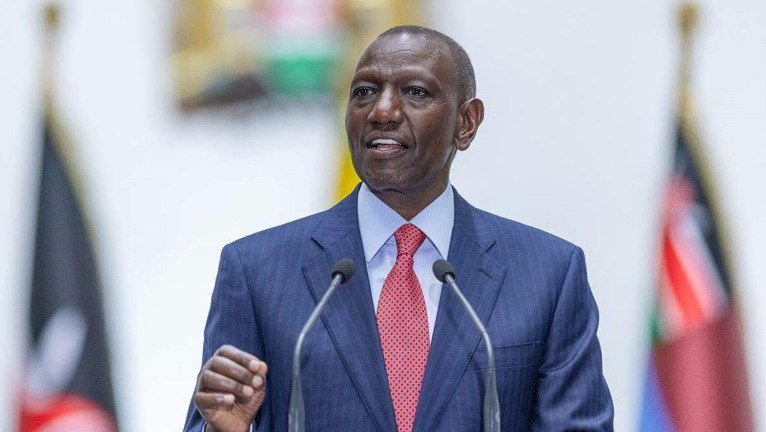
Four years into President William Ruto’s administration, Kenya’s employment numbers have continued to rise, although most of the jobs created have been concentrated in the informal sector, official statistics show.
Data from the Kenya National Bureau of Statistics (KNBS) indicates that the economy generated about 3.27 million jobs between 2022 and 2025, with approximately 2.84 million of them created outside the formal sector.
This means the informal economy accounted for about 87 per cent of the total jobs added during the period, while roughly 420,400 were modern or formal-sector positions.
The figures provide a mixed picture for an administration that has made job creation a central pillar of its economic agenda, particularly through programmes targeting construction, manufacturing, small businesses and youth employment.
Jobs rise steadily
Kenya recorded 816,600 new jobs in 2022, including 702,900 informal-sector positions and 113,700 jobs in the modern sector.
The 2022 figure largely serves as a baseline for assessing the Ruto administration since he assumed office in September that year.
In 2023, the economy generated 848,200 jobs, the highest annual increase over the four-year period. Informal employment accounted for 720,900 of those jobs, compared with 122,800 in the modern sector.
The economy added another 782,300 jobs in 2024. Of these, 703,700 were informal-sector jobs, representing about 90 per cent of the annual increase, while 78,600 were created in the modern sector.
In 2025, Kenya added 822,100 jobs, according to the KNBS Economic Survey 2026. Informal employment accounted for 716,800, or 87.2 per cent, while approximately 105,300 jobs were created outside the informal sector.
Overall, recorded employment excluding small-scale agriculture increased from 20.8 million in 2024 to 21.6 million in 2025.
The informal sector employed about 18.1 million people during the year, while wage employment rose from approximately 3.21 million in 2024 to 3.32 million in 2025.
Housing programme emerges as major jobs driver
The government has identified the Affordable Housing Programme as one of the major initiatives supporting employment creation, particularly in construction.
In January 2026, President William Ruto said more than 500,000 Kenyans were working under the programme.
“The housing project is about jobs. Today, more than 500,000 Kenyans are working under the housing programme,” he said.
The figure marked a significant increase from the 200,000 direct jobs that Ruto said had been created through the programme by December 2024.
Housing Principal Secretary Charles Hinga subsequently said in February 2026 that government data showed more than 428,000 Kenyans were directly employed full-time at construction sites.
He added that another one million people were engaged in supplying materials and services connected to the housing projects.
By February 2026, data cited by Hinga showed that 262,913 housing units were under development in 111 constituencies across all 47 counties.
The government has set a target of delivering 200,000 affordable homes every year.
In January 2025, Ruto said more than 124,000 housing units were under construction and that the projects had created jobs for more than 250,000 young people.
The different figures on employment under the housing programme reflect varying definitions. Ruto’s December 2024 figure referred specifically to direct jobs, while the later figures included workers at construction sites and, separately, people involved in supplying materials and services.
Govt cites more than 6.2 million opportunities
The government’s assessment of its job creation record is considerably higher than the employment growth recorded by KNBS.
In May 2026, Labour Cabinet Secretary Alfred Mutua said more than 6.2 million jobs and employment opportunities had been created during Ruto’s tenure.
Speaking during Labour Day celebrations, Mutua attributed the figure to government reforms and programmes implemented across different sectors.
He said the public service employed about 1.895 million people, while more than 128,000 teachers had been recruited and county governments had employed nearly 60,000 workers.
Mutua also cited government programmes, including the Affordable Housing Programme, which he said had created 640,442 jobs, and Kazi Mtaani, which generated 583,868 employment opportunities.
The government’s figure is higher than the 3.27 million employment increase recorded by KNBS between 2022 and 2025.
The difference stems partly from how the figures are calculated. KNBS measures changes in employment across the economy, while Mutua’s figure brings together employment and employment opportunities associated with government programmes, the public service and other interventions.
Ruto acknowledges unemployment challenge
Despite the government’s claims on employment creation, Ruto has acknowledged that unemployment and inadequate incomes remain significant challenges for millions of Kenyans.
Speaking during the Beyond Vision 2030 national conversation on August 12, the President said the country still had too many people without jobs and others without reliable incomes.
He said tackling unemployment should form part of a broader effort to reduce inequality and improve living standards, particularly for people at the lower end of the income scale.
“How they access employment opportunities. And how we create equality,” Ruto said.
The President identified micro, small and medium enterprises (MSMEs) as a key avenue for expanding employment and household incomes.
He said the government needed to create an environment where small businesses could grow by improving access to credit, markets and business opportunities.
The comments come as the administration faces continued scrutiny over the quality and sustainability of jobs being created.
While informal employment provides livelihoods for millions of Kenyans, it is often associated with less predictable incomes and limited access to employment benefits and social protection compared with formal wage employment.
Focus shifts to next development vision
Ruto said the challenge of unemployment would need to be addressed as Kenya develops a new long-term development framework beyond Vision 2030.
He argued that the next plan must reflect economic and social changes that have taken place since Vision 2030 was formulated, including technological advances, artificial intelligence and climate change.
The President also highlighted inequality and household financial pressures as issues requiring greater attention.
“We have too many people who still sleep hungry. We have too many people who are jobless. We have too many people who don’t have income,” he said.
He said Kenya’s future development plans must therefore focus on expanding access to employment, education, healthcare and other opportunities for vulnerable households.
The employment data leaves the government with a dual challenge: sustaining the growth in the number of jobs while creating more productive, stable and better-paying opportunities that can translate into higher household incomes.
For the Ruto administration, the record so far points to significant employment growth, but with the informal sector continuing to absorb the overwhelming majority of new workers.
Read: Ruto Formally Onboards 106,000 Village Elders, Announces KSh3,000 Monthly Facilitation
>>> Ruto Sets 10-Year Target to Transform Kenya Into an Upper Middle-Income Economy











Leave a comment