


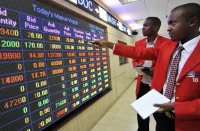
Foreign investors pulled billions out of the Nairobi Securities Exchange (NSE) in the first three months of 2026, signalling growing unease about global risks and their impact on frontier markets like Kenya.
Fresh data from the Capital Markets Authority (CMA) shows that the market recorded net foreign outflows of Ksh 8.8 billion between January and March. This was a sharp 90 per cent jump from the previous quarter, underlining how quickly sentiment shifted at the start of the year.
The CMA links this trend directly to geopolitical tensions in the Middle East, which have rattled global markets and pushed investors to move their money into safer assets.
“The significant outflows observed during the quarter can largely be attributed to prevailing geopolitical tensions in the Middle East region, which prompted global investors to rebalance their portfolios in favour of safer investment destinations and lower-risk assets,” the regulator said in its latest soundness report.
That shift was also reflected in reduced foreign activity at the bourse. Foreign participation in equity trading dropped by 10 per cent during the quarter, a sign that international investors were scaling back their exposure to Kenyan stocks.
Kenya’s position as a frontier market makes it particularly vulnerable when global uncertainty rises. When risk appetite tightens, funds often flow out of smaller markets first, heading instead to developed economies or traditionally safer investments such as US Treasury bonds, gold, and stable currencies.
Even so, the NSE showed surprising resilience.
While foreign investors were exiting, local investors stepped in more aggressively, helping to stabilise the market. Their growing presence supported trading activity and cushioned the bourse from what could have been a sharper downturn.
This shift toward domestic participation is becoming more important. It reduces reliance on volatile foreign flows and gives the market a more stable base, especially during periods of global stress.
Strong key market indicators
All four major indices posted gains during the quarter. The NSE 20 Share Index rose to 3,431.56 points, while the NSE 25 Index climbed to 5,416.72. The broader NASI closed at 194.82, and the NSE 10 Index reached 2,030.35. These increases ranged between 3.32 per cent and 9.31 per cent, reflecting steady investor confidence locally.
Trading activity also picked up. The number of shares traded rose from 1.49 billion to 1.86 billion, pointing to improved liquidity and renewed interest among investors within the country.
Market capitalisation crossed a major milestone as well.
“Equity market capitalisation as at March 31, 2026, stood at Ksh 3.23 trillion, surpassing the three-trillion mark and reflecting growth from Sh2.94 trillion recorded in the previous quarter,” said CMA acting director for Research, Policy and Market Development, Samuel Kamunyu Njoroge.
Even with this growth, the structure of the market remains uneven. About 82.9 per cent of total market capitalisation is concentrated in just 10 companies. This level of concentration means the overall market is still heavily influenced by a small group of large firms, creating some risk if those stocks underperform.
In the fixed income segment, government securities continued to dominate.
Treasury bonds accounted for virtually all turnover, 99.99 per cent—highlighting investor preference for stable and predictable returns. During the quarter, the government reopened and switched bonds with maturities of 15 and 20 years, targeting Sh205 billion.
Demand far exceeded expectations.
Total bids reached Sh451.41 billion, more than double the amount on offer. The government eventually accepted Sh265.68 billion, showing a strong appetite for long-term government debt, especially in uncertain times.
Corporate bonds, however, struggled.
Turnover in this segment dropped sharply to Sh73.6 million, a 63.9 per cent decline from Sh203.5 million in the previous quarter. Investors appear to be avoiding corporate debt in favour of government instruments, which currently offer better returns and higher liquidity.
This pattern reflects a cautious market environment. Even with relative macroeconomic stability at home, investors are choosing safety over risk.
Collective Investment Schemes continued to attract attention, particularly Money Market Funds. These funds remain the preferred option for many investors due to their liquidity, lower risk, and consistent returns. Fixed income funds, equity funds, balanced funds, and special funds also maintained a steady following, though at lower levels.
Overall, the first quarter of 2026 paints a mixed picture.
On one hand, foreign investors are pulling back, driven by global uncertainty and risk aversion. On the other hand, the local market is holding firm, supported by domestic investors and strong demand for government securities.
The coming months will likely depend on how global tensions evolve. If uncertainty persists, foreign outflows could continue. But if stability returns, Kenya could once again attract international capital, especially given the resilience its market has shown so far.











Leave a comment