

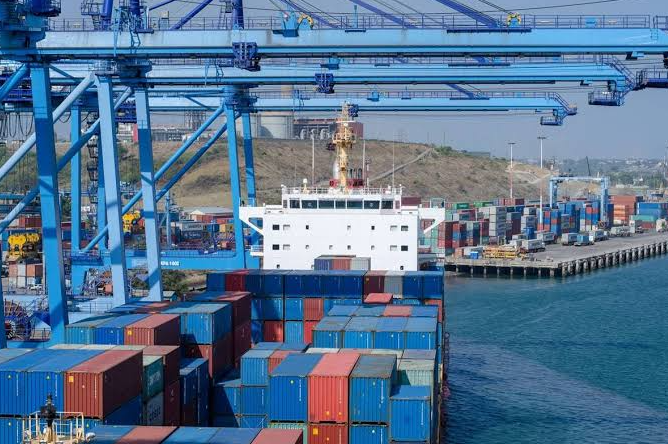
The Kenya Ports Authority (KPA) has defended the Ksh 8.3 billion infrastructure project at the Port of Mombasa following criticism that the amount being spent is too high for what has been described as a road construction project.
KPA says the development has been misunderstood because it has largely been referred to as a road, yet it is a complex engineering project involving an elevated viaduct, extensive excavation works, retaining structures, utility relocation and new traffic management systems designed to improve cargo movement at East Africa’s busiest port.
KPA Managing Director Captain William Ruto said the project was approved after years of studies showed that congestion at the back of the port had become one of the biggest obstacles to efficient cargo movement.
According to KPA, a 2018 traffic management study conducted by TradeMark Africa identified the Back of Port Road as a major bottleneck and recommended a grade-separated transport corridor to ease traffic and improve access between different sections of the port.
Captain Ruto dismissed claims that the authority had overpriced the project, saying the contract went through an international competitive tender before being awarded.
“The project is not just a road. It is an infrastructure project which involved levelling the hill slope and the construction of a retention wall to prevent erosion. We floated an international tender where some bidders wanted to do the project for Sh10 billion. We awarded it to the lowest bidder,” he said.
He explained that bids submitted by international contractors ranged between Ksh 8.3 billion and Ksh 9.6 billion, with the joint venture of Stecol Corporation and Miliki Development Company emerging as the lowest evaluated responsive bidder at Ksh 8.3 billion.
Captain Ruto added that the authority’s consultants had estimated a higher cost, meaning the winning bid represented value for money.
“It is within the market price, and I can even say it is cheaper. We are getting value for money as KPA. The problem is only that we called it a road instead of calling it a major infrastructure project that we are building in the port,” he said.
Construction is already about 50 per cent complete, with completion expected in March next year.
Once finished, the new transport corridor is expected to improve connectivity between Gates 18 and 20, Kipevu Road and the Northern Corridor transport network. It is also intended to speed up cargo evacuation as container volumes at the Port of Mombasa continue to grow each year.
The Port of Mombasa remains Kenya’s main maritime gateway and serves several landlocked countries, including Uganda, Rwanda, South Sudan, Burundi and parts of the Democratic Republic of Congo. Improving cargo flow at the port is considered critical for regional trade, especially as cargo throughput has continued to increase over the past few years.
KPA on project
Unlike a conventional road project, the development includes a 1.8-kilometre dual carriageway featuring a 704-metre elevated viaduct supported by bored pile foundations and reinforced concrete box girders. The viaduct will stand approximately 15 metres above ground, allowing heavy trucks to move continuously without interfering with existing port operations below.
Project consultant engineer Stephen Wasike explained that the elevated structure became necessary because several critical installations could not be relocated.
He said live petroleum pipelines operated by the Kenya Pipeline Company, together with the One Stop Centre and other strategic facilities, made a ground-level road impossible. Instead, engineers designed a viaduct that would safely pass above the existing infrastructure while allowing normal port activities to continue during construction.
Beyond the elevated roadway, the project includes two large roundabouts, entry and exit ramps, slip roads and modern traffic management systems aimed at reducing congestion around the port.
Engineers have also carried out one of the largest earth-moving exercises within the port, excavating about 450,000 cubic metres of rock from Kipevu Hill and placing roughly 150,000 cubic metres of engineered fill to create a stable transport corridor.
A 265-metre Geosynthetic Mechanically Stabilised Earth retaining wall is also being built to stabilise the excavated hillside and protect nearby Kenya Pipeline Company fuel storage facilities from erosion and ground movement.
The project further involves relocating high-voltage electricity lines, water pipelines, fibre-optic communication cables, security systems and other underground utilities. Contractors are also constructing a major underground stormwater drainage tunnel to channel rainwater away from the new infrastructure and protect surrounding port facilities from flooding.
KPA says these additional engineering works explain why the project cost is significantly higher than that of a standard road, insisting the investment is intended to support the long-term expansion and efficiency of the Port of Mombasa as regional trade volumes continue to rise.











Leave a comment