FEATURED STORYHEALTHNEWS

Kenya Among Top Global Performers as African Youth Lead Mind Health Rankings

Sapien Labs survey of 84 countries finds 41% of young adults in “mind health crisis,” with U.S., U.K. near bottom while sub-Saharan Africa dominates top five

Share
job queue Nairobi
Youths queue for job interviews in Nairobi. (Photo: File)
Share

Young adults in sub-Saharan Africa are outperforming their peers in wealthier nations on measures of mental well-being, even as a broader global decline deepens among younger generations, according to a new report from Sapien Labs.

The Global Mind Health Report 2025, based on online survey data from nearly 1 million people in 84 countries, found that 41% of internet-enabled adults aged 18 to 34 fall into what researchers describe as a “mind health crisis,” marked by declines in cognitive, emotional, social and physical functioning.

Yet the regional breakdown shows a stark divergence. Ghana ranked first worldwide for youth mind health, followed by Nigeria, Kenya, Zimbabwe and Tanzania — making the top five entirely African. By contrast, high-income countries including the United Kingdom, the United States and Finland ranked near the bottom.

Sapien Labs’ Mind Health Quotient (MHQ) shows a sharp generational reversal. In the early 2000s, young adults reported the strongest well-being of any age group. Today, they are four times more likely than those over 55 to experience clinically significant mental health challenges. The gap widened during the Covid-19 pandemic and has persisted over the past five years.

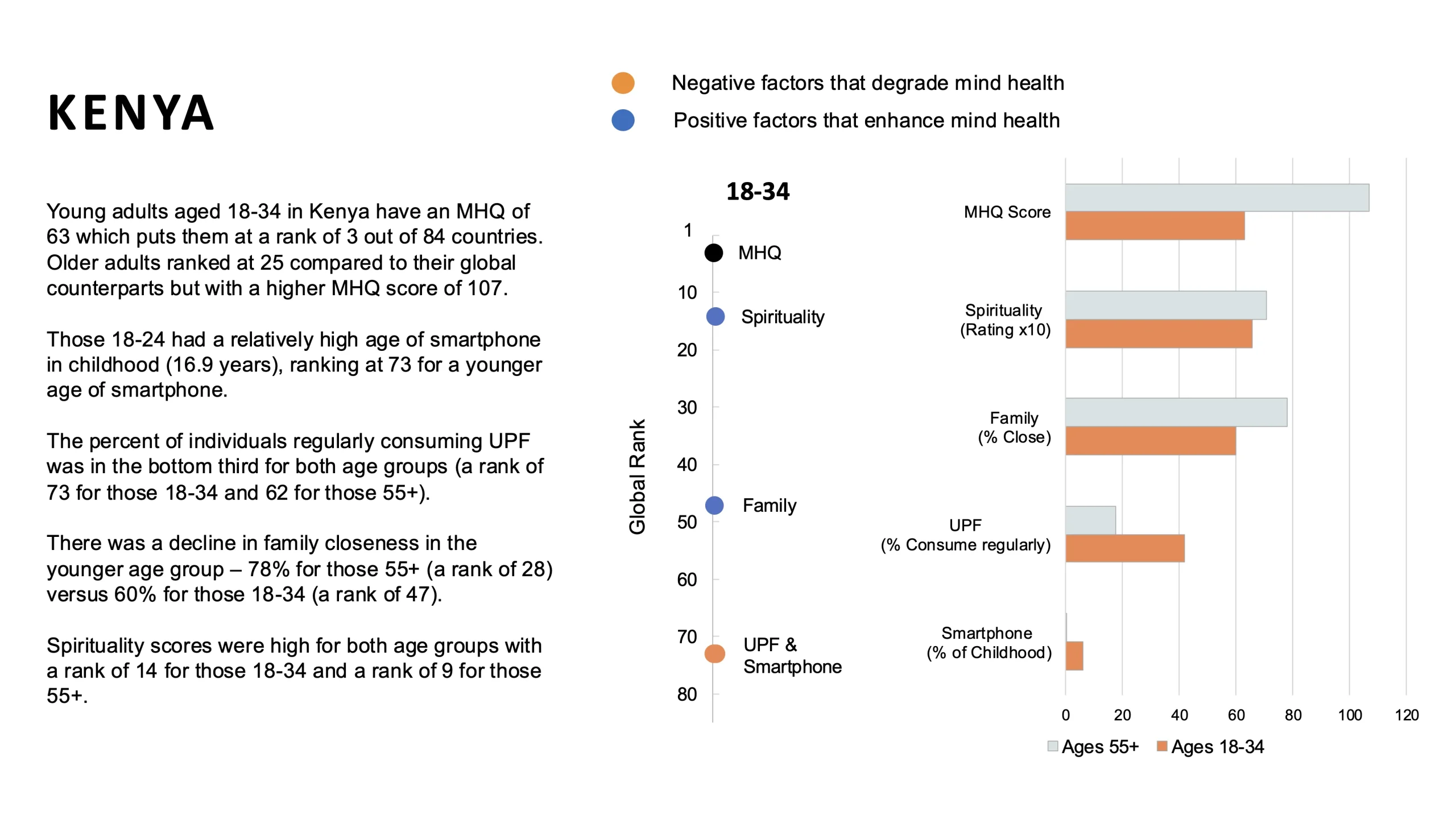
Kenya snapshot

The report attributes much of the decline to early smartphone adoption, rising consumption of ultra-processed foods, weakening family ties and lower levels of spirituality. Countries in sub-Saharan Africa scored higher on measures such as later childhood smartphone access and stronger spiritual and family connections. Tanzania, for example, ranked highest globally for spirituality and had one of the oldest average ages of first smartphone use.

In the US and other Western economies, spending on mental health care has surged, but outcomes have not improved materially, the authors said. They called for policy interventions including school-hour smartphone bans, minimum age rules for social media and tighter scrutiny of food additives.

The findings point to a potential inverse relationship between national wealth and youth mind health, raising concerns about long-term workforce productivity as more young adults enter employment struggling with cognitive and emotional capacity, the report said.

Written by
OORO GEORGE -

Ooro George is a correspondent at Business Today, where he covers business, media, arts & culture, entertainment, and Africa’s evolving creative economy.

Leave a comment

Leave a Reply

Your email address will not be published. Required fields are marked *

PAST ARTICLES AND INSIGHTS

Related Articles
President William Ruto with President Macron
NEWS

Kenya, France Sign 11 Deals as Ruto Hosts Macron for Africa Forward Summit

Kenya and France have signed 11 agreements covering transport, energy, trade, ports...

Amsons Group managing director Edha Nahdi
BUSINESS

Amsons Bets Bigger on Kenya as Infrastructure Demand Grows

Amsons Group is betting big on Kenya’s future, with the Tanzanian conglomerate...

libya prison
NEWS

8 Kenyan Workers Detained in Libya Amid Unpaid Wages

A Kenyan woman living in Libya has issued a desperate plea to...

The Technical University of Mombasa’s
FEATURED STORYNEWS

UON, JKUAT, Egerton Among Hardest Hit as Govt Slashes University Funding by Ksh13 Billion

Public universities in the country have faced steep reductions in direct government...