

Madaraka Day, Swahili for “Self-Rule” or “Authority or Power”, is Kenya’s annual national holiday celebrated on June 1. It marks the day in 1963 when Kenya gained internal self-rule (Madaraka) from British colonial administration.
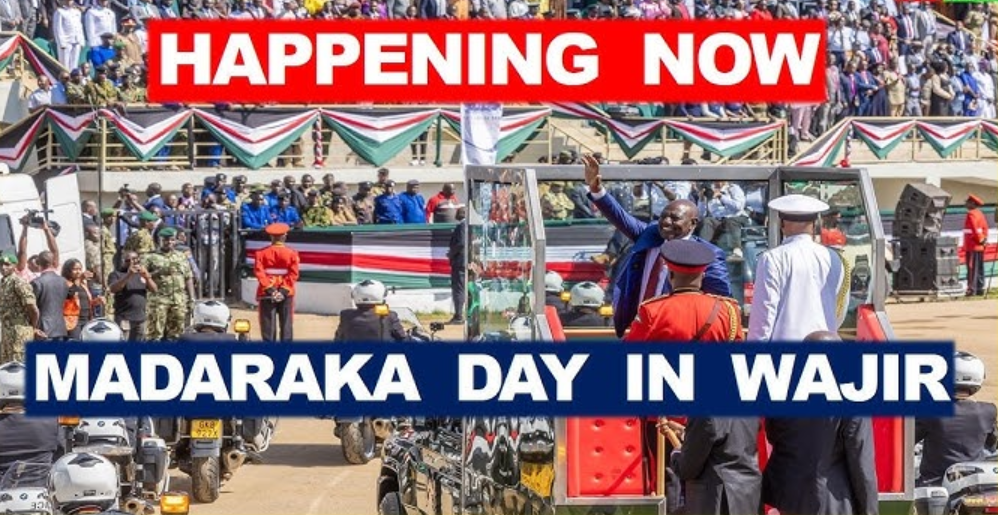
Kenya observed its 63rd Madaraka Day on June 1 in Wajir County, marking the first time the North Eastern region hosted the national holiday since independence in 1963.
Short History and Founding Date
Kenya was a British colony initially as the East Africa Protectorate, then the Kenya Colony, from around 1920.
After years of struggle involving political negotiations, constitutional talks, and the independence movement led by Mau Mau, Jomo Kenyatta and others, Kenya achieved internal self-government on June 1, 1963. Jomo Kenyatta became the first Prime Minister.
This was a key stepping stone but not full independence: Kenya became fully independent on December 12, 1963, now celebrated as Jamhuri Day every year on Dec. 12. Madaraka Day specifically honours that first major transfer of governing authority to Kenyans, what we call the internal self-rule.
Achievements and Significance
- Symbol of self-determination: It represents Kenyans taking control of their political affairs after decades of colonial rule.
- Foundation for nation-building: It paved the way for full sovereignty, constitutional development, economic growth, and social progress.
- Post-Madaraka achievements: Often highlighted include expanded education, healthcare improvements, infrastructure growth, economic diversification in agriculture, tourism, tech and more, and democratic advancements e.g., the 2010 Constitution. Kenya has grown into an East African economic hub.
Where Celebrations Are Held
National Madaraka Day events are typically large public gatherings with parades, military displays, cultural performances, speeches by the President, and addresses on national themes.
They are usually hosted in different counties, decentralized from Nairobi, to promote national unity and development across regions.
The President presides, often with the Deputy President, Cabinet members, opposition leaders, governors, and foreign dignitaries. Thousands of citizens attend, along with performances and exhibitions.
Recent locations
* 2024 (61st): Masinde Muliro Stadium, Bungoma County.
* 2025 (62nd): Raila Odinga Stadium, Homa Bay County. Attendees included President William Ruto, Deputy President Kithure Kindiki, former PM Raila Odinga, and international guests like the President of Slovenia. The theme focused on the blue economy.
Madaraka Day 2026
The current 63rd Madaraka Day 2026 celebrations is being held in Wajir County at Wajir Stadium — the first time in the region since 1963. This symbolized efforts toward equitable development and inclusion of marginalized areas.
Theme: “Education, Skills and the Future.” President Ruto presided, with focus on infrastructure projects at the Ksh900 million stadium. Ruto toured projects like a Ksh639 million solar plant serving 8,500 households, and announced hiring 100 teachers per constituency, plus ending extra ID vetting for locals.
Impact on Kenya and Citizens
- National Pride & Unity — Reinforces shared identity and the value of independence.
- Political & Developmental Focus — Presidents use the platform to outline achievements, policy priorities in the economy, infrastructure, and equity, and call for national unity.
- Economic & Social Boost — Hosting counties see infrastructure upgrades, tourism boost, and local pride. It promotes devolution by bringing national attention to different regions.
- For Citizens — A day off for reflection, family, and community events. It inspires younger generations about self-determination and civic responsibility.
Madaraka Day remains a powerful symbol of Kenya’s resilience and ongoing quest for prosperity. Happy Madaraka Day!
Follow Business Today Whatsapp channel for more news.












Leave a comment