


For many young Kenyans, the idea of studying overseas is not just about changing environments, mere experiences or chasing fun and games. It is often a practical, calculated economic decision, driven by an ambition of a brighter, safer future.
Australia has become a particularly compelling destination for such of these dreamers, thanks to its strong job market, relatively flexible student work rights and high-quality education.
Education consultants and students familiar with the process say Australia continues to draw strong interest not only because of the quality of its universities, but also because of the country’s comparatively favourable student work policies and long-term career prospects.
They note that while the initial investment is substantial, the potential to earn while studying – and recoup some costs – draws many applicants. Australia’s student visa, Subclass 500, currently allows international students to work up to 48 hours per fortnight (roughly 24 hours per week on average) during term time, with unlimited hours during scheduled semester breaks.
This compares favourably to stricter limits elsewhere. In the UK, most degree-level students on a Student visa are capped at 20 hours per week during term time.
In the United States, F-1 visa holders are generally limited to 20 hours per week on campus during academic terms. Australia’s structure, combined with a robust minimum wage, currently around AUD $24.95 or Ksh2,200 per hour plus loadings, offers a practical advantage for those balancing studies with part-time work in sectors such as hospitality, retail, aged care and warehousing.
Is it a Cheaper Option?
Studying in Australia is not necessarily a low-cost option. Education advisers and insiders estimate the initial outlay for Kenyan students, including tuition deposits, visa fees, travel, Overseas Student Health Cover (OSHC), and initial living setup, typically range from Ksh1.8 million to Ksh3.5 million, depending on exchange rates and program. Costs vary significantly by level of study, city, and institution—regional campuses or vocational colleges can be more affordable.
Many students and families view the expense as an investment. Strong academic performance and part-time work can help manage ongoing costs, while post-study work visas offer pathways to longer-term earnings. IELTS preparation and visa-related fees are often bundled into service packages by consultancies guiding Kenyan applicants.
A reliable partner: Bng’eny Consultancy – Study Abroad Excellence
For many would-be applicants, navigating the process can be overwhelming, from choosing institutions and securing offers to preparing documentation and lodging a strong visa application.
But no worries, this is why Kenyan students increasingly turn to specialist agencies for support. One such agency, an established player, is Bng’eny Consultancy – Study Abroad Excellence, based in Eldoret.
Bng’eny Consultancy
Bng’eny Consultancy provides services covering IELTS training, application support, and visa guidance.
The firm says one of its strengths lies in simplifying a process that many applicants initially find complex. Students receive guidance on course selection, budgeting, English-language requirements and visa compliance, helping them make informed decisions before committing significant financial resources.
Bng’eny Consultancy says its student visa approval rate is close to 100 per cent, reflecting years of experience helping students secure placements and complete Australia’s education and visa requirements successfully. While visa decisions ultimately remain the responsibility of Australian immigration authorities, the consultancy’s strong track record has earned it the trust of students and parents across Kenya.
One of the consultancy’s distinguishing features is its commitment to remaining accessible throughout the entire process. Students are encouraged to ask questions, seek clarification and receive continuous support from application to departure, ensuring they make informed decisions at every stage of their study-abroad journey.
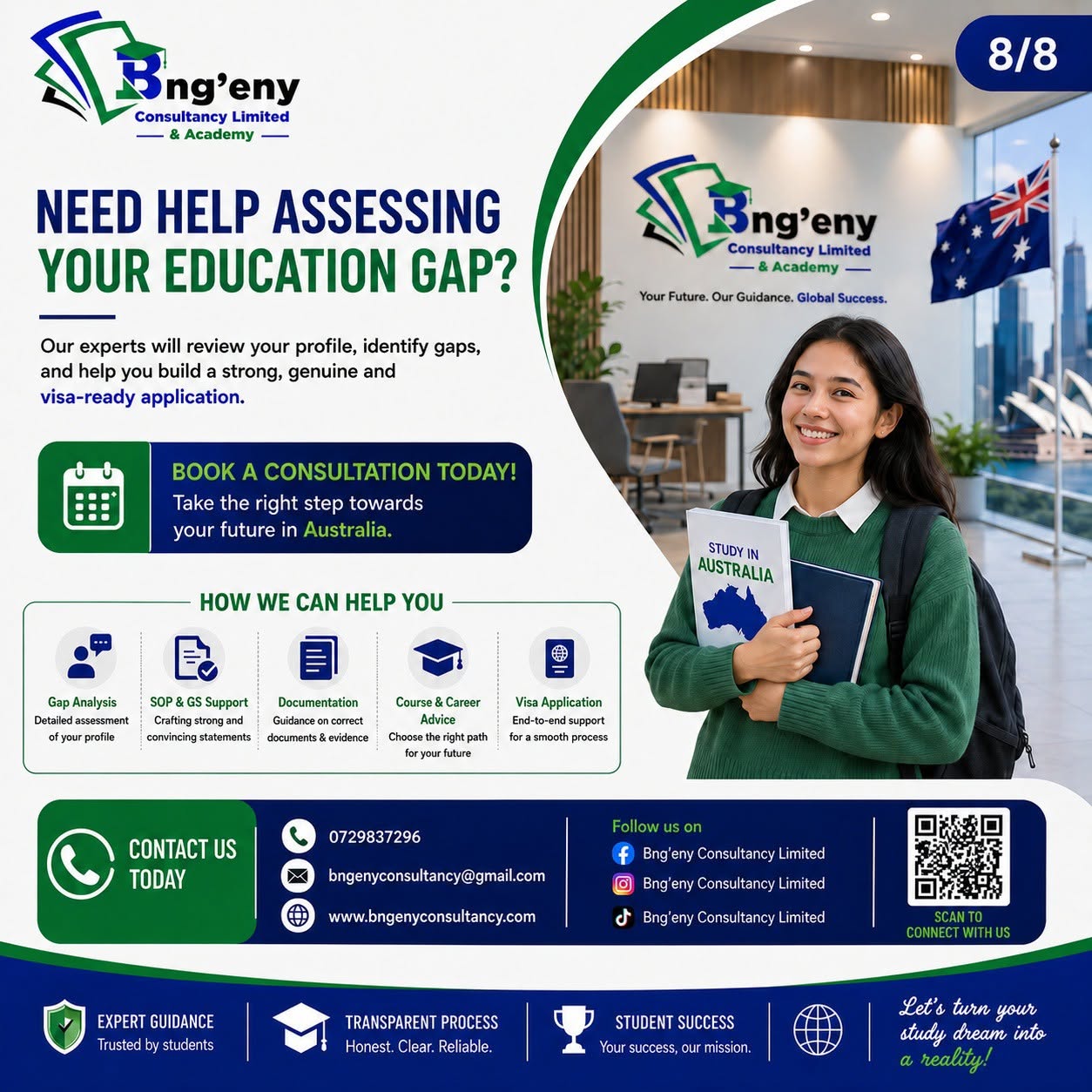
They can be reached by phone on 0729 837296, via WhatsApp, text or email at [email protected], or in person at The Anchor Building, 6th Floor, Room 604B, along Kenyatta Street (City Clock), Eldoret 30100.
Bng’eny Consultancy describes Australia as a market rich with opportunity for students willing to work hard, remain focused and take advantage of the resources available to them.
Practical steps to get started
1. Research and choose a course: Align your goals with Australia’s strengths – from business and health to engineering, IT and vocational trades.
2. Meet academic and English requirements: Prepare for IELTS or equivalent early.
3. Secure a Confirmation of Enrolment (CoE) from a registered provider.
4. Prepare finances and documentation: Demonstrate genuine intent and sufficient funds as required by the Department of Home Affairs.
5. Lodge a student visa application: This is where experienced guidance from expert minds and companies like Bng’eny can make a difference in presenting a complete, compelling case.
5. Plan for arrival: Budget for health cover (OSHC), accommodation and initial expenses.
The Form 4 Question: Is KCSE accepted in Australia?
Putting the pen to rest, one of the questions frequently asked by prospective students is whether a Kenyan KCSE certificate is accepted in Australia. Education advisers say the answer is generally yes. Australian universities, colleges and vocational institutions recognise Kenya’s KCSE qualification, although specific entry requirements vary depending on the institution and programme.
For many undergraduate programmes, students with a KCSE mean grade of C+ and above may qualify for direct entry into selected Australian universities, particularly where their subject grades meet programme requirements.
Unlike many agencies that focus solely on university applicants, Bng’eny Consultancy in an interview said they work with a broad range of students. Form Four leavers can access pathway programmes that may lead to some of Australia’s leading universities, while diploma holders, degree graduates and working professionals can explore direct-entry opportunities tailored to their academic backgrounds.
“Students who do not qualify for direct admission may still access foundation, diploma or pathway programmes that can lead to degree studies,” a consultant confirmed on phone.

Navigating visas
Putting my pen to rest, one of the most critical and uncertain parts of the process is securing the student visa. Reputable consultants openly acknowledge that even the best-prepared applications carry some risk.
From the perspective of experienced consultants like those at Bng’eny, some reasons for the few cases of refusals are usually;
- Genuine Temporary Entrant (GTE) assessment: Officers must be satisfied the applicant intends to study temporarily and return to Kenya. Weak demonstration of ties to home (family, property, future career plans in Kenya) can lead to refusal even with strong academics.
- Financial documentation gaps or inconsistencies that raise doubts about the ability to cover costs without relying solely on work.
- Course relevance and progression: Applications where the chosen programme does not clearly build on previous studies or align with the applicant’s career goals in Kenya sometimes face scrutiny.
- Incomplete or unclear supporting evidence, timing issues, or changes in personal circumstances during processing.
- Broader policy shifts: Australian immigration periodically tightens assessments for certain nationalities or risk profiles, affecting outcomes independently of individual merit.
As I land, remember that success depends on thorough preparation, realistic expectations, and choosing the right support.
Success and bye for now.
















Leave a comment