

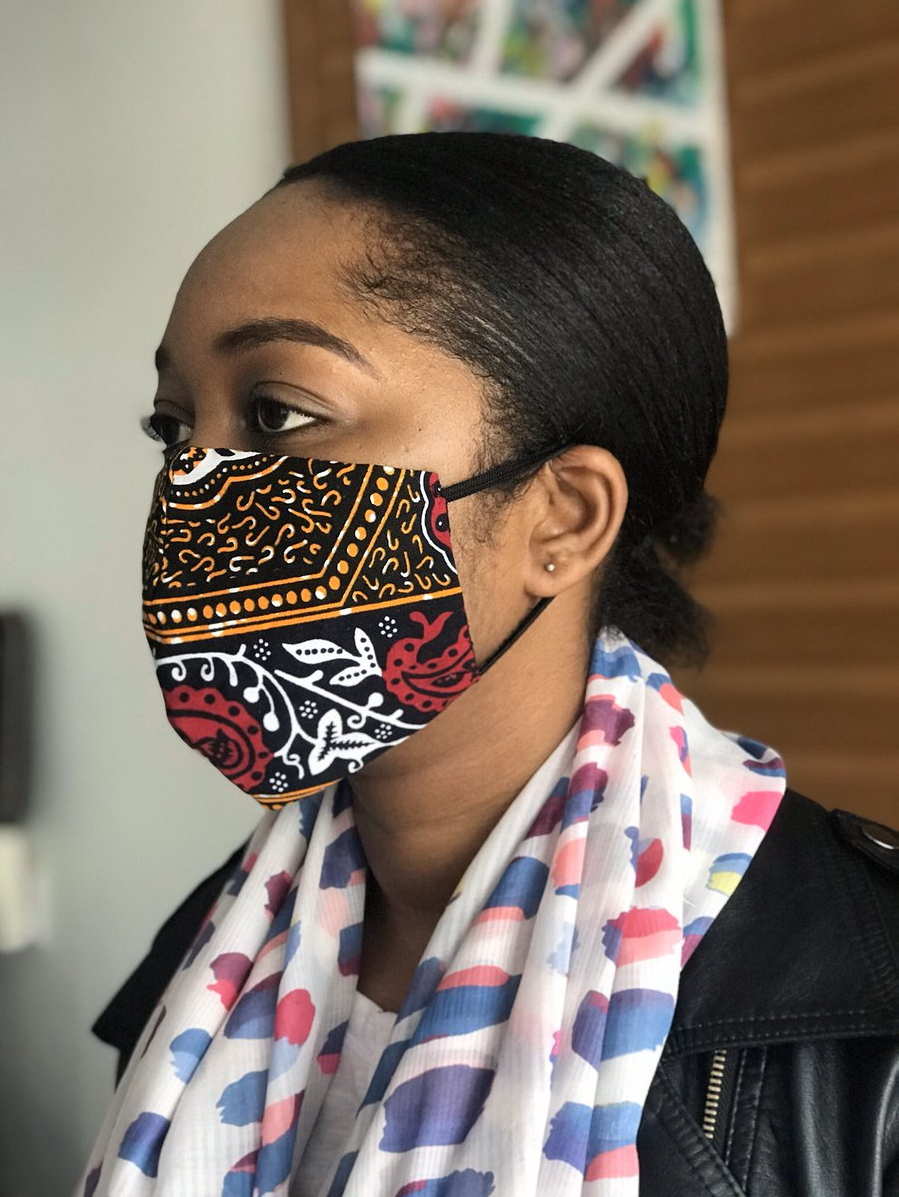
Kenya Bureau of Standards and Ministry of Health have urged Kenyans to comply with the government directive on wearing face mask in public spaces urges as a preventive measure against contracting Covid-19.
On Monday 6th April 2020, the President reiterated that wearing face masks in public settings and washing hands will save lives while urging Kenyan to avoid places where people could be less than 1.5 metres apart. He also encouraged businesses in the textile industry to produce more masks.
Blocking virus droplets
Last week, the Ministry of Health issued a mandatory regulation requiring people to wear masks in public settings such as pharmacies, grocery stores, markets and supermarkets and other public places with high populations where other social distancing measures are difficult to maintain.
This follows confirmation by the World Health Organisation (WHO) that the Coronavirus can remain suspended in the air for hours. Medical face masks are designed to cover the mouth, nose and chin to provide a barrier to minimize the direct transmission of infectious agents.
“Wearing of masks will help in blocking virus-laden droplets projected during sneezing, coughing and talking that could be both from external environment and by the wearer of the mask thus preventing transmission of the Coronavirus,” says Lt. Col. (Rtd) Bernard Njiraini, the Managing Director, Kenya Bureau of Standards (KEBS).
However, the public should be careful when purchasing these masks to ensure that they are of good quality for maximum protection. The use of substandard medical face masks, or even misuse of the masks, is highly risky, because it gives a false sense of protection while increasing the risk of exposure.
Manufacturers are encouraged to submit their personal protective equipment’s for testing to confirm their efficacy.
Currently, there are two types of masks covered under Kenya Standards that are being used locally namely surgical masks including N95 and particle masks that protect against dust.
The government notes that there is a limited supply of personal protective equipment (PPEs) for health workers and encouraged the general public to leave the N95 masks to the healthcare workers and patients.
Reusable cloth coverings made of woven fabrics – which many Kenyans are now using made by local tailors – may offer limited protection against the Coronavirus as there is no data to indicate their effectiveness in filtering bacteria and virus projected forcefully during sneezing or coughing.
The public should therefore take additional measures such as social distancing and hand washing with soap for at least twenty seconds several times a day.
At the moment there is no Kenya Standard for these types of covering, as certification for re-usable cloth coverings is currently not a mandatory requirement prior to sale.
READ: TV Queen Betty Kyalo Behaving Badly in the Bar
Clothe material masks should be made of double layer of fabric with a filter layer in the middle for greater protection. However, the general public must take heed that such cloth coverings do not guarantee protection against coronavirus.
Members of the public are also advised to wash the re-usable face masks with soap and water before use.
Quality Face Masks
So far, KEBS is already assisting all tailors to attain the required standards to be able to produce and supply masks to all Kenyans and has made available FREE of charge standards for PPEs on its website. KEBS also conducts FREE testing of the masks to ensure they are of good quality and safe for use.
Additionally, the President directed the Ministry of Health and Ministry of Industrialization, Trade and Enterprise Development to ensure that these tailors are provided the right information through the National Government Administrative Officers on the materials required and the proper method of piecing the fabrics together to make the face masks.












Leave a comment