

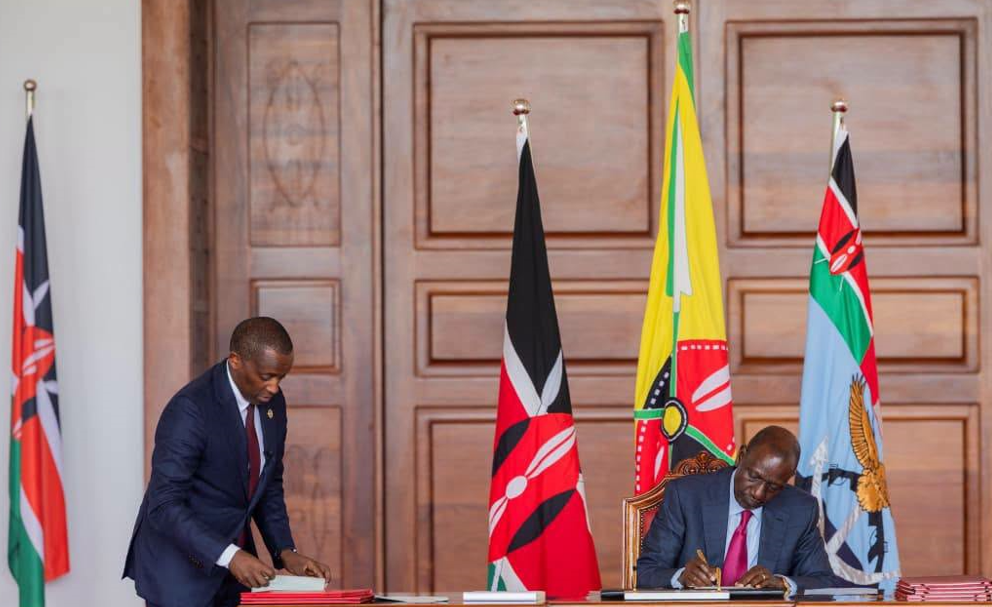
President William Ruto has signed the Finance Bill 2026 and the Appropriation Bill 2026 into law, using the occasion to directly confront what he described as widespread misinformation surrounding the latest budget measures.
In a strongly worded address at State House, Nairobi, Ruto insisted that the Finance Act does not introduce new taxes on ordinary Kenyans, dismissing claims that had circulated for months regarding taxes on land ownership, M-Pesa transactions, bottled water, mobile phones, airtime, data bundles and second-hand clothing.
“Let me state clearly: this law does not raise taxes on ordinary Kenyans,” the President said during the assent ceremony.
The remarks mark the government’s most direct response yet to public concerns over taxation, which have dominated national debate in recent years and fueled widespread criticism of previous Finance Bills.
Ruto accused critics of spreading “propaganda, misinformation, disinformation and fake news” about the contents of the legislation.
Among the claims he specifically rejected were allegations that the government had proposed taxes on freehold land, mitumba imports, bottled water, rental income, mobile money transfers, mobile phones, airtime and internet data.
“There is no new tax on M-PESA or mobile money. The money you send to your family, your business, or your friends will move tomorrow just as it always has,” the President said.
The Head of State argued that the Finance Act instead focuses on strengthening tax compliance, closing loopholes and ensuring businesses and individuals pay taxes already required under existing law.
“We are pursuing tax avoidance, not taxpayers; offshore schemes, not ordinary wages; and leakages, not livelihoods,” he said.
The President said Parliament received submissions from more than 170 organisations and over 100,000 citizens during public participation before passing the legislation.
Beyond defending the Finance Act, Ruto outlined several measures contained in the new law, including a six-month tax amnesty on penalties and interest for outstanding tax obligations, increased duty-free allowances for returning travellers from KSh39,000 to KSh260,000, and incentives targeting electric mobility, solar energy technologies and locally assembled mobile phones.
The government also raised import duty on sugar from KSh7.50 to KSh40 per kilogramme in a move aimed at protecting local sugar producers and the millions of Kenyans dependent on the sector.
The President framed the legislation as part of the broader Bottom-Up Economic Transformation Agenda, arguing that it seeks to create jobs, support livelihoods and finance development without imposing additional tax burdens on ordinary households.
His remarks come amid heightened public scrutiny of government taxation policies and growing demands for greater transparency in fiscal planning.
With the Finance Act now signed into law, attention is expected to shift from debate over proposed taxes to implementation of the government’s KSh4.29 trillion 2026/27 budget and whether the promised benefits translate into tangible relief for Kenyan households and businesses.
“The ultimate measure of this Budget will be the opportunities it creates and the lives it transforms,” Ruto said.
Read: Finance Bill 2026: Why Kenya’s PAYE Debate Matters More Than Ever for the Ordinary Worker
>>> 5 Issues Dominating Finance Bill 2026 Conversations








Leave a comment