

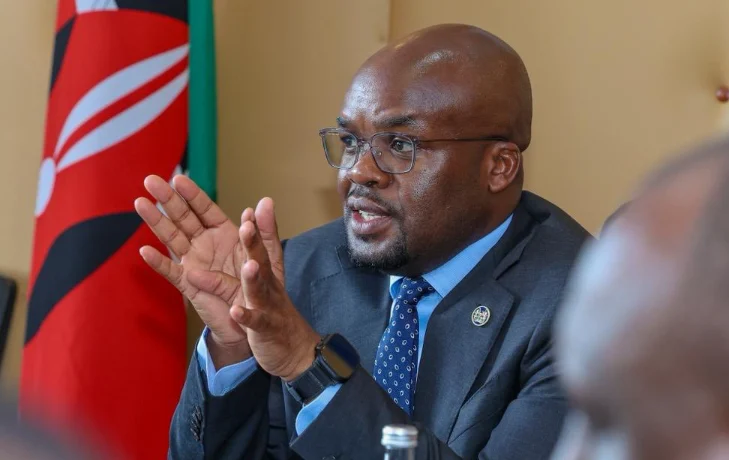
Senior officials from government and industry have held high-level talks to tackle the rising threat of illicit and counterfeit tobacco products undermining public health and government revenue.
Principal Secretary for Health Raymond Omollo said on Thursday that following a meeting with President William Samoei Ruto on implementing the Presidential Proclamation on Alcohol and Drug Control, he convened discussions with the British American Tobacco Kenya (BAT) Board of Directors to strategise on curbing the growing illegal tobacco trade.
The meeting, Omollo noted, covered both proven past measures and new interventions, immediate and long-term, to address the vice, protect public health and safeguard government finances. Present from BAT Kenya were Chairperson Rita Kavashe, Managing Director Crispin Achola, Phyllis Wakiaga, and other board members.
“Our discussions focused on collaborative action to stem the proliferation of illicit and counterfeit tobacco products that threaten the health of Kenyans and substantially erode government revenue,” Omollo said in a statement.
Recent industry and independent data show the illegal cigarette market in Kenya has surged sharply in recent years, with illicit products now accounting for more than one-third of all cigarettes sold. According to a study by Kantar, illicit cigarettes made up about 37 percent of the market in 2024, up from roughly 27 percent the previous year, signaling an accelerating trend.
This growing black market costs the Kenyan government an estimated Sh9 billion annually in lost tax revenue, as illicit and smuggled cigarettes evade excise duties and levies. Most of these contraband products are smuggled across porous borders from neighbouring countries, highlighting enforcement and customs challenges.
BAT Kenya’s management has repeatedly warned that the illicit trade not only weakens legitimate business but also fuels organised crime and poses a broader national risk.
“Every illicit cigarette sold represents an increase in organised crime and a threat to legitimate local businesses and jobs,” the company has said.
The talks between the health ministry and BAT come amid a broader government push to implement Kenya’s National Policy on the Prevention, Management and Control of Alcohol, Drugs, and Substance Abuse, a comprehensive framework adopted in 2025 to strengthen enforcement, community response, border control and rehabilitation efforts.
President Ruto has repeatedly underscored the urgency of confronting alcohol and drug abuse as a “silent but deadly” national crisis, affecting millions of Kenyans and hampering socioeconomic growth.
Stakeholders from both public and private sectors agreed this week that a multipronged approach—spanning stronger regulation, improved intelligence sharing, tighter border controls and public education—is key to reversing the illicit trade trend and reinforcing health and fiscal stability.
“Success requires coordinated action by government agencies, law enforcement, industry partners and civil society,” Omollo emphasized, calling for sustained collaboration to protect Kenya’s markets and people.
Read: Shocking Details of Drugs Often Abused by High School Students










Leave a comment