

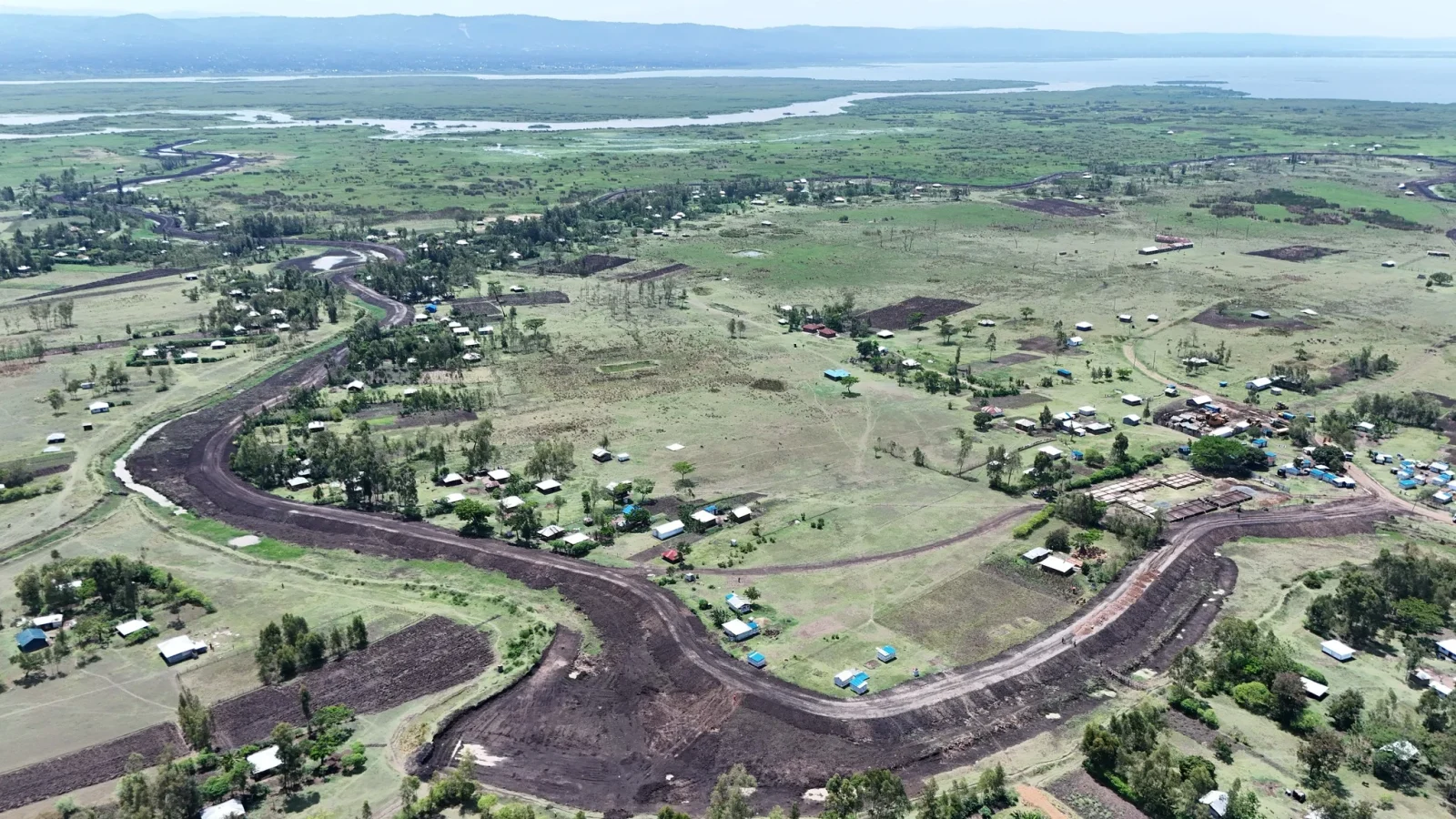
The government has intensified efforts to end the cycle of destruction caused by perennial flooding in West Kano, Kisumu County, with the ongoing construction of the West Kano–Kanyagwal Flood Control Project now nearly halfway complete.
For decades, communities in the low-lying plains of Kadibo Sub-county have suffered some of the worst floods in the Lake Victoria Basin, largely due to the backflow of water from the lake and overflow from River Nyando. The most recent flooding left a trail of devastation, with 684 households affected and 450 homes completely destroyed in Kanyagwal alone.
Principal Secretary for Interior and National Administration Dr Raymond Omollo said the government is determined to deliver a lasting solution after years of displacement, loss of property, and disrupted livelihoods.
“For years, residents of West Kano in Kisumu County have endured perennial flooding that has displaced families, destroyed property and disrupted livelihoods. The most recent floods devastated 684 households, with 450 houses completely destroyed in Kanyagwal,” Dr Omollo noted.
To end the recurring crisis, the National Water Harvesting & Storage Authority (NWHSA) is implementing the West Kano–Kanyagwal Flood Control Project in Ogenya Sub-location, one of the most flood-prone zones in the region due to its position along the River Nyando delta.
The project is 48% complete and is designed to reclaim approximately 7,000 hectares of land, transforming the flood-scarred plains into usable and productive land for farming and settlement.
Key components include construction of a 1.5-metre-high, 3.5-kilometre-long dyke, a footbridge to improve mobility for residents, grassing and tree planting to stabilize reclaimed land.
Key components include construction of a 1.5-metre-high, 3.5-kilometre-long dyke, a footbridge to improve mobility for residents, grassing and tree planting to stabilize reclaimed land and additional climate resilience measures to prevent soil erosion.
Dr Omollo emphasized that the multi-pronged project will restore dignity to affected families and safeguard critical public infrastructure.
“The project will protect farmlands and human settlements from frequent floods and facilitate the resettlement of displaced families, safeguarding critical public infrastructure such as schools, health centres, roads, markets and places of worship in severely affected villages including Kanduru, Kanyangi, Kajowi, Wachiegwe, Kanyamuok and Karagwel,” he said.

Long-awaited solution
Flooding along the Nyando Basin has historically been one of Kenya’s most stubborn humanitarian and environmental challenges. According to the Kenya Meteorological Department and the Lake Basin Development Authority (LBDA), the flat terrain and increasing rainfall patterns linked to climate variability have intensified the frequency of floods in the region.
Villages such as Kanyagwal, Kanduru, and Kajowi have repeatedly required emergency support, food supplies, temporary shelters, and health interventions, whenever River Nyando bursts its banks. Schools and dispensaries often shut down during peak flooding periods, affecting education and healthcare access.
Unlocking agricultural potential
Beyond protecting lives and homes, reclaiming 7,000 hectares is expected to significantly boost agricultural production. West Kano is part of Kisumu’s wider irrigable plains, with potential for large-scale rice, maize, and vegetable farming.
Once complete, the dyke will allow farmers to resume year-round cultivation, households to rebuild permanently and investors and cooperatives to venture into agribusiness in the reclaimed land.
National strategy
The flood control project aligns with the government’s broader agenda of climate-resilient infrastructure and disaster preparedness across flood-prone regions such as Budalang’i, Tana River, Baringo, and parts of Migori.
For residents of West Kano, the progress brings renewed hope.
After decades of living at the mercy of floodwaters, the community may finally be on the verge of reclaiming safety, stability, and the economic prosperity long denied by the unpredictable forces of nature.
Read: Raymond Omollo’s Program Changes Life For Widow Living In Shack
>>> Kisumu Port Revenue Soars to Ksh107M as KRA Cracks Down on Smuggling















Leave a comment