

As donor fatigue, geopolitical fragmentation and post-pandemic austerity reshape international development, a coalition of leaders from Africa, Asia and Latin America is pushing for a sweeping overhaul of global health governance — one that shifts power away from donor capitals and toward national governments.
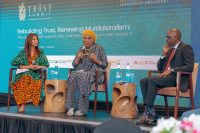
At a high-level gathering on the sidelines of the 79th World Health Assembly in Geneva, presidents, health ministers and executives from some of the world’s largest health financing institutions backed what organizers called a “sovereign, country-led” model for global health delivery. The meeting, branded the “Geneva Clarion Call,” forms part of the broader Accra Reset initiative launched by Ghanaian President John Dramani Mahama during the 2025 United Nations General Assembly.
The initiative has rapidly evolved from a regional African proposal into a wider reform movement attracting support from multilateral lenders, philanthropic foundations and health agencies seeking to recalibrate a system long criticized for fragmentation, dependency and donor-driven priorities.
More than 250 delegates attended the Geneva summit, including ministers from Ghana, Brazil, Indonesia and Kenya, alongside senior officials from the World Health Organization, Gavi, the Vaccine Alliance and The Global Fund to Fight AIDS, Tuberculosis and Malaria.
The central argument emerging from the discussions was that low- and middle-income countries should no longer function primarily as implementation sites for externally designed health programs. Instead, governments should define national priorities, mobilize domestic financing and coordinate international support on their own terms.
“If the Accra Reset can move health commitments into working programmes, it can do so for any sector,” Mahama told delegates in his keynote address. “Health is the vanguard, the proof of concept, and the moral imperative.”
The summit comes at a pivotal moment for global health financing. International aid budgets are tightening across major Western economies, while governments in the Global South face mounting pressure to build resilient health systems without relying indefinitely on foreign assistance. The Covid-19 pandemic exposed deep inequities in vaccine access, manufacturing capacity and emergency preparedness, accelerating calls for structural reform.
Indonesia’s Health Minister Budi Gunadi Sadikin argued that the challenge is not simply the absence of capital, but the inability of health ministries to compete for national investment.
“The money is there,” Sadikin said. “Health ministers must be able to convince finance ministers and major financial institutions that health is an investment, not a cost.”
Brazil’s Health Minister Alexandre Padilha framed the debate in geopolitical terms, saying countries in the Global South should have a greater role in shaping the rules governing international health systems.
“Sovereignty is not merely an aspiration,” Padilha said. “It is an executable agenda grounded in stronger national systems, sustainable financing and regional production capacity.”
Kenya’s Health Minister Aden Duale pointed to domestic reforms underway in Nairobi as evidence that countries can increasingly finance their own healthcare priorities. Kenya, alongside Ghana, has positioned itself as a leading advocate for “health sovereignty,” a term repeatedly invoked throughout the summit.
The Geneva discussions also highlighted growing pressure on multilateral health organizations to simplify overlapping funding structures that many governments say create duplication and administrative inefficiencies. Executives from major financing institutions signaled openness to reform.
Peter Sands said the organization is adapting its partnerships to strengthen local systems and supply chains rather than maintaining narrowly siloed disease programs. Meanwhile, Sania Nishtar said Gavi’s internal reform agenda is intended to accelerate country ownership while reducing operational bottlenecks.
One of the sharper warnings came from Vanessa Kerry, who cited new analysis mapping more than a dozen global health reform initiatives currently underway. While many share similar principles — including country ownership and sustainable financing — Kerry said the growing number of overlapping proposals risks deepening fragmentation unless coordinated through a clear implementation roadmap.
“There is remarkable agreement on what needs to change,” Kerry said. “But there is still insufficient agreement on how reforms will actually be carried out.”
The Accra Reset initiative is attempting to move beyond rhetoric by creating new institutional mechanisms designed to operationalize reform. Mahama announced two new pillars under the initiative’s Sovereign Health Agenda: a Reform Observatory intended to monitor global health reforms, and a financing platform known as HINGE aimed at channeling investment into locally led health projects.
Supporters say the initiative reflects a broader ideological shift underway across development policy, where governments in Africa and other emerging economies are increasingly challenging aid models perceived as paternalistic or externally imposed.
Elhadj As Sy described the movement as a response to growing demands across the Global South for “equity, fairer trade, better health and accountability.”
Critics of the existing system argue that decades of vertical donor programs — often focused on individual diseases such as HIV, tuberculosis and malaria — have weakened broader public health infrastructure by creating parallel delivery systems. Reform advocates are now pushing for integrated financing models tied more closely to national health insurance systems and long-term institutional capacity.
Nigeria’s National Health Insurance Authority has already begun experimenting with integrating donor-backed disease programs into broader insurance structures, according to its Director General Kelechi Ohiri.
The emerging consensus, however, raises difficult questions about implementation. Many low-income countries continue to struggle with debt burdens, fiscal constraints and uneven governance capacity, complicating ambitions for fully sovereign financing models.
Still, the Geneva summit underscored how the language of global health reform is evolving. Where past conversations centered largely on aid expansion, the focus is increasingly shifting toward domestic ownership, institutional resilience and strategic autonomy.
“This moment is not just one of challenge, but of choice,” said Mohamed Yakub Janabi. “We must move from promises to progress.”








Leave a comment