

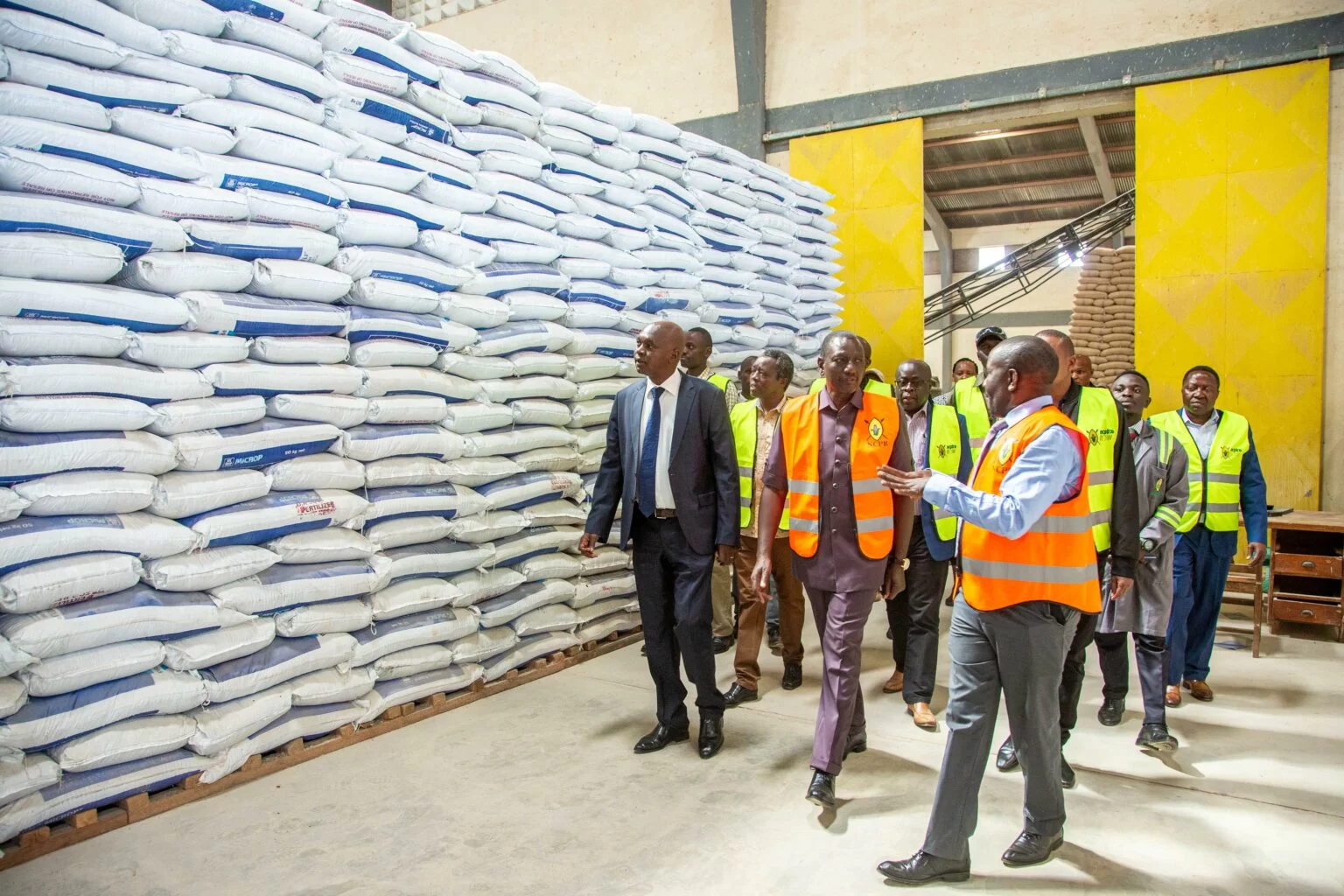
Farmers in Western and Nyanza regions say improved access to affordable farm inputs, water and infrastructure is making agriculture more productive and helping households increase food production.
The farmers say the reduced cost of fertilizer has enabled them to expand acreage, while investments in irrigation and modern farming methods are helping them overcome some of the challenges that previously constrained production.
In Western Kenya, farmer Dorothy Selebwa says access to affordable fertilizer has made a significant difference in her farming activities.
She says the fairly priced fertilizer allows her to plant more on her farm and achieve better harvests, which she uses to feed her family and support orphans and widows under her care.
Dorothy says Western Kenya has favourable climatic conditions for a wide range of crops, including bananas, food crops and trees, but farmers need affordable inputs and reliable markets to realise the region’s full agricultural potential.
She also points to improvements on the Shimanyiro Road, which she says had previously been in poor condition.
According to Dorothy, completion of the road will ease movement, attract more vehicles to the shortcut connecting the area to Eshisiru and improve the exchange of agricultural commodities.
She says continued support through affordable fertilizer, coupled with completion of the road works, would enable families to produce enough food for consumption and increase production for sale.
Dorothy says the interventions are already benefiting farmers and that better roads will further improve farming and trade in the region.
Irrigation transforming farming in Nyanza
In Nyanza, farmer Willis Odhiambo says access to water has made farming easier, with canals and water pumps helping farmers irrigate their crops.
Willis says the government supported the digging of canals, provided some water pumps and introduced modern seed varieties that farmers are now using.
He says continued adoption of modern farming methods could enable farmers to produce enough food while ensuring they have reliable markets for their produce.
The situation, he says, is a major improvement from previous years when farmers struggled to get water to their farms, faced poor drainage and relied heavily on manual labour.
Farmers also depended on older seed varieties that produced lower yields, partly because many could not afford improved seeds.
Willis says improved access to water and modern inputs is changing the way farmers approach production and giving them an opportunity to increase yields.
Lower fertilizer costs boost maize production
For maize farmer Norah from Kakamega County, the reduction in fertilizer prices has enabled her to increase the amount of land under maize production in both Kakamega and Kitale.
Norah says she previously purchased fertilizer from agrovets at between KSh4,000 and KSh6,000, depending on the brand. The high cost limited the amount of land she could put under cultivation.
She says the current price has made farming more consistent because the money that previously bought one bag can now enable her to acquire more bags for her farm.
According to Norah, the fertilizer is dependable in quality and is contributing to good yields, with more land now under agriculture compared with previous years.
She says demand remains high, with farmers sometimes arriving at outlets when available stocks are limited.
Despite the supply challenges, Norah says lower prices and more consistent availability have made it easier for farmers to continue producing maize.
Farmers welcome KSh2,500 fertilizer
Kakamega farmer Martin Shikuku says farmers are happy with the reduction in fertilizer prices, which has made agricultural production more affordable.
Martin says fertilizer that previously cost between KSh6,000 and KSh7,000 is now available at KSh2,500, giving farmers an opportunity to access essential inputs at a substantially lower cost.
He thanked the government for reducing the cost of fertilizer, saying the intervention is helping farmers remain in production.
Martin says affordable fertilizer allows farmers to cultivate more land and improve harvests, helping address food shortages and reduce the pressure associated with hunger.
Another farmer, Lawrence Wabuko from Butere in Kakamega County, says the lower fertilizer price has enabled farmers to buy enough inputs for their farms.
Lawrence says a bag of urea fertilizer previously cost close to KSh6,000 at agrovets, making it difficult for farmers with large farms to purchase enough fertilizer to cover their entire acreage.
With government fertilizer available at about KSh2,500, he says, the money that previously bought one bag can now purchase two.
This has enabled farmers to cover a larger area and improve crop performance, particularly because the soils in the area are acidic and require fertilizer to achieve good harvests.
Lawrence, however, wants more fertilizer to be supplied across cereals board outlets and, where possible, at sub-county level.
He says farmers should not be forced to travel long distances from areas such as Butere to Kakamega in search of fertilizer or contend with congestion at outlets.
Sugarcane farmers see new hope
Beyond food crops, sugarcane farmers in Western Kenya say reforms in the sugar sector have improved the prospects of cane farming, which has supported families across generations.
Tom Lukuru Ojwang, a sugarcane farmer from Kholera Location in Matungu Sub-County, says cane farming has been part of his family for generations.
His father started growing sugarcane in 1971, while Tom took up the practice in 1984. He is now guiding his sons to continue with the family farming tradition.
James Lukuru says sugarcane farming played a major role in educating him and shaping his life, although farmers experienced difficult periods when sugar companies collapsed.
During those years, he says, harvested cane could remain in farms after cutting, resulting in losses as the crop stayed under the sun. Payments to farmers could also take months.
James says the revival of sugar companies has changed the situation.
He says cane is now collected on the same day it is cut and weighed that day, while farmers receive messages indicating the tonnage delivered before payments are made within about a week.
According to James, the government has also created a better operating environment for the sugar industry by reducing deductions imposed on farmers, improving cane prices and ensuring sugar companies operate more efficiently.
For Tom, the revival of the sector is about more than improved earnings. It is also about passing on a farming legacy and giving the next generation an opportunity to achieve more.
He says he wants his sons to do better than he did, just as he improved on what his father started.
Tom believes the next generation will carry the work forward with commitment, saying what a parent begins with their hands, a child can move forward with all their heart.
Read: Govt Targets Coffee Expansion in Nyanza to Boost Farmers’ Incomes
>>> CBK: More Farmers Turning to Produce Buyers for Financing
















Leave a comment