

A free tool that will help farmers and pastoralists across Africa to predict and control locust behaviour has been launched.
Kuzi—the Swahili name for the wattled starling, a bird renowned for eating locusts—is an Artificial Intelligence-powered tool that generates a real-time heatmap of locusts across Africa, shows all potential migration routes, and gives a real-time locust breeding index.
Using satellite data, soil sensor data, ground meteorological observation, and machine learning, Kuzi can predict the breeding, occurrence and migration routes of desert locusts across the horn of African and Eastern African countries, and uses deep learning to identify the formation of locust swarms. Kuzi then sends farmers and pastoralists free SMS alerts 2-3 months in advance of when locusts are highly likely to attack farms and livestock in their areas.
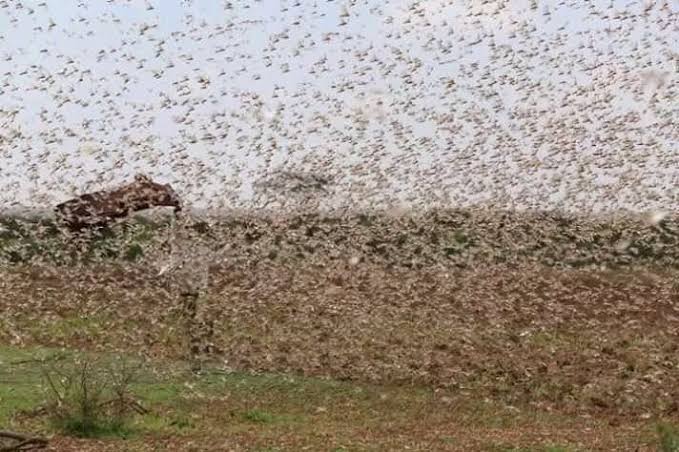
Without preventative measures, a swarm of 80 million locusts can consume food equivalent to that eaten by 35,000 people a day, devastating food stocks for vulnerable communities.
Putting in place early detection and control measures, which are critical in desert locust management, will offer farmers and pastoralists a vital tool in the fight against world hunger and food insecurity.
Alerts are currently available for Ethiopia, Somalia, Kenya, and Uganda, in the regional languages of Kiswahili, Somali and Amharic, spoken by over 200 million people across Eastern Africa.
“The first international anti-locust conference was held in Rome in 1931 and yet Africa continues to experience locust invasions almost 100 years later, with the worst locust invasion in 70 years occurring in 2020, threatening food supplies for millions of people across Eastern Africa. There has to be a better way to do this, one that has the local communities being central in the fight against locusts,” said John Oroko, CEO of Kuzi’s creator, Selina Wamucii.
“A new wave of locust upsurge now threatens millions across Eastern and Southern Africa, exacerbating food insecurity for already vulnerable communities, amidst the challenges of the COVID-19 pandemic. We have a responsibility to develop and deploy locally bred solutions that address these challenges faced by our vulnerable rural communities,” adds Oroko.
The free tool is currently available to users in Somali, Ethiopia, Kenya, and Uganda with plans to roll out to cover the rest of Africa.
Farmers can sign up for the free SMS alerts with any mobile device, with or without an internet connection, capture the GPS location of their farm, and they are good to go, without any charges.














Leave a comment