


Seven years ago, Sam Gachambi was just a mere farmer struggling to eke out a living in the vast agriculture sector. For years, he tilled his land for coffee, avocado and macadamia, yet no one noticed him in a sector where success is largely measured by land size and production volumes.
He seemed to mark-time in terms of growth, with production low and sales never assured. Often, he would dispose of his produce to middlemen, known as brokers, who set a price that barely left him with a profit. “It was crazy,” says Sam. “I operated alone for five years. I made mistakes and there was no one to help. I would, for instance, plant crops at the wrong time or even use wrong inputs because I didn’t understand how the market worked. But worst of all is that after all the struggles brokers would cash in and buy produce at their own prices.”
Then one day, through interactions with sector players, Sam joined a co-operative society. It turned out to be a turning point in his farming venture. From the frustrations of lonely farming, the cooperative society, KINOGERAMA, opened a new world, where operations were done professionally.
He started learning a lot from meetings and trainings by his cooperative, helping him not only to streamline his business but also expand and grow revenues. For the first time, he says, he started relying on market research and he would be paid on time.
Sam is among hundreds of young farmers who are benefitting from Co-operative Bank’s Youth Forums, which offer financial training for students and youth in business and employment. In a recent training – Cooperatives & Co-ops: The Power of Collective Farming for Young People – held virtually on Friday 18th July 2026, Sam revealed how joining a cooperative society has transformed his business and urged young people to tap the huge benefits that coops offer in what has come to be known as collective farming.
Mr Brian Gitonga, the value chain manager for agribusiness at Co-operative Bank of Kenya, took participants through the nuts and bolts of cooperatives, stressing the many benefits that come with collective farming. He said the main purpose of a cooperative is to get maximum value for its members and young people can be part of this movement that has transformed many lives and businesses.
Related >> Co-op Bank Named Best Bank in Retail, Digital at Euromoney Awards
“It’s advisable for a cooperative society to focus on one crop to be more effective,” Mr Gitonga said. “With current technology young people can form or join a cooperative while in different locations as long as they have a channel for communication and coordination.”
In fact, he says, nothing stops young people from coming together to form a cooperative society, register it to serve their interests. According to the law, a cooperative society needs a minimum of 10 members and has no limit. The catch is that these members need to have common goals.
Alternatively, one can join an exiting cooperative like Sam did. KINOGERAMA cooperative has 75 members, among them 15 youth. “joining a cooperative is easy. You need to identify the appropriate society that fits your needs then register with a one-off payment and secure shares,” says Sam. “There also regular contributions that help members build up savings.”
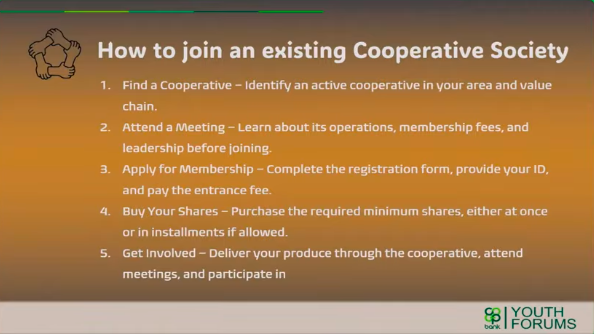
Gitonga adds that every crop in every value chain can support a cooperative. In this case, therefore, someone like Sam can join a coffee cooperative, macadamia or avocado group. “Coops are not just for old people,” he said. “Even young people, as it were, can join or form.”
The benefits of young people joining cooperatives societies are many. First, members have easy access to markets and their produce fetches better prices due to bulk selling. The power of numbers also ensures cheaper inputs through collective bargaining.
In addition, there are shared services that would be too expensive for an individual. Last but not least, a cooperative enhances the credibility of members through various ways including, management, branding and quality checks. Besides, the deposits also build savings for the member, ensuring good credit record which then can be used to secure credit for business.
Gitonga says all these present a strong case for cooperatives among young people. “Collective farming is a business opportunity,” he says. “It’s not an option for failures.”
https://www.youtube.com/watch?v=axAngWWRnkU













Leave a comment