


I must confess: I may be a die-hard Tyler Perry fan living in denial. And, apparently, I am not ready for an intervention just yet.
I am back with yet another critique of All the Queen’s Men, the BET crime drama I have followed since its first season. If there is one thing this show has taught me, it is to expect a body to drop before the credits roll.
Season 5 continues to deliver the familiar cocktail of power, betrayal, violence and shifting loyalties, with Marilyn “Madam” DeVille reminding everyone why crossing her is a potentially fatal career move.
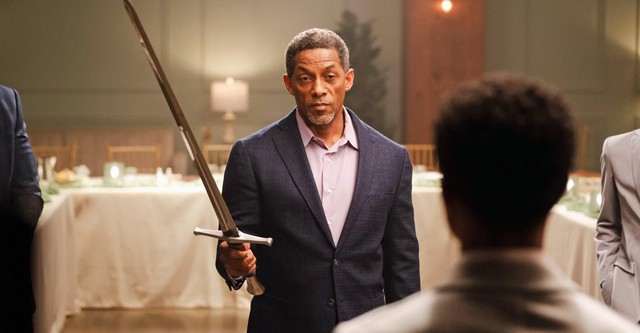
But in this latest episode, Madam takes her ruthlessness to another level by killing Attorney Lovett, her own lawyer. And while the show has never shied away from bloodshed, this particular death left me asking a more fundamental question: how much longer can a character remain virtually untouchable before the storytelling begins to lose its grip?
Attorney Lovett deserved better
Lovett was not some opportunist who had wandered into Madam’s orbit looking to cash in on her criminal empire. He had been loyal from day one, helping her navigate legal trouble, getting charges dropped and mounting a defence during her trial.
His professional value to Madam was obvious. He was the man who could help her manage the legal consequences of a life built around power, violence and criminal enterprise. Yet one mistake was apparently enough to make him expendable. I genuinely felt for him. He did not deserve to die like that, particularly after years of service to a woman whose interests he had worked so hard to protect.
But then again, should we really be surprised? This is the same Madam who was willing to slit the throat of Carla, her own sister. And if she could contemplate such violence against family, why should anyone else expect mercy? Amp, her favorite nephew, has hardly been exempt from her threats either. Madam was prepared to eliminate him over allegations of theft. In her world, blood relations may earn you a place at the table, but they certainly do not guarantee your safety.
Nobody is safe, and apparently, nobody is safe enough to make a mistake.
That is part of what makes Madam such a compelling antagonist. She is ruthless, calculating and intolerant of failure. She does not merely want to control her empire; she wants to control the people within it, their decisions and, ultimately, their survival.
But there is a difference between writing a formidable villain and creating a character who appears almost impossible to defeat.
When invincibility becomes a storytelling problem
I enjoy a good crime drama. Give me the suspense, the double-crossing, the alliances that crumble at the worst possible moment and the plot twists that leave me staring at the screen in disbelief. Tyler Perry understands spectacle. He knows how to construct confrontations, manufacture tension and place characters in situations where loyalty becomes a liability.
However, suspense depends on uncertainty. Viewers need to believe that characters can lose, that decisions have consequences and that even the most powerful person in the room can eventually meet their match. With Madam, I sometimes struggle to believe that any of those rules apply.
She has survived threats, legal troubles, betrayals and repeated attempts to undermine her authority. Even when her empire appears vulnerable, she finds a way to regain control. Her enemies come and go, but Madam remains standing, ready to remind everyone who runs the show.
At some point, though, the question shifts from How will she survive this? to Will this woman ever face consequences that actually stick? That shift matters. When a central character repeatedly escapes situations that should fundamentally alter her circumstances, the stakes begin to feel less convincing. The audience may remain entertained by the spectacle, but its emotional investment can begin to weaken.
Why worry about Madam’s next enemy if the story continually finds a way to restore her dominance? I have experienced precisely that frustration with All the Queen’s Men. My interest in the series has fluctuated, particularly after Madam’s courtroom victory, which left me questioning just how far the show was prepared to stretch the limits of plausibility.
Lovett’s death intensified that feeling. Rather than simply demonstrating Madam’s cruelty, it reinforced a familiar pattern: anyone who disappoints her can be discarded, while she herself continues to operate with remarkable impunity.
My suspicion is that Lovett also became a convenient scapegoat for the defeat Madam suffered at the hands of Concierge. That is my interpretation, of course, but it fits a character who appears incapable of accepting failure without finding someone else to punish for it. Concierge remains an interesting challenge to Madam’s authority precisely because he is not an easy opponent to eliminate.

The series has an opportunity here. Instead of repeatedly demonstrating that Madam can outmanoeuvre everyone, it could explore what happens when she finally encounters a rival she cannot intimidate, manipulate or destroy. That would make her power more interesting, not less. The problem with another shocking death. Lovett’s death also raises questions about how the series treats loyalty.
In a world as treacherous as Madam’s, loyalty should be a valuable currency. Her operation depends on people willing to protect her interests, manage her problems and remain useful when the pressure mounts. Lovett did precisely that. His death, apparently over an honest mistake, makes his years of service seem almost meaningless.
There is dramatic potential in such betrayal. A ruthless leader who destroys her own loyalists can create a compelling story about paranoia, isolation and the eventual collapse of an empire. But that development needs consequences beyond another shocking death. Does Lovett’s absence leave Madam more vulnerable? Does it make others reconsider their allegiance? Does it deepen her isolation or expose a weakness in the way she runs her affairs? These are the questions that could give his death greater narrative weight.
Without that deeper exploration, his exit risks becoming another grisly entry in the show’s expanding body count. And while I appreciate a good plot twist, not every character’s departure should feel like an excuse to shock the audience.
I even suspected something terrible was coming when Lovett walked into the scene with the furniture covered in tarps. The visual setup practically invited suspicion. Still, anticipating a death does not make it any less disappointing when a character you like meets such an end. Lovett was one of my favourite characters. I wanted more for him.
Carla and Madam: flowers, childhood memories and selective amnesia
Now, let us talk about Carla. If Lovett’s death tested my patience, Carla and Madam’s reconciliation tested my memory on Carla’s behalf. Carla and Madam are the definition of “never get involved in a siblings’ fight”. And this episode provides all the evidence I need.
One minute, their relationship is violent enough to leave you questioning whether reconciliation is even possible. The next, there are flowers, childhood memories and laughter, as though the previous night’s events belong to an entirely different television series.
Chile, all Madam apparently needed was a hospital visit, a few dollar bills wrapped around some cheap-ass flowers and a sentimental trip down memory lane. And boom! Carla forgives her? Excuse me? Are we talking about the same Madam who had already chopped off Carla’s fingers and was preparing to slit her throat the night before?

Because that is quite a lot to overlook in exchange for flowers and childhood nostalgia. The scene would have been easier to accept if the series had given Carla more room to process the betrayal, confront the danger she was in or establish the conditions under which she might consider forgiving her sister. Instead, their sudden warmth risks making the preceding violence feel strangely inconsequential.
Forgiveness is not inherently implausible, even between people who have caused one another immense harm. Family relationships can be complicated, contradictory and emotionally messy. But reconciliation after extreme violence requires more than a sentimental gesture if it is to feel convincing on screen. That is my problem with this storyline. It is not that Carla forgives Madam; it is how quickly the show seems willing to move past what happened.
And just like that, I found myself struggling to sympathise with Carla. I had felt sorry for her. I understood why she might be conflicted about her sister. But watching the two laugh together as though nothing had happened left me exasperated. These two deserve each other. And Pissy Elliott? Chile, she just pissed me off.
The Tyler Perry formula: addictive, but not without its flaws
To be fair, All the Queen’s Men has qualities that keep viewers coming back. Its world of nightclub politics, criminal alliances, shifting loyalties and personal rivalries provides plenty of material for a heightened crime drama.

The character played by Eva Marcille commands attention, and her appetite for control gives the series a recognizable center of gravity. The show understands spectacle. It knows how to deliver a confrontation, introduce a betrayal and leave viewers debating what they have just watched. But spectacle alone cannot sustain a story indefinitely.
The more violence a series delivers, the more important it becomes to make each act mean something. The same applies to courtroom victories, betrayals and reconciliations. When major developments repeatedly serve to restore the status quo, the drama can become exhausting rather than exhilarating.
This is the distinction between keeping viewers on the edge of their seats and simply keeping them busy. I do not need Madam to become a saint. That would defeat the point of her character. Nor do I expect a crime drama to operate according to the moral standards of everyday life.
I do, however, expect its storytelling to establish credible limits, meaningful consequences and enough character development to make its twists matter. Madam can be terrifying without being invincible. She can be powerful without winning every confrontation. And she can remain the show’s most magnetic character without the narrative constantly bending to accommodate her.
In fact, watching her lose something she cannot easily recover might be the most compelling development the series could offer.
Verdict: Madam needs a worthy opponent
I remain fascinated by Madam, even when she frustrates me. That, perhaps, is the show’s greatest achievement: it has created a character capable of provoking outrage, admiration and disbelief, sometimes within the same episode. But fascination has its limits. Attorney Lovett’s death was brutal, Carla’s rapid reconciliation with Madam was difficult to swallow, and the recurring question of Madam’s invincibility continues to undermine my investment in the story.
I am still watching, which says something about the show’s ability to hold an audience’s attention. Yet I am also watching with questions that spectacle alone cannot answer.
Tyler Perry, sir, I have questions.
How many people must Madam eliminate before someone finally makes her answer for her actions? How much can Carla reasonably be expected to forgive? And at what point does a character’s extraordinary ability to survive stop being impressive and start becoming a storytelling liability?
For a viewer who has followed the series since Season 1, these are not trivial complaints. They are questions about whether a show I have enjoyed can continue to make its story satisfying without relying too heavily on its central character’s seemingly limitless power.
I may be a die-hard Tyler Perry fan living in denial, but even my loyalty has limits. Madam, darling, the crown is yours. Just remember that being queen should not mean being above consequences.












Leave a comment