

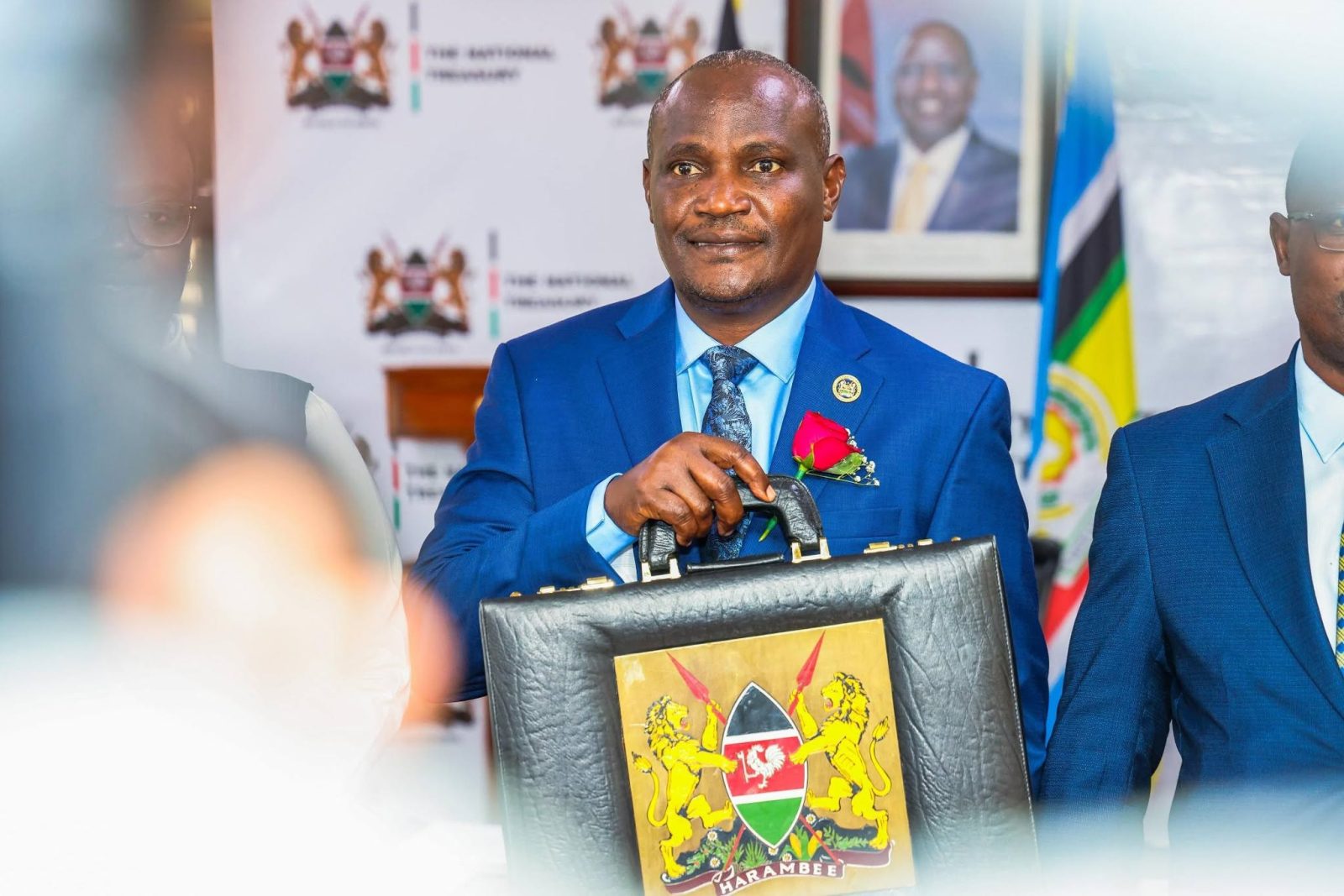
The government has unveiled a KSh4.82 trillion budget for the 2026/27 financial year, prioritising agriculture, affordable housing, healthcare, education and support for small businesses under the Bottom-Up Economic Transformation Agenda (BETA).
According to the National Treasury, the budget is anchored on the theme “Sustaining the Bottom-Up Economic Transformation Agenda for Resilient and Inclusive Growth amid Global Uncertainty.”
The spending plan comes at a time when Kenya is navigating rising geopolitical tensions, higher global energy prices and inflationary pressures that continue to affect economies worldwide.
Treasury projects total government expenditure and net lending at KSh4.82 trillion against expected revenues of KSh3.63 trillion, resulting in a fiscal deficit of KSh1.15 trillion, equivalent to 5.5 percent of GDP. The deficit will be financed through a combination of domestic and external borrowing.
Education Receives Largest Share
Education remains the biggest beneficiary of government spending, receiving KSh784.5 billion, followed by Energy, Infrastructure and ICT at KSh531.3 billion and Public Administration and International Relations at KSh373.7 billion.
The health sector has been allocated KSh177.2 billion, while Agriculture, Rural and Urban Development will receive KSh111.7 billion.
Key education allocations include KSh408.5 billion for the Teachers Service Commission, KSh96.4 billion for HELB and scholarships, KSh61.6 billion for free primary and day secondary education, and KSh30.9 billion for Junior Secondary School capitation.
Agriculture Gets Major Boost
Agriculture remains a central pillar of the government’s economic agenda, with billions earmarked for food production and farmer support programmes.
Among the notable allocations are KSh18 billion for the Fertilizer Subsidy Programme, KSh5.4 billion for the Food Systems Resilience Project, KSh4.7 billion for the National Agricultural Value Chain Development Project and KSh4.6 billion for Blue Economy projects.
The government says the investments are intended to move Kenya from a food-deficit to a food-surplus nation while reducing reliance on imports and strengthening export earnings.
Housing and Healthcare Prioritised
The Affordable Housing Programme continues to receive substantial funding, with KSh50.6 billion allocated for the construction of affordable housing units and KSh20.9 billion for social housing.
In healthcare, the government has allocated KSh19.1 billion to the Primary Healthcare Fund, KSh18.5 billion to programmes supported by the Global Fund, KSh9.3 billion for health interns and KSh8.6 billion for Universal Health Coverage.
Additional funding has been earmarked for vaccines, cancer centres and the construction of a new 2,000-bed multi-specialty hospital at Moi Teaching and Referral Hospital.
Support for SMEs and Youth
Recognising the role of Micro, Small and Medium Enterprises (MSMEs) in job creation, Treasury has allocated KSh5.4 billion for the Supporting Access to Finance and Enterprise Recovery (SAFER) programme and KSh4.9 billion for the National Youth Opportunity Towards Achievement (NYOTA) initiative.
The government has also allocated KSh761 million to the Youth Enterprise Development Fund and KSh550 million to entrepreneurship support programmes.
Youth empowerment initiatives will receive KSh110.2 billion, including funding for the National Youth Service, employment programmes and women-focused enterprise funds.
Infrastructure and Security Spending
Infrastructure remains a major spending priority, with KSh220.4 billion allocated for road maintenance, rehabilitation and construction.
The government has also set aside KSh38.1 billion for railway transport and infrastructure as it seeks to improve connectivity and support trade.
National security agencies, including the police, military, intelligence service and prisons department, will receive a combined KSh557 billion. The allocation includes KSh13 billion for leasing police vehicles and KSh7 billion for police modernisation.
Counties Receive KSh502 Billion
County governments have been allocated KSh502 billion, comprising KSh428 billion in equitable share, KSh16.6 billion in conditional allocations from the national government and KSh57.4 billion from development partners.
The funding is expected to support service delivery and strengthen devolution across the 47 counties.
Tax Relief Measures
The budget also introduces several tax measures aimed at easing the cost of living and supporting key sectors.
Among the proposals are the removal of excise duty on bottled water, VAT exemptions on dialysis equipment, an increase in the duty-free baggage threshold from $300 to $2,000, and tax exemptions for aircraft and aircraft spare parts.
The government has also proposed duty-free importation of inputs used in the assembly of smart telecommunication devices and motorcycle parts.
At the same time, excise duty on sugar-sweetened beverages will rise from KSh14.14 to KSh20 per litre, while a new 10 percent excise duty will apply to imported and locally manufactured plastic products.
Growth Outlook
Treasury projects the economy will expand by 5.0 percent in 2026, slightly lower than an earlier forecast of 5.3 percent due to emerging global risks, particularly tensions in the Middle East.
However, the government expects growth to strengthen to 5.2 percent in 2027 as global supply chains stabilise and external pressures ease.
The budget signals the government’s intention to maintain fiscal discipline while continuing investments in sectors considered critical for economic growth, job creation and improved household welfare.
Read: CBK Back to the Market Seeking KSh 60 Billion for Budget Support
>>> Central Bank of Kenya Raises KSh 34.4 Bn for Budget Spending in June







Leave a comment