

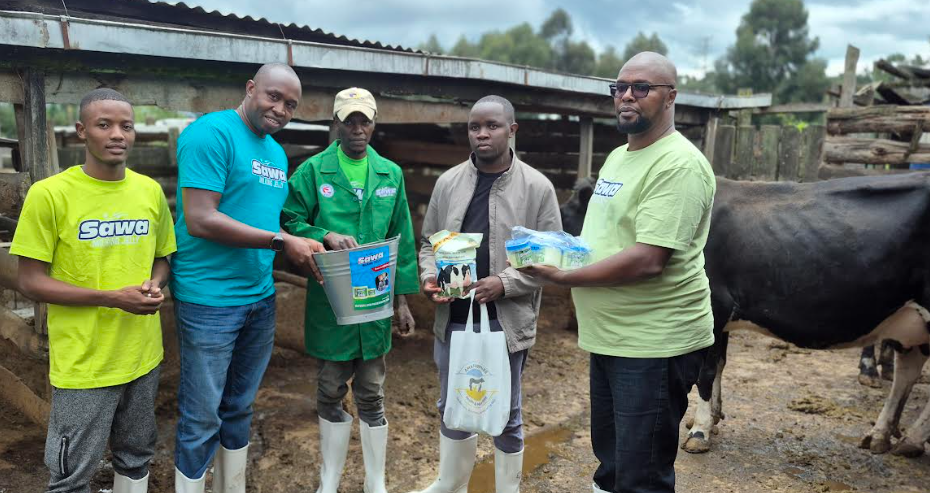
Sawa Milking Jelly by Pwani Oil has kicked off a nationwide farmer empowerment initiative aimed at helping dairy farmers across Kenya boldly tackle mounting challenges linked to mastitis infections, poor dairy hygiene, declining milk quality and reduced farm productivity.
Working in partnership with AMA Energy, the Sawa team seeks to support farmers through practical education, animal wellness support and improved milking practices. AMA Energy is a high-efficiency animal feed additive that delivers clean, immediate energy to livestock while supporting sustainable agriculture through the use of food-manufacturing co-products and reducing human-animal crop competition.
The campaign, set to run until August 2026, will pass through 17 towns across 4 counties- Bomet, Narok, Nyandarua and Muranga, targeting 105 mini farm activations and 2 regional intensive farm activations.
Speaking during one of the engagement forums in Gatanga,Murang’a, Sawa Milking Jelly Brand Manager James Faraja noted that “Kenya’s dairy farmers are at the centre of the country’s food systems and rural economy. Supporting them with practical knowledge, proper udder care education and animal wellness solutions is essential in improving milk quality, protecting livestock health and building more sustainable farming communities.”
The initiative comes at a time when Kenya’s dairy sector continues to face increasing pressure from animal health concerns, rising production costs and the growing need for improved milk quality standards.
Recent data from the International Centre for Antimicrobial Resistance Solutions indicate a high prevalence of subclinical mastitis – mild infections without visible clinical signs in Kenya, exceeding 50 per cent.
This, even as dairy farming continues to lead as one of the country’s most important economic activities, supporting millions of livelihoods and serving as a critical source of nutrition and household income for rural communities.
According to the Food and Agriculture Organisation of the United Nations (FAO), the global dairy sector supports more than 150 million farming households worldwide and plays a vital role in food security, economic resilience and rural development.
Recent agricultural sustainability studies published in late 2025 further show that improving dairy hygiene and animal health practices directly contributes to key United Nations Sustainable Development Goals (SDGs), including zero hunger, good health and well-being, decent work and economic growth, and responsible consumption and production.
AMA Energy will further support the initiative through grassroots engagement efforts aimed at empowering rural farming communities and strengthening direct connections with farmers across the country.
Speaking at the engagement in Gatanga, Veterinary expert Mr. Job Munene noted that mastitis is one of the leading causes of milk loss and reduced dairy productivity among smallholder farmers across East Africa.
“The condition not only affects milk quality and farmer earnings but also impacts animal comfort, welfare and long-term farm sustainability. Many of these losses can be reduced through greater farmer education, preventative animal care and improved milking hygiene practices,” said Vet. Munene
Through the initiative, farmers will receive hands-on education around proper udder care, mastitis prevention, milk hygiene, cow wellness and best milking practices aimed at improving both dairy productivity and animal welfare.
The programme will also amplify farmer voices and experiences through community engagement and storytelling that highlights the realities and resilience of Kenya’s dairy farming communities.
Read: Brookside Dairy Rewards Farmers with Ksh257M Bonus
>>> First Ever Large-Scale Climate Funding Targets Dairy Systems















Leave a comment