

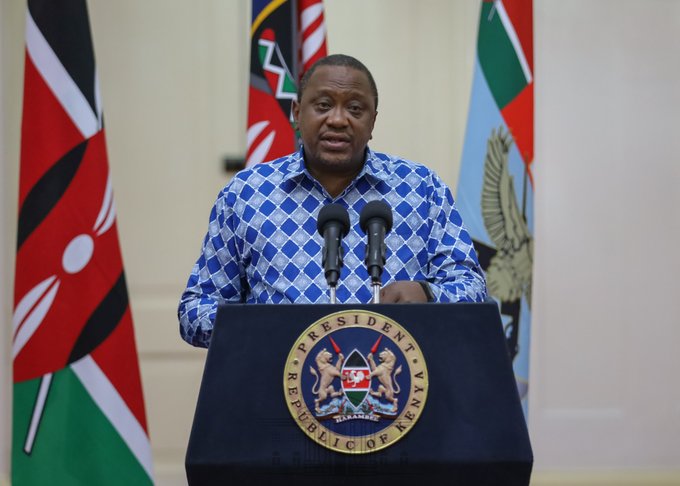
All eyes are on President Uhuru Kenyatta on Monday when he is expected to address the nation on the way forward regarding restriction of movement even as COVID-19 infections continue to rise across the country.
This comes following the lapse of a full month since President Kenyatta ordered an extension of the nationwide curfew by another 30 days to contain the spread of COVID-19 but since then, the situation has worsened.
“We must accept that we are not dealing with a right or wrong opinion we are caught in between two rights. Those who want to open the economy are right and those opposed to opening the economy are also right,” said President Kenyatta on June 6.
On Sunday, Kenya reported a further 309 cases taking the total number 7886 with the Ministry of Health projecting that the country’s health systems might become overwhelmed on the current trajectory.
More than 1 million previously employed Kenyans have lost their jobs while a Kenya National Bureau of Statistics (KNBS) survey showed that a third of Kenyans are unable to pay their rent due to disrupted livelihoods.
Reports indicate that by Sunday evening, President Kenyatta had given serious thought to reopening the country only for contrasting opinions between experts to delay a decision.
The national government is wary of both the economic and health ramifications of the options on the table, a situation further compounded on by the under-preparedness of some counties, the state is only willing to open up once the counties display capability to handle cases within their borders and to assume political responsibility for it.
Meanwhile, Kenyans in their droves are praying for one result only, that the Head of State will ease the movement restriction measures to allow them to sustain their livelihoods even as medical experts advise that lifting the restrictions might culminate into infections spiralling out of control in a way that the government might not be able to handle.
Dr. Njagi Kumantha, an expert on health services management told The Star the current infections will increase until about 70 percent of Kenyans have had an infection.
“The current measures are not meant to eradicate COVID-19 but to slow it down so that our health systems can cope with the seriously sick cases. The focus should now be on counties to increase capacity because the national government facilities are already overwhelmed,” Dr. Njagi said
He said measures like the night curfew, restriction of movements, social distancing, hand washing and sanitising, wearing face masks, treatment and monitoring have been fairly successful in slowing the spread.
“At the same time, these containment measures have caused devastating side effects to the psycho-social and economic aspects of normal life. The biggest problem is the loss of earnings directly associated with restrictions on movements of people from counties to and fro from Nairobi cosmopolitan and Mombasa,” said Dr. Kumantha.
The medical expert opines that it would be prudent for President Kenyatta to lift the restrictions curtailing movement into and from Nairobi and Mombasa but maintain all the other restrictions.
On the other hand, the Council of Governors wants Nairobi and Mombasa to remain closed until the curve is flattened.
“Counties with high numbers should not be forced to open without consideration due to the ability to cope. The curfew should be maintained with the current hours for as long as it takes to flatten the curve,” Council of Governors Chairperson Wycliffe Oparanya told Uhuru during the extra-ordinary session of the national and county governments coordinating summit held on Thursday, last week.
Oparanya further faulted the national government for failing to wire funds due to counties saying that the situation will make it hard for the devolved units to deal with the rising numbers.
“To-date the payments have not been effected and unfortunately healthcare workers have now issued a strike notice that starts next week,” Oparanya said.
As the government mulls easing the movement restrictions, it is possible that such a move will lead to sharp rises in infections leading to more deaths and expose the country’s health systems to a situation it cant handle.










Leave a comment