

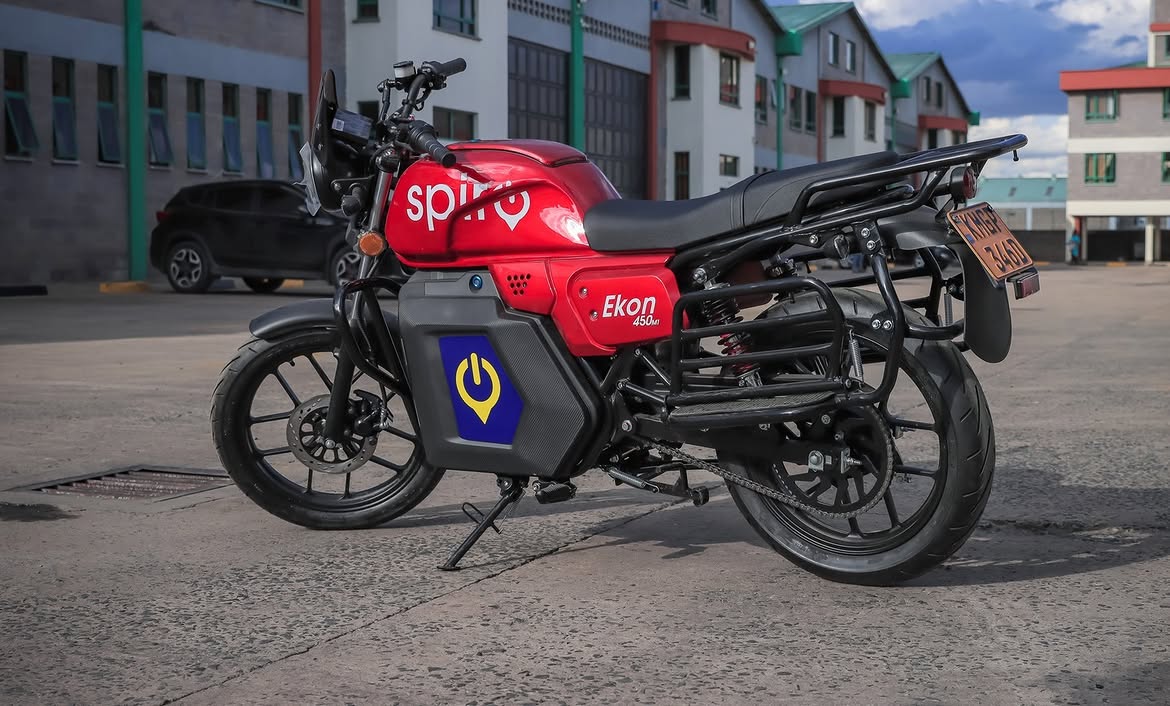
Electric motorcycles are transforming Kenya’s boda boda sector, the backbone of urban and rural transport that moves millions of people and goods daily.
Spiro, a Dubai-headquartered firm with major operations in the country, has become the dominant player. Its flagship Ekon models, such as the 450M1, typically sell for around Ksh95,000 to Ksh152,000 cash for the bike chassis without the battery. Financing is common: deposits often range from roughly Ksh9,500–30,000, followed by daily payments of about Ksh150–450 over 14–24 months via partners including M-KOPA, Watu Credit, Mogo or KCB.
But even as these electric motorcycles are becoming increasingly visible on Kenya’s roads, the real calculation is no longer just the purchase price. For boda boda riders, the bigger questions are how far a battery can take them, what each kilometre costs and whether the charging or battery-swapping network can keep up with their work.
A buyer should therefore ask not simply, “How much is the bike?” but also:
- How much is the battery?
- Who owns the battery?
- How much is each swap?
- Where are the swap stations?
- Can the battery be charged at home?
- What happens if the rider stops using the motorcycle for several days?
Those terms can change the economics considerably.
Is a Spiro equivalent to a 250cc motorcycle?
Not exactly.
Electric motorcycles do not have engine displacement in cubic centimetres because they do not have petrol engines. Their performance is normally described using kilowatts (kW), torque and battery capacity.
This makes a comparison with a 250cc petrol motorcycle useful only as a rough indication of performance.
The Spiro EKON 450M models listed in Kenya have a 9kW motor. That is about 12 horsepower when converted from kilowatts.
For comparison, the KingBird KB250-1, a 249.6cc petrol motorcycle, is listed with 18.5kW of maximum power, or roughly 25 horsepower, and fuel consumption of less than 3.5 litres per 100 kilometres.
In simple terms, a 9kW Spiro should not be described as a 250cc equivalent. Its peak power is roughly half that of the cited KingBird 250.
But that does not mean an electric motorcycle will feel half as useful in ordinary boda boda work.
Electric motors deliver torque differently from petrol engines, with strong torque available from low speeds. The motor also does not need a conventional gearbox, clutch or internal-combustion engine.
The comparison is therefore better expressed as performance rather than engine size.
Running costs: one swap versus petrol litres
Kenya’s petrol prices have risen and fallen over time, so the comparison needs a specific date.
For the current September 15 to October 14, 2026 pricing period, EPRA lists Super Petrol at Ksh214.03 a litre in Nairobi, Ksh213.69 in Eldoret and Kisumu, and Ksh212.92 in Nakuru.
Take the KingBird 250 as an example.
Its listed fuel consumption is below 3.5 litres per 100 kilometres. At 3.5 litres, 100 kilometres would therefore require:
3.5 litres × Ksh214.03 = Ksh749.11
That means the petrol cost would be about Ksh7.49 per kilometre at that consumption rate and Nairobi’s current petrol price.
Against Spiro’s reported Ksh290 for 80–100 kilometres:
The figures are not a laboratory comparison. Actual consumption varies according to speed, passenger weight, hills, tyre pressure, traffic, road conditions and riding style.
Still, the difference illustrates why electricity has become attractive to commercial riders.
At 100 kilometres, a KingBird 250 consuming 3.5 litres would spend about Ksh749 on petrol, compared with about Ksh290 for a Spiro battery swap.
The difference is approximately Ksh459 for every 100 kilometres, before maintenance and financing costs.
The bigger saving may be maintenance
The economics of electric motorcycles are not limited to energy.
A petrol motorcycle contains an internal-combustion engine with engine oil, oil filters, spark plugs and other components that require regular maintenance.
An electric motorcycle has an electric motor and electronic control system instead.
Business Daily reported that riders using electric motorcycles have noticed lower maintenance costs because they no longer have the same engine-oil, spark-plug and oil-filter requirements associated with petrol motorcycles.
That does not mean an electric motorcycle is maintenance-free.
Tyres, brakes, chains, suspension, bearings, wiring, electronics and other components still require attention.
And because electric motorcycles are relatively new in Kenya, access to trained technicians and genuine replacement parts can become an important consideration.
Spiro complaints: why some Kenyan riders have been unhappy
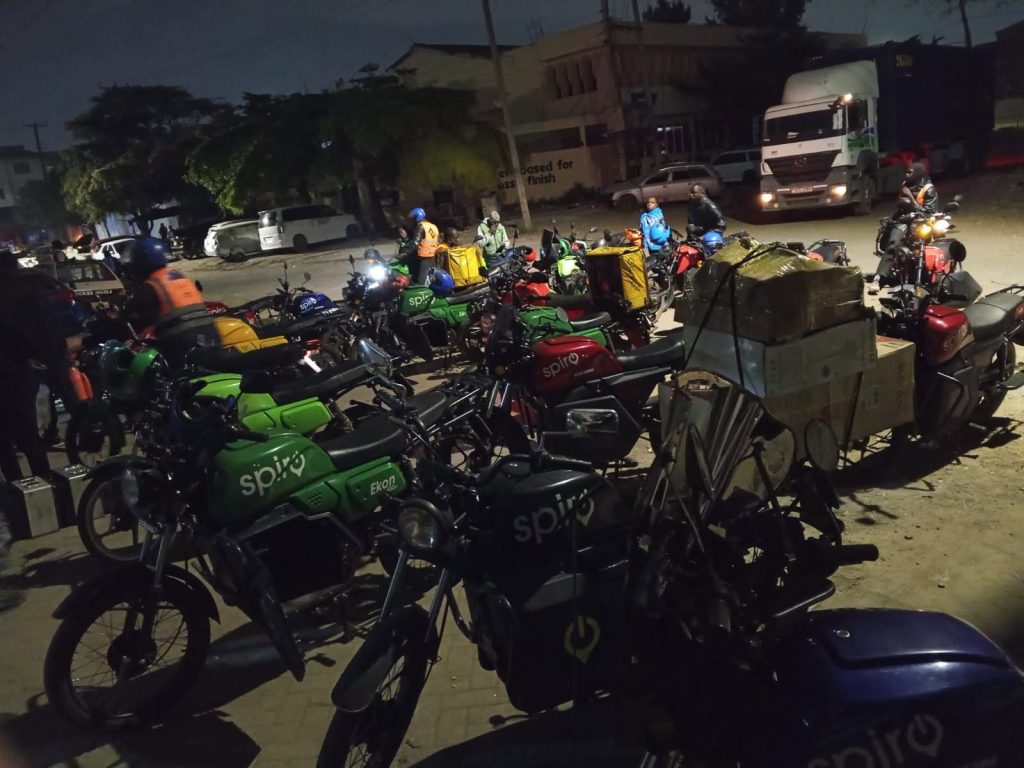
The electric motorcycle boom has not been without controversy.
Late in 2025, Kenyan riders began publicly complaining about Spiro’s battery ownership and management system. Some riders alleged that motorcycles could effectively become unusable when batteries were marked dormant or when riders stopped operating their bikes for several days.
The controversy became particularly visible after social-media posts by riders alleged remote disabling and battery repossession.
Spiro responded in December 2025, saying the disputed notices concerned its battery-inactivity policy and that the batteries remained company property under its Battery-as-a-Service model. The company said it was reviewing how exceptional situations such as illness, accidents and other interruptions should be handled.
The issue also became part of a broader dispute about battery interoperability.
Associated Press reported in February 2026 that riders had raised concerns about proprietary batteries, uneven swap-station distribution and motorcycles that could allegedly be remotely disabled after periods of inactivity. Protests in Nairobi and Mombasa in late 2025 also highlighted demands for more accessible swapping infrastructure and greater compatibility between networks.
These are important complaints, but they should be distinguished from the broader economics of electric mobility.
The battery-as-a-service model reduces the rider’s upfront cost because the rider does not have to buy a costly battery. The trade-off is that the rider becomes dependent on the company’s battery network and operating rules.
That dependence is the central business-model question facing electric motorcycles in Kenya.
Other electric motorcycles gaining ground
Spiro is not alone.
Roam Air has developed an electric motorcycle assembled in Kenya and says its latest model can travel up to 80 kilometres per battery, or 160 kilometres with two batteries. Roam also operates charging hubs and points and has expanded into counties outside Nairobi.
Ampersand operates electric motorcycles and a battery-swapping network in Kenya and Rwanda. In 2025, the company announced a funding round involving British International Investment, Seedstars Africa Ventures, Gaia Impact, the Rwanda Green Fund and other investors to expand its motorcycles and battery infrastructure.
Ampersand has since moved to open its battery network to compatible third-party electric motorcycles, a significant development because it could reduce the problem of riders being locked into a single manufacturer’s battery ecosystem.
ARC Ride is another significant player. Its Nairobi network uses automated battery-swapping cabinets, allowing riders to exchange batteries rather than waiting for conventional charging. In September 2026, ARC Ride announced a $33.3 million funding round, with about 70 per cent of the money earmarked for battery-swapping infrastructure and the remainder for motorcycles.
The company has also received backing from the International Finance Corporation, which disclosed an investment of up to $5 million to support ARC Ride’s Series A financing, network expansion and technology development.
Also read: U.S., Kenya Discuss Critical Minerals Partnership as Nairobi Seeks Local Processing













Leave a comment