

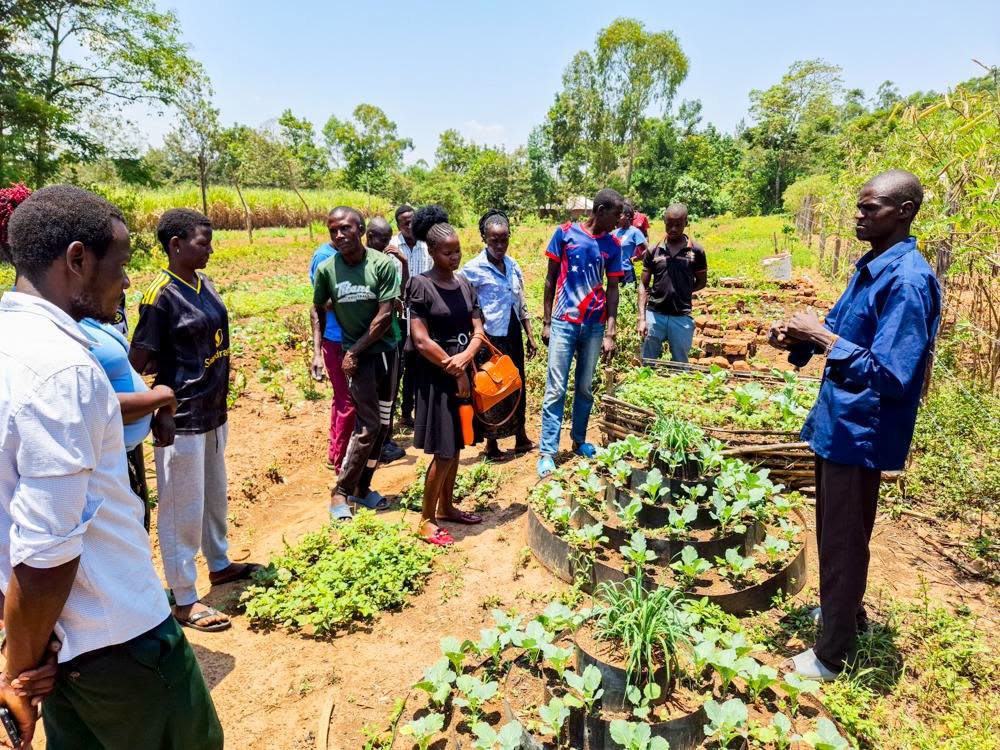
The initiative, spearheaded by the Lake Basin Development Authority (LBDA) in partnership with the Wezesha Agribusiness Programme, seeks to help farmers maximise limited land and reduce production costs by turning farm waste into useful resources.
Under the circular farming model, poultry manure is used to fertilise fish ponds, encouraging the growth of zooplankton that feed fish. Water enriched with nutrients from the ponds is then channelled to vegetable gardens, reducing waste while supporting crop production.
The approach is being promoted in Busia County, where farmers are adopting improved poultry housing, better biosecurity and modern production methods to reduce losses and make farming more commercially viable.
At Angoorom, farmer Miriam Ojakol turned to poultry farming after months of unsuccessful attempts to secure formal employment. She joined her father in the family enterprise but suffered losses before enrolling in a training programme that introduced her to improved poultry housing.
Ojakol said keeping chickens within a controlled environment helped protect them from infections associated with roaming and contact with other birds.
“Wakizunguka nje anapata magonjwa mengi juu sio hao pekee wanazunguka wanapatana na kuku wengine wanapewa ugonjwa na vitu kama hizo,” she said, explaining that free-roaming chickens face greater exposure to diseases.
In Malaba, Rebecca Odalo has also changed her approach to poultry production after repeated losses threatened her chick-brooding business.
Odalo said rodents were responsible for the deaths of 30 out of 100 chicks in one of her early batches. She subsequently installed wire mesh to block the openings used by rats to enter the poultry house.
“Nililose 30. Na nikawa na nikaendeleza baada ya kufunga hizo panya route zenye panya zilikuwa zinapitia ndani,” she said.
The intervention enabled her to continue with the business after she had initially struggled to establish a reliable source of income.
Odalo said farmers did not necessarily need large pieces of land to increase production, pointing to the use of shelves and vertical space in poultry housing.
“Si lazima mtu akuwe na shamba kubwa kwa sababu ukiangalia pale penye nimeweka vifaranga zangu hiyo nyumba iko na capacity ya 2000 of which vifaranga zinaweza kaa chini na bado uweke shelves ambazo zinaweza kusaidia sana ukawa na capacity kubwa unlike ukiweka tu chini peke yake,” she said.
Her experience illustrates how improved housing and space management can allow farmers to increase production without expanding the size of their farms.
5,000 youths targeted through agribusiness training
The Wezesha programme has trained at least 5,000 young people in climate-smart agriculture over the past two years, according to reporting by Citizen Digital.
The programme is being implemented through partnerships involving LBDA, Safaricom Foundation, Ustadi Foundation and the County Government of Busia.
Ustadi Foundation’s project information identifies the initiative as the Wezesha III Agri-EcoHub, a 2024–2027 programme valued at KSh120 million. It targets 5,000 young people in Busia, with women expected to make up 60 per cent of the beneficiaries.
The project has established a centre of excellence at Alupe, with activities including demonstration farming, technology transfer, agribusiness training, market access support and the adoption of climate-smart agricultural practices.
Wezesha Project Coordinator Philip Steve said the programme was also seeking to change perceptions about agriculture and make it more attractive to young people.
“The youth that are there we are changing the notion that agriculture is a dirty job and we want to grant them access to finances and also market,” Steve said.
The programme’s focus on access to finance and markets is intended to help young people move beyond subsistence production and establish viable agribusinesses.
LBDA targets lower poultry production costs
LBDA Managing Director Wycliffe Ochiaga said the authority was promoting modern poultry production and working towards developing locally produced animal feeds to reduce the cost of keeping birds.
Feed is one of the major expenses facing poultry farmers, with high production costs affecting the price of eggs and other poultry products.
“It is costly to price eggs locally and the highest cost in feeds. So that is why as an authority we are working towards developing feeds so that our farmers can access the feeds at affordable prices,” Ochiaga said.
He said the authority wanted more farmers to adopt modern poultry practices and was using its facilities to provide technical support.
“Our vision is to have more people come in to poultry farming practicing modern practices and that is why our centre is a centre of excellence to support farmer,” he said.
The government has also established a poultry technology transfer centre in Kisumu, which is reported to produce 300 trays of eggs daily for the local market.
The facility is intended to demonstrate modern poultry production while contributing to local egg supplies.
Kenya’s poultry sector has significant room for expansion. Citizen Digital, citing the 2024 Economic Survey by the Kenya National Bureau of Statistics, reported that the country’s poultry population stood at approximately 52 million birds, most of them indigenous chickens kept by small-scale farmers under free-range systems.
The report also cited an annual deficit of about 6,000 tonnes of poultry meat and a shortage of five billion eggs, highlighting the gap between local production and demand.
The circular farming model is therefore being positioned as one way of improving productivity, diversifying household incomes and making better use of available resources.
By combining poultry, fish and vegetable production, farmers can establish several income streams while reducing waste and dependence on external farm inputs.
For small-scale producers in areas where land is increasingly limited, the approach offers an opportunity to increase output through better management, technology and the efficient use of resources.
Read: Sio Port Pier Redevelopment Set to Boost Trade and Transport on Lake Victoria
>>> Electrifying Performances Light Up Voices of the Lake Festival











Leave a comment