

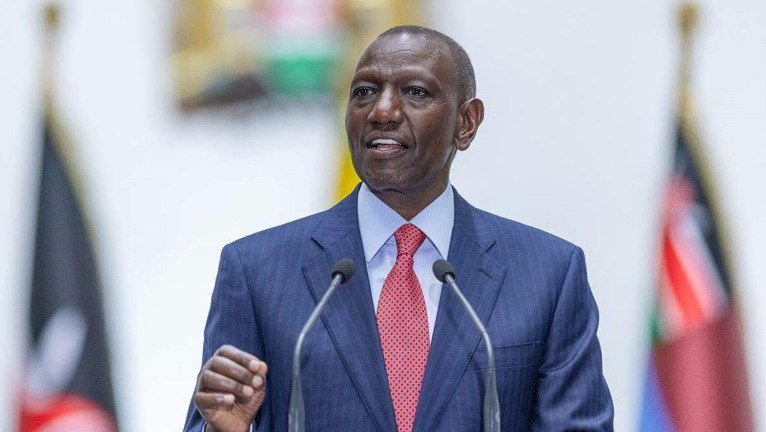
President William Ruto on Thursday hailed his administration’s economic reforms after the Nairobi Securities Exchange (NSE) 20 Share Index climbed to 4,062 points, its highest level since 2017, in a rally that has become one of the strongest signals yet of returning investor confidence in Kenya’s economy.
The benchmark index has staged a dramatic recovery from the lows recorded in 2023, with market analysts describing the rebound as a classic “hockey-stick recovery” under the Kenya Kwanza administration’s Bottom-Up Economic Transformation Agenda (BETA).
Addressing the nation from State House during a speech on Kenya’s development vision beyond Vision 2030, President Ruto said the difficult early phase of his presidency was focused on stabilising the economy and rebuilding confidence before growth dividends could emerge.
“Four years ago, our priority as a nation was not to imagine Kenya’s next chapter. It was to survive global economic turbulence, restore stability, rebuild confidence, and place our economy back on a firm foundation,” Ruto said.
He argued that the government had since restored macroeconomic stability, stabilised the shilling, rebuilt foreign exchange reserves to more than US$15 billion, reduced inflation and lowered borrowing costs.
“Investor confidence has returned. Last year, Kenya attracted a record US$3.2 billion in foreign direct investment, more than double the amount recorded in 2022,” he said.
The president linked the market rally to improving economic fundamentals rather than short-term political sentiment, saying reforms undertaken since 2022 were beginning to bear fruit.
The surge in equities came as investors responded positively to easing inflationary pressures, relative currency stability, declining domestic interest rates and renewed foreign participation in the stock market.
Analysts said the NSE’s performance suggests investors are increasingly pricing in stronger economic growth, improved corporate earnings and a more predictable policy environment.
“Markets do not rise because of speeches alone. They rise when investors begin to believe that future conditions will be better than current conditions,” said a Nairobi-based investment analyst. “The rally reflects growing confidence that the economy is moving from stabilisation into recovery.”
The president also pointed to international competitiveness indicators to support his argument that confidence in Kenya was improving.
“The 2025 IMD World Competitiveness Ranking placed Kenya as the most competitive economy in Africa, reflecting the confidence our reforms have restored,” he said.
Ruto used the address to announce the start of a national conversation on a new development vision beyond Vision 2030, arguing that Kenya had reached a historic turning point after years of economic adjustment.
“Because we have restored stability, rebuilt investor confidence, and laid a firm foundation for our economy, now is the perfect opportunity for Kenya to begin shaping the next phase of our national development,” he said.
In a candid assessment of Kenya’s economic history, the president acknowledged that the country had failed to fully benefit from previous global waves of industrialisation that transformed economies such as South Korea, China and Vietnam.
“In 1965, Kenya and South Korea each had a GDP per capita of approximately US$110. Today, South Korea’s exceeds US$36,000 compared to ours of US$2,400,” he said, arguing that Kenya must seize what he called a once-in-a-generation opportunity to participate in the next wave of global growth centred on Africa.
Ruto said Kenya had positioned itself to become one of the countries that would define Africa’s economic rise, citing the continent’s youthful population, expanding consumer markets, renewable energy potential and growing investor interest.
He further defended the government’s long-term economic strategy, saying prosperity would be sustained through institutions designed to outlive political administrations.
The president highlighted the creation of the National Infrastructure Fund and the Sovereign Wealth Fund, saying the two institutions were intended to finance transformation projects sustainably and preserve wealth for future generations.
“Lasting prosperity is built through institutions that outlive governments, inspire long-term investment, safeguard intergenerational wealth, and provide confidence in our economy,” he said.
Despite the stock market rally, economists cautioned that investors would now be watching for evidence that the financial recovery is translating into broader economic gains such as faster growth, job creation and stronger corporate profitability.
“If this is the first half of the recovery, the second half will be judged by whether ordinary Kenyans see more jobs, higher incomes and stronger business activity,” the analyst said.
The NSE has been one of the standout performers in the region over the past year, with banking, telecommunications and industrial stocks leading the recovery.
By Thursday evening, market participants said the renewed optimism had been reinforced by the President’s insistence that future economic policy would remain anchored on stability, institutional reform and long-term development planning.
“We have secured the foundations of our democracy. Let us now secure the foundations of our prosperity,” Ruto said, adding that the next phase of Kenya’s development must be guided by a shared national vision that endures beyond election cycles.
Read: NSE Signs MOU with Global Digital Assets Firm to Drive Financial Innovation
>>> NSE Remains Resilient Against Continued Foreign Investor Exits










Leave a comment