

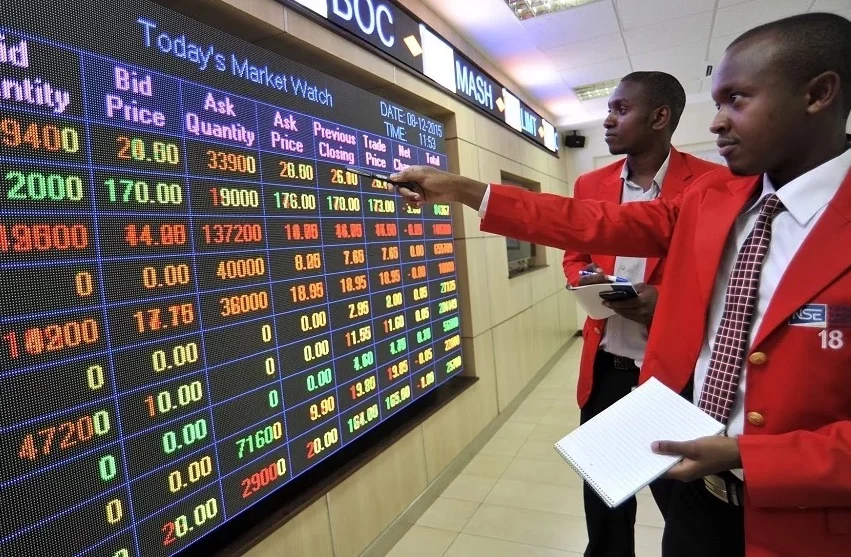
NSE (Nairobi Securities Exchange) has received a major image boost after the National Treasury Cabinet Secretary announced an exemption of Foreign Investors from obtaining Kenya Revenue Authority PIN (Personal Identification Numbers) before opening Central Depository and Settlement Corporation (CDSC) accounts. This was made while CS Mbadi was presenting the 2026/27 budget before parliament on 11th June 2026
“In order to improve the attractiveness of Kenya’s capital markets to foreign portfolio investors, the Finance Bill proposes to exempt foreign investors from the requirement to obtain KRA PIN solely for purposes of opening Central Depository and Settlement Corporation accounts. Mr. Speaker, income earned by non-resident investors from investments in the NSE is subject to withholding tax as a final tax and they are not required to file annual income tax returns,” said Treasury CS John Mbadi while reading the 2026/27 budget statement.
The Government continues to implement measures to deepen and broaden capital markets in order to mobilize savings for productive long-term investment. These efforts have continued to yield results, with the Nairobi Securities Exchange recording exceptional performance in 2025.
The NSE recently witnessed the Initial Public Offering (IPO) by Kenya Pipeline Company and its subsequent listing in March 2026 after a long drought at the bourse.
Several firms have also come to the NSE to raise Capital including I&M Bank, Kenya Mortgage Refinance Company(KMRC), the KSh 44.8 billion Sharia-compliant Linzi Bond for infrastructure financing; the Safaricom’s KSh 20 billion Green Bond to support 5G expansion; the East African Breweries PLC KSh 16.8 billion Medium-Term Note Programme, and the KSh 3.4 billion by Spearhead Africa Infrastructure Fund to support long term infrastructure financing across the region.
In another positive for the NSE, market access has now advanced significantly for retail investors with the launch of the Ziidi Trading Application integrated into the Safaricom M-Pesa platform.
“This ground-breaking platform enables Kenyans to conveniently buy and sell securities through their mobile phones, marking a major milestone in financial inclusion and retail investor participation,” CS Mbadi told parliament while presenting the 2026/27 budget.
He said that while activity at the NSE has been impressive over the past one year, global uncertainties brought by the Middle East War has slowed down market activity, still largely controlled by foreign investors.
NSE Performance between May 2025 and May 2026
The NSE 20 Share Index rose by 59.9 percent to 3,491 points in May 2026, up from 2,183 points in May 2025, while market capitalization expanded by 61.6 percent to KSh 3,412 billion from KSh 2,111 billion over the same period.
“However, between February and May 2026, the NSE 20 Share Index declined by 5.5 percent, as investors became cautious of the rising global uncertainty associated with the conflict in the Middle East,” said CS Mbadi.
According to the NSE 2025-2029 Strategic plan, foreign investors have dominated the trading activity on the NSE over the last decade, particularly in high-cap stocks such as Safaricom, Equity Bank, and East African Breweries Ltd (EABL).
However, foreign investment has been highly volatile. For example, in 2023, the NSE saw significant foreign outflows, particularly due to a weakened shilling and a flight to safety by global investors, resulting in a net foreign outflow of KSh 18.6 billion.
This trend was exacerbated by global economic uncertainties and rising yields in safer markets, like the U.S. In contrast, local retail investor participation has been minimal, which has left the market vulnerable to foreign capital flight during periods of volatility.















Leave a comment