

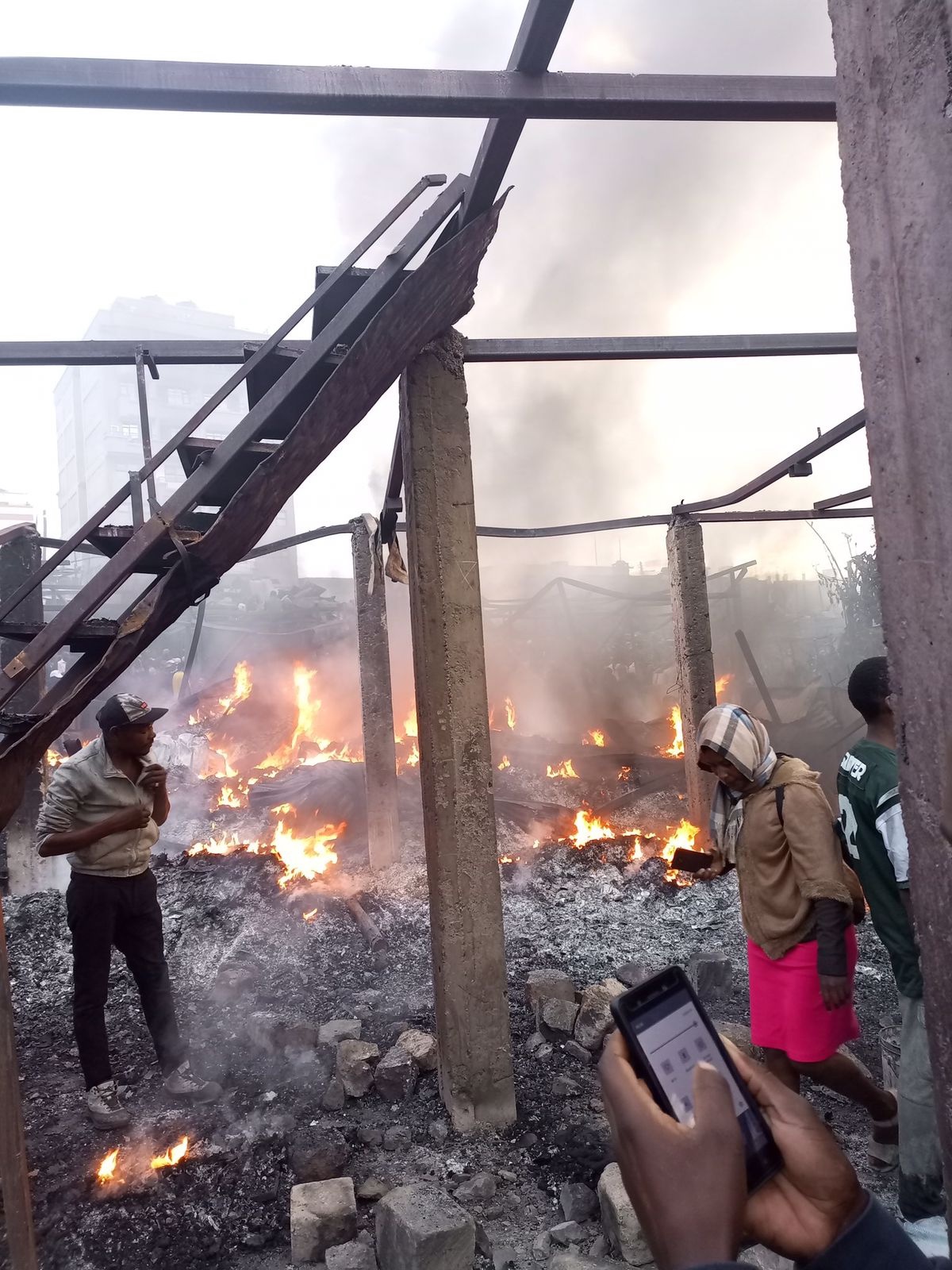
When a predawn fire swept through Nairobi’s Toi Market mid-March 2026, hundreds of small businesses lost their premises and stock within hours. The incident added to a growing list of disasters that have exposed the vulnerability many informal and small traders continue to face. Gikomba Market has suffered repeated fires over the past decade, while the 2024 Embakasi gas explosion disrupted both businesses and surrounding residential communities. A single catastrophe can bring economic activity across an entire area to a halt.
In the aftermath, businesses that depend on daily turnover often remain closed for extended periods as investigations and safety reviews continue. Without adequate business interruption protection, many traders are forced to rely on personal savings or loans to restart, deepening their financial pressure when recovery is already uncertain.
For many traders, the greatest anxiety begins after the immediate danger has passed and they now have to deal with replacing lost income and holding on to customers who may already have found alternatives. Restarting becomes especially difficult without the working capital that daily trade normally provides. These experiences reflect the reality that the greatest threat after a disaster is often not the physical damage but the business interruption that follows.
This is the real dimension of business interruption because disruption rarely arrives with warning. And when it does, the financial consequences extend well beyond physical loss. Revenue stops immediately but expenses are sustained. Rent obligations continue, salaries remain due, loans must still be serviced and suppliers still expect settlement. This means that even a short pause in operations can create long-term financial strain, particularly for businesses operating on tight margins. Increasingly, and with business-interrupting events becoming fairly common, forward-looking enterprises are now eyeing insurance to protect their balance sheets and income statements.
> A Blueprint For SMEs to Sail Through Economic Turbulence
Business interruption insurance, if properly structured, can help cover lost profit and take care of the additional costs required to resume operations quickly. It can allow a cottage manufacturer to retain skilled workers during a shutdown or a retailer to maintain supplier relationships while rebuilding. In this sense, it protects both what a business owns and what it is capable of earning.
This broader view of protection is reflected in how MUA Insurance Kenya approaches its role in strengthening business resilience through risk management. Our approach is informed by the heritage and financial strength of the MUA Group, which brings more than 125 years of insurance experience and a presence across Kenya, Tanzania, Uganda, Rwanda and the Indian Ocean region.
This group depth enables us to combine strong local underwriting with international reinsurance support, giving our clients the assurance that their protection is backed by substantial financial capacity. Equally important is the technical knowledge that comes from membership in the Globus network, which operates across 47 markets. Our shared expertise in risk assessment and business continuity planning allows us to help clients think more holistically about disruption.
It is this perspective that makes recent events such as the Toi Market fire important reminders that the true cost of disruption often lies in lost time. Buildings can be reconstructed and inventory replaced, but market position and customer trust are far harder to rebuild when a business is forced into prolonged inactivity. At MUA Insurance Kenya, our commitment is to ensure that when interruption occurs, recovery is supported by experience and capital strength.
The writer is the Claims & Legal Manager and Company Secretary at MUA Insurance (Kenya) Ltd
> How Access to Finance in Changing Lives in Africa














Leave a comment