


Kenya’s financial markets and key economic indicators remained steady in the week ending February 26, 2026, according to the latest update from the Central Bank of Kenya (CBK).
In its latest bulletin, the regulator said inflation is contained, the shilling is stable, and investor appetite for government securities remains strong.
Inflation edged down in February, with the overall rate settling at 4.3 per cent compared to 4.4 per cent in January. The figure remains within the CBK’s preferred range. Core inflation, which removes food and fuel prices, dropped slightly to 2.1 per cent from 2.2 per cent, mainly due to lower processed food costs. Non-core inflation also eased to 10.1 per cent from 10.3 per cent, largely on account of falling energy prices.
Latest data from the Kenya National Bureau of Statistics (KNBS) shows that the slowdown in inflation was supported by reduced prices of items such as sugar, electricity and fuel, although some food products recorded increases during the month.
The shilling continued to trade in a narrow band against the US dollar and other major currencies. By February 26, it was exchanging at Ksh 129.02 per dollar, the same level recorded a week earlier.
“The Kenya Shilling remained stable against major international and regional currencies during the week ending February 26, 2026. It exchanged at Ksh129.02 per U.S. dollar on February 26, unchanged from February 19,” the CBK said in its bulletin.
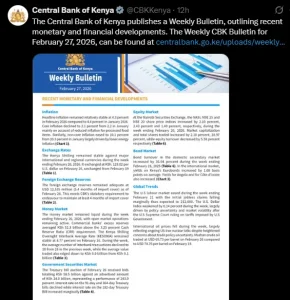
Foreign exchange reserves rose to Ksh 1.617 trillion, equivalent to 5.4 months of import cover. This remains well above the four-month statutory threshold and provides a cushion against external shocks, including volatility in global markets.
Liquidity in the banking sector remained adequate. Commercial banks held excess reserves averaging Ksh 52.3 billion above the 3.25 per cent Cash Reserve Ratio requirement. The Kenya Shilling Overnight Interbank Average Rate stood at 8.77 per cent during the week, even as interbank trading volumes declined slightly.
Demand for short-term government debt remained high. At the February 26 Treasury bill auction, investors submitted bids worth Ksh 58.5 billion against an offer of Ksh 24 billion, representing a 243.9 per cent oversubscription. Yields on the 91-day bill fell to 7.580 per cent while the 364-day bill dropped to 8.789 per cent, reflecting expectations of continued accommodative monetary policy following the recent Central Bank Rate cut. The 182-day paper recorded a slight increase.
On the equities market, the Nairobi Securities Exchange All Share Index gained 2.1 per cent over the week, supported by buying in select counters.
Treasury bonds continue to account for the bulk of domestic debt at about 83 per cent, with financial institutions holding the largest share of government securities.
The CBK says the latest trends show a stable macroeconomic environment, supported by manageable inflation, a firm exchange rate, strong reserves and sustained investor confidence in government paper.












Leave a comment