

The opposition is gearing closer to the unity but even as its principals signed an agreement to work together this week, one of the coalition’s most prominent figures was pursuing his own political agenda.
The United Alternative Government principals met at Windsor Hotel in Kiambu County on August 24 and signed a Personal Unity Pledge and a Coalition Unity Agreement. The agreement commits them to remain united, participate in a credible process to select one presidential candidate and support whoever eventually emerges as the coalition’s flag bearer.
The Windsor agreement appears to be an attempt to address that problem before the 2027 contest enters its decisive phase and the message is clear: individual ambitions and party interests should eventually give way to one common presidential candidate.
Although Rigathi Gachagua was conspicuously absent from the Windsor meeting, the Democratic Party for Citizens deputy leader Cleophas Malala attended and signed on his behalf. Malala’s presence was significant because it kept Gachagua within the arrangement even as he stayed away from the actual signing.
However, while Kalonzo Musyoka, Martha Karua, Fred Matiang’i, Eugene Wamalwa, Justin Muturi and other principals were putting their names to an agreement that seeks to subordinate individual ambitions to a collective decision, Gachagua was concluding his own political consultations in Nyeri.
This raises the question whether his absence was simply a matter of political scheduling, or an indication that Gachagua wants to remain part of the opposition unity effort without surrendering his own claim to lead it
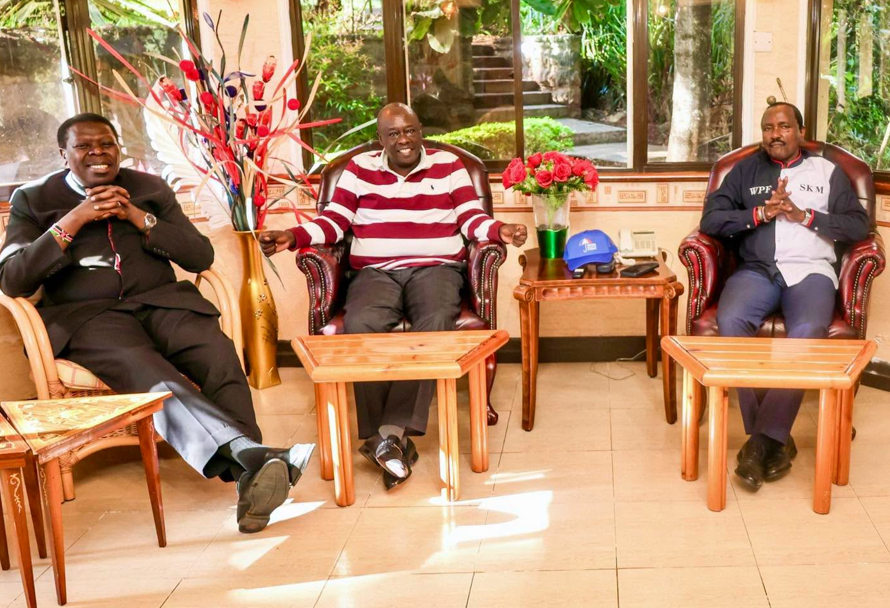
Notably, on August 25, Gachagua met Kalonzo Musyoka and Eugene Wamalwa in Nairobi. The meeting came barely a day after the Windsor agreement and was presented as part of continuing consultations aimed at strengthening opposition unity. Kalonzo described it as “unity of purpose”, while Wamalwa said “Umoja ni Nguvu!”
The meeting therefore appeared to calm, but it also raised another question: what kind of unity does Gachagua envisage? Gachagua has not hidden his presidential ambition, but the timing of his renewed quest for presidency is notable.
As he concluded his 55-day grassroots consultations, he said he had received strong support for his bid and portrayed himself as the candidate best placed to challenge President William Ruto. He cited his experience, energy and national political network as part of his case.
There is nothing unusual about this since the rest of the 2027 presidential hopefuls have each drummed support for themselves. Kalonzo has his own long-running presidential claim.
Karua has repeatedly made clear that she is interested in the top seat. Matiang’i is building a national political network. Others in the opposition are also positioning themselves for the moment when the coalition eventually has to decide.
The Coalition Unity Agreement commits the principals to a credible and agreed process for selecting the presidential candidate and to support whoever emerges favourite. They have also pledged not to undermine the eventual nominee or sponsor rival bids.
Gachagua can therefore argue that he is the most suitable candidate. However, he cannot be both the candidate and the person who decides that he is the most suitable. This decision is supposed to be made through a due process, as per the Windsor Agreement.
If his argument is that he is the strongest candidate and he is prepared to subject that claim to a credible process, then his position is not necessarily inconsistent with the unity agreement. However, if his growing political mobilisation is intended to make his candidature inevitable before the process begins, the coalition could face its first serious test.
The 2002 experience remains the strongest reminder that unity can work. Opposition parties eventually rallied behind Mwai Kibaki and ended KANU’s long hold on power. But subsequent alliances have shown how difficult it is to sustain such arrangements when competing leaders begin calculating their individual political interests.
The current principals understand this history. Hence, the Windsor agreement is an attempt to deal with the problem early. But signing an agreement is one thing while accepting its outcome is another.
Gachagua’s absence from the signing, his meeting with Kalonzo and Wamalwa the following day and his continued assertion that he is the most suitable candidate provide an early indication of where the real contest could lie.
Read: At Wamalwa Memorial in Kitale, Echoes of Opposition Unity Dilemma
>>> Will the Opposition Overcome the Unity Jinx in 2027?










Leave a comment