

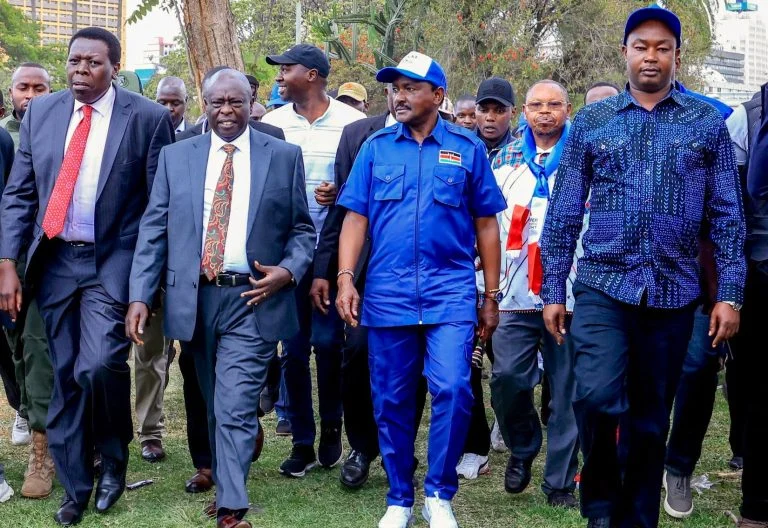
With just under two years to the 2027 General Election, questions around whether Kenya’s opposition can rally behind a single presidential candidate are already shaping public debate. A new opinion poll suggests that many Kenyans remain unconvinced that such unity will happen.
The survey by TIFA Research, released on Tuesday, December 23, 2025, shows that only 38 per cent of Kenyans believe it is very likely that opposition leaders will unite to back one candidate in a bid to defeat President William Ruto. The findings point to widespread scepticism, despite frequent public calls for opposition cooperation.
The poll reveals a divided public mood. While 27 per cent of respondents feel that opposition unity is somewhat likely, a slightly smaller share—26 per cent—believe it is not very likely. Another 9 per cent said they were unsure, highlighting uncertainty and a lack of confidence in the opposition’s current political trajectory.
TIFA said voters are paying closer attention to actions rather than statements.
“Kenyans are cautiously optimistic—but deeply divided—about the opposition’s ability to unite behind a single presidential candidate in 2027,” the research firm noted. It added that any unity claims will only be taken seriously once formal agreements are announced.
Political attitudes toward the broad-based government (BBG) also appear to influence expectations. Among respondents who oppose the BBG, 45 per cent believe opposition unity is very likely.
This compares to 33 per cent among BBG supporters, suggesting that personal political leanings shape how Kenyans interpret opposition prospects.
However, TIFA cautioned that this optimism may reflect hope rather than reality. The firm observed that the differences in perception are “likely influenced by wishful thinking,” particularly among voters who are already opposed to the current administration.
The level of uncertainty was highest among respondents with no clear view on the broad-based government. In this group, only 18 per cent considered opposition unity very likely, while 38 per cent said they were unsure, signalling disengagement or confusion about the opposition’s plans.
In its concluding remarks, TIFA noted that the survey did not distinguish between pre-election unity and cooperation in the event of a second-round run-off, a scenario allowed under Kenya’s electoral system if no candidate secures more than 50 per cent of the vote.
The firm also pointed to changing dynamics within the opposition, particularly in the absence of Raila Odinga as the dominant unifying figure. According to TIFA, this could leave ODM leaders and supporters with greater freedom to choose their own political paths ahead of 2027.
The poll was conducted between November 10 and 17, 2025, involving 2,053 adult respondents across all 47 counties. The survey has a margin of error of plus or minus 2.16 per cent.
As the election season slowly takes shape, the findings suggest that opposition leaders will need more than unity talks to win public confidence—clear structures, formal coalitions and consistent messaging may prove just as important as political ambition.








Leave a comment