

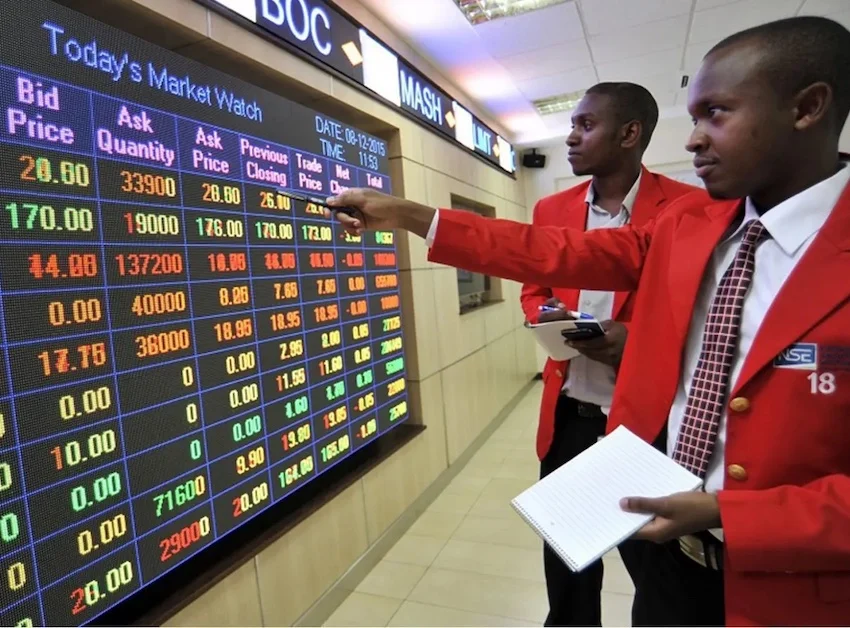
NSE (Nairobi Securities Exchange) closed the week down, with the NASI, NSE 25 and NSE 20 share price indices decreasing by 2.57%, 2.52% and 1.97% respectively, during the week ending October 15th, 2026.
Market capitalization and total shares traded also decreased by 2.57% and 25.91% respectively, while equity turnover increased by 33.42%.
According to analysts, the current weakness at the NSE reflects three key dynamics namely institutional portfolio adjustments, rising competition from US Treasury yields and risk management ahead of Q3 earnings reports.
Institutional investors at the NSE initially appeared to be liquidating short-term trading positions. The subsequent emergence of lower lows suggests that selling pressure is now extending into some medium-term positions as investors reduce risk exposure ahead of the forthcoming General Elections in Kenya.
“This is part of tactical portfolio management. Institutions are adjusting their exposure to market risk rather than necessarily abandoning equities altogether,” said CFA Dedan Maina – Wealth Consultant & Capital Markets Analyst, Ketu Capital
For NSE investors, the critical consideration is identifying where institutional demand is likely to re-emerge.
Historical price support zones provide useful reference points because they indicate levels at which demand has previously absorbed supply. These zones help assess where institutional investors may be willing to re-accumulate positions at more attractive valuations.
“The focus remains on identifying these accumulation zones and positioning accordingly, rather than chasing prices during rallies. Support levels are not guaranteed floors; sustained selling can push prices below them,” said Maina.
NSE hit by exit of foreign investors chasing higher yields in US Treasury Bills
The NSE is also affected by what is happening in the global financial markets. For instance, the recent Federal Reserve rate hike has reinforced the attractiveness of US Treasury securities.
Higher yields improve the returns available from dollar-denominated government securities, increasing their competitiveness against riskier assets, including equities in frontier markets such as the NSE.
This creates an additional hurdle for Kenya’s equity market.
Foreign investors have less incentive to assume equity risk when US government securities offer more attractive yields, particularly when local share prices have yet to correct to compelling valuations.
Consequently, the market needs more attractive entry prices to strengthen its investment case and attract fresh demand. Until valuations adequately compensate investors for the prevailing risks, foreign institutional support may remain subdued.
NSE activity remains subdued as Q3 earnings season is awaited
As the third quarter earnings reporting season approaches, price corrections are a normal part of risk management. Investors may reduce exposure ahead of announcements to limit the risk of adverse earnings surprises.
The current selling pressure at the NSE does not automatically signal deteriorating fundamentals. The NSE can recover before results are released as expectations improve, or after positive earnings reports restore investor confidence.
The distinction is between a correction driven by positioning and one justified by weakening business performance. Investment decisions must account for both price and fundamentals.
“We are leveraging market dips through moderate dollar-cost averaging (DCA), with no aggressive deployment at this stage. Smart investors should maintain liquidity of approximately 10%–30% of their portfolio value or intended capital allocation, depending on their existing exposure and investment horizon. One should not exhaust available capital during the initial stages of a correction.
The NSE may present more attractive entry points as institutional selling continues, valuations adjust and earnings expectations become clearer. Liquidity preserves one’s capacity to take advantage of those opportunities.
“We also remain alert to the possibility of another Federal Reserve rate hike before year-end. Further monetary tightening would reinforce the competition for global investment capital and could exert additional pressure on equity valuations,” said CFA Maina.
He adds that the current environment requires tactical trading, disciplined accumulation and prudent liquidity management. Investors need to leverage the dips, accumulate moderately at attractive prices, preserve liquidity and avoid aggressive deployment.















Leave a comment