

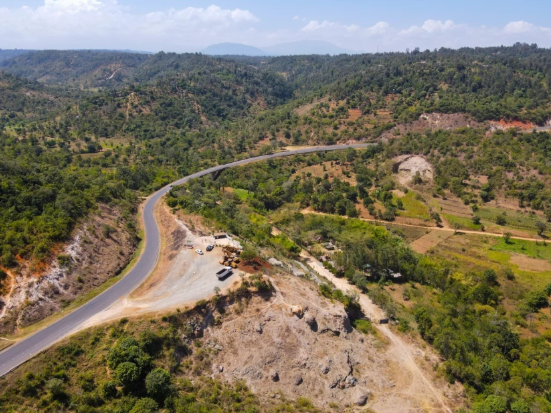
For decades, the Nithi Bridge along the Makutano–Embu–Meru Highway has been associated with fatal road accidents, dangerous bends and steep gradients that have made the crossing one of Kenya’s notorious road black spots.
Built in 1985, the bridge has undergone repairs over the years. However, the interventions did not fully address the underlying engineering challenges, leaving motorists exposed to the risks posed by the road’s sharp bends and hazardous descent into the Nithi River valley.
Now, the government is pursuing a major reconstruction project aimed at permanently addressing the danger by replacing the existing crossing with a high-level viaduct and realigned approach roads.
In a statement, Principal Secretary for Internal Security and National Administration Raymond Omollo said the project was designed to tackle the problem at its source rather than continue with temporary repairs.
The reconstruction features an 880-metre high-level viaduct rising approximately 100 metres above the Nithi River valley. It will be supported by 2.7 kilometres of realigned approach roads connecting Marima and Mitheru.
The new design is expected to eliminate the hazardous descent that has characterised the existing crossing, while introducing wider carriageways, pedestrian walkways, crash barriers and improved visibility.
These features are intended to make the route safer for motorists and pedestrians, particularly along a section of the A9 Highway that has for years presented a major challenge to road users.
A critical link for regional trade
Beyond addressing road safety concerns, the reconstruction is expected to strengthen connectivity between Nairobi and Central Kenya and the counties of Tharaka Nithi and Meru, as well as the wider Upper Eastern region.
The A9 Highway is an important transport corridor for people and businesses moving between the capital and the eastern parts of the country. Improving the Nithi crossing could ease the movement of agricultural produce, goods and passengers, while supporting trade and tourism.
For communities along the corridor, better road access can also improve links to markets and essential services.
The project therefore carries significance beyond the replacement of an ageing bridge. Its impact will depend on whether the improved infrastructure delivers safer journeys and more reliable movement along the route.
Security administration and public access
Omollo said the State Department for Internal Security and National Administration was complementing the infrastructure investment through its field officers and local administrative structures.
The department’s role includes promoting road safety awareness, facilitating community access to government services and helping ensure that improved connectivity translates into safer mobility and better access to public institutions.
The approach highlights the relationship between infrastructure development and public administration, particularly in areas where transport links determine how easily residents reach government offices and other essential services.
Moving beyond temporary repairs
The Nithi Bridge reconstruction represents an attempt to address a longstanding road safety problem through a permanent engineering intervention.
For years, repairs have offered limited relief because the dangerous gradients and bends remained part of the road’s design. The proposed viaduct and realigned approaches seek to remove those risks rather than simply restore the existing crossing.
Once completed, the new crossing is expected to transform a section of the A9 Highway that has been feared by motorists into a safer and more dependable route.
For travellers, businesses and communities in the Upper Eastern region, the ultimate test will be whether the project delivers on that promise: fewer accidents, improved connectivity and a transport corridor capable of supporting the region’s economic activity.
Read: New Ksh7.5 Billion Nithi Bridge to Boost Road Safety
>>> Chinese Firm Lands Ksh7.5 Billion Nithi Bridge Deal
















Leave a comment