

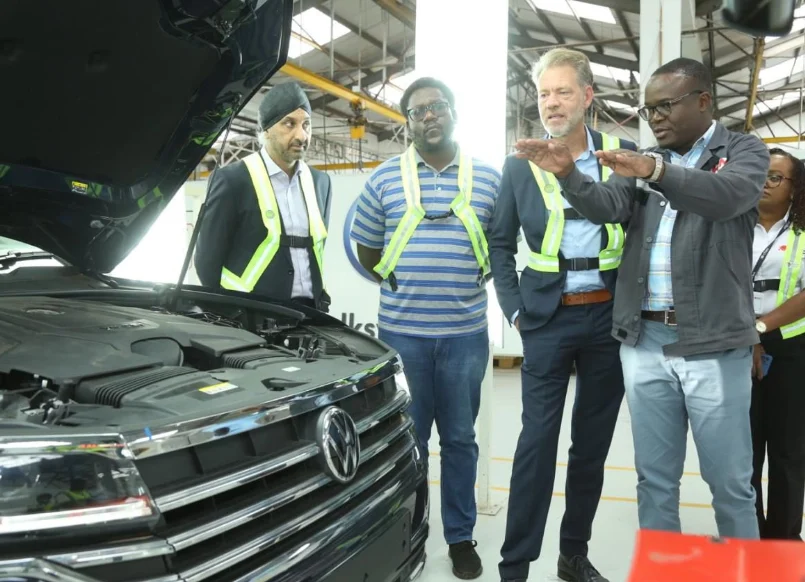
Kenya’s oldest vehicle assembler, Kenya Vehicle Manufacturers (KVM), has breathed new life into its operations with the return of Volkswagen models on its Thika assembly line.
The company is now producing the Touareg, Tiguan and T-Cross, a development that signals stronger industrial cooperation between Nairobi and Berlin.
Speaking during a tour of the plant, Germany’s Deputy Ambassador and Trade Counsellor Alexander Fierley said the renewed partnership reflects Germany’s commitment to support Kenya’s automotive ambitions.
He noted that the collaboration is designed to sharpen technical skills, encourage innovation in vehicle production and pave the way for cleaner transport solutions.
KVM, which is partly owned by CFAO Mobility Kenya, has long been at the centre of the country’s automotive story. Beyond Volkswagen, the plant turns out a variety of vehicles ranging from Mercedes-Benz trucks and Tata models to electric buses built for local operators.
Its expanded portfolio, industry observers say, is key to positioning Kenya as a serious player in regional car assembly.
Arvinder Reel, the Managing Director of CFAO Mobility Kenya, said the project is expected to generate more jobs while creating opportunities for small businesses that supply parts and services to the assembly chain.
He added that the partnership would also make new vehicles more affordable for ordinary Kenyans.
The revival of Volkswagen assembly comes at a time when the government is encouraging more manufacturers to shift to local production under its industrialisation agenda.
Analysts believe the strengthened German involvement could attract fresh investment and inject momentum into Kenya’s broader automotive sector.
Volkswagen’s return to KVM follows an earlier attempt in 2016 when the Polo Vivo was assembled in Kenya but struggled to gain traction due to limited volumes and stiff competition from used imports.
Its comeback under a broader model line-up is seen as a renewed commitment by the German automaker to tap into Kenya’s growing demand for new vehicles while anchoring the country’s role as a hub for regional distribution.








Leave a comment