

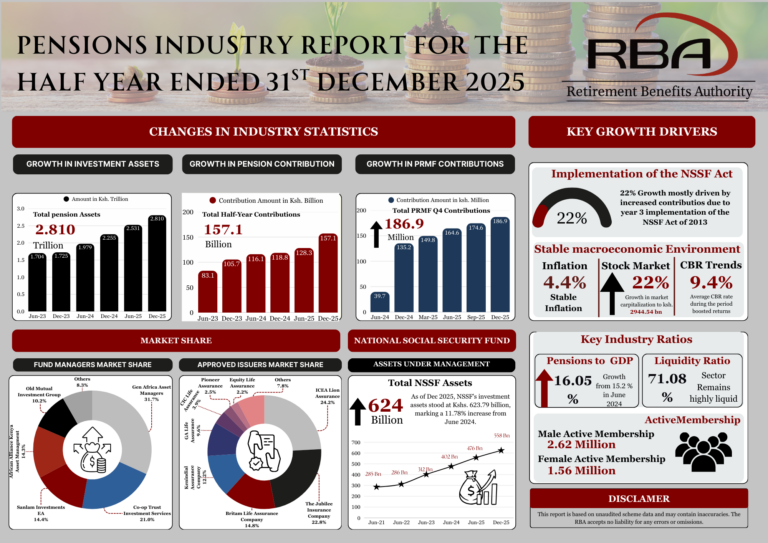
Kenya’s retirement benefits industry closed December 2025 pension assets of KSh2.81 trillion, underscoring sustained growth in contributions and investment performance. here
According to the Retirement Benefits Authority Industry Brief, Kenya’s pension assets expanded by 11.06% between June and December 2025 (from KSh2.53 trillion to KSh2.81 trillion) and by 24.57% year-on-year, representing an increase of KSh554 billion from December 2024.
This growth in Kenya’s pension assets was supported by KSh157.06 billion in new contributions and KSh122.87 billion in investment income and valuation gains over the half-year period.
Kenya’s pension industry: Key Drivers of Growth
The third year of implementing the National Social Security Fund Act significantly strengthened inflows into retirement schemes.
Contribution limits increased to a lower limit of KSh8,000 and an upper limit of KSh72,000, materially broadening the contribution base and improving long-term savings accumulation.
Investment Portfolio Structure
Kenya’s retirement benefits portfolio remains predominantly allocated to traditional asset classes, which account for over 90% of total AUM. Government Securities (52.14%) – KSh1.47 trillion continued to anchor portfolios, although growth moderated as yields declined following monetary easing.
Quoted Equities have an allocation of 11.13%, which amounted to KSh312.84 billion at the close of 2025 while Guaranteed Funds had an allocation of 18.59% or KSh522.39 billion. These funds remained attractive, particularly for smaller schemes seeking stability and capital preservation.
Pension funds invested in immovable Property was 8.57% or KSh240.96 billion
At the same time, diversification into alternative and specialised assets gained momentum. Listed corporate bonds rose sharply to KSh28.29 billion, supported by infrastructure-backed issuances.
Private equity grew by 49.23% to KSh29.93 billion, while unquoted equities nearly doubled to KSh 8.90 billion.
Commercial paper and non-listed bonds expanded significantly to KSh12.06 billion, and REITs and Shariah-compliant funds continued to attract increased allocations.
Kenya’s total half-year pension contributions reached KSh157.06 billion, reflecting a 22.42% increase from June 2025.
Contributions to Post-Retirement Medical Funds (PRMF) also increased by 13.55% to KSh186.9 million (quarterly), demonstrating growing emphasis on post-retirement healthcare security.
The National Social Security Fund (NSSF) reported net assets of Ksh623.79 billion, an 11.78% increase over six months.
Approximately 79% of its assets were allocated to government securities and listed equities. Half-year contributions stood at KSh43.48 billion, reflecting a marginal 3.05% decline largely attributable to Tier II opting-out trends.
Key Industry Indicators
Kenya’s pension industry’s liquidity ratio stood at 71.08%, indicating strong capacity to meet short- to medium-term benefit obligations.
The pension-to-GDP ratio reached 16.05%, slightly above the non-OECD average (15.2%) but below OECD levels (92.2%), signalling continued room for long-term system deepening and expansion.
Kenya’s Pension Industry Outlook for 2026
The retirement benefits sector remains well-positioned for continued growth, supported by sustained contribution momentum under NSSF reforms, macroeconomic stability, and regulatory space for greater diversification into infrastructure and alternative assets.
However, declining interest rates may compress fixed-income yields, encouraging schemes to adopt more diversified and growth-oriented strategies.
The Bigger Picture
With pension assets now exceeding KSh2.8 trillion, Kenya’s retirement benefits sector continues to play a pivotal role in long-term capital formation, infrastructure financing, capital market development, and overall economic stability.
The expanding asset base reinforces the sector’s strategic importance within Kenya’s financial ecosystem and its contribution to sustainable economic growth.
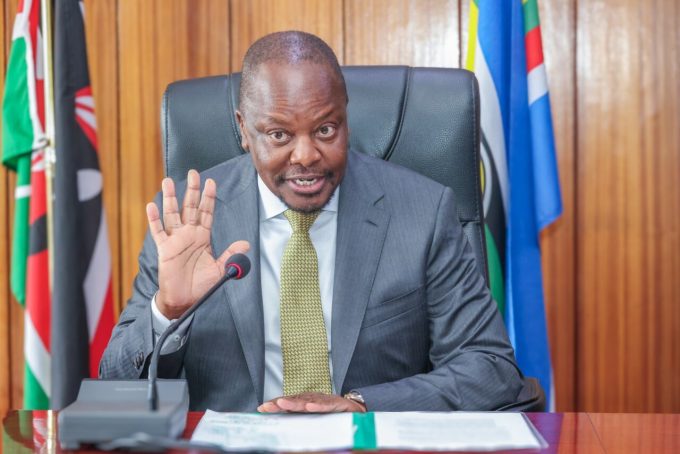
Meanwhile the Retirement Benefits Authority (RBA) is pleased to announce the appointment of Mr. Abdi Ali Mohamed as the new Chairperson of the Board of Directors. His appointment, which spans a period of three years, officially took effect on 27th February 2026.
A New Chapter in Governance
Mr. Mohamed assumes the role from Nelson Havi, whose successful tenure concluded on 10th February 2026. “The Authority extends its deepest gratitude to Mr. Havi for his strategic leadership. His time at the helm was marked by a strengthened governance framework and significant contributions to the stability and growth of Kenya’s retirement benefits sector,” said RBA CEO Charles Machira.
Mohamed is a distinguished Public Policy and Governance Specialist with over twenty-five (25) years of experience spanning public sector leadership, institutional reform, and development programming across the Horn of Africa. His career reflects deep expertise in regulatory governance, policy formulation, strategic oversight, and multi-sector stakeholder engagement in Kenya, Somalia, Ethiopia, and Sudan.
He has previously served as Vice Chairman of the Water Tribunal and as a Board Member of the Competition Authority of Kenya, where he contributed to strengthening regulatory frameworks and institutional accountability. He has also served as a Council Member at Tharaka University, providing governance oversight in higher education.
Abdi holds a Bachelor of Arts in Sociology from the University of Nairobi and a Master of Arts in Public Policy and Administration from Kenyatta University. His professional orientation is grounded in evidence-based policy making, sustainable institutional development, and the promotion of transparent and accountable governance systems.
ALSO READ: Standard Chartered Bank Kenya in C-Suite Changes After Profit Drop Alert











Leave a comment