

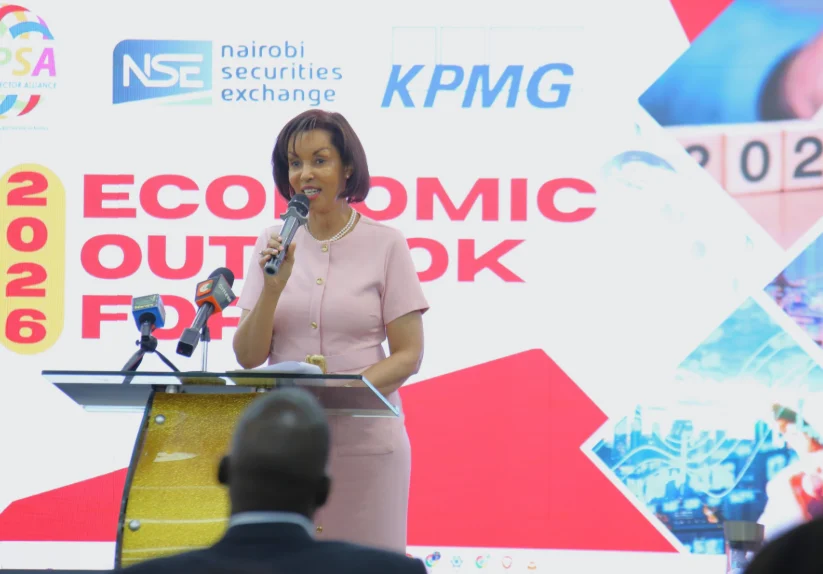
Kenya’s economy is starting to steady in 2026, with growth expected to hover near 5 per cent, Kenya Private Sector Alliance (KEPSA) says.
At the 2026 Economic Outlook Forum hosted by the KEPSA in partnership with the Nairobi Securities Exchange (NSE) and KPMG, analysts projected that GDP will grow between 4.9 per cent and 5.2 per cent, following a slower period in 2024.
The forum noted that inflation has eased to a more manageable 3–5 per cent range, while the Kenyan shilling has remained relatively stable, giving businesses a more predictable environment to plan and invest.
“Businesses are operating in a landscape marked by global uncertainty, shifting trade dynamics, and rapid technological transformation,” KEPSA Vice Chair Brenda Mbathi said.
“Yet within these challenges lie significant opportunities. The private sector remains central to unlocking inclusive growth through investment, job creation, and productivity.”
Despite the improving outlook, experts warned that Kenya remains exposed to external pressure, especially through global food and fuel prices, which can quickly push up costs for households and businesses.
Analysts also pointed to rising fiscal pressures and compliance costs, saying they could reduce domestic investment and slow the pace of expansion for companies already operating on thin margins.
The forum highlighted how global tensions, including US–China technology disputes and rare-earth export restrictions, continue to disrupt supply chains, with ripple effects reaching African markets.
“In Africa, growth is projected to rise modestly from 3.9% in 2025 to 4.1% by 2027,” Sandeep Main, Tax Partner and Head of Private Enterprise in Africa at KPMG, said, adding that businesses must prioritise strategic sourcing and stronger risk management.
NSE Chief Executive Frank Mwiti urged firms to rely more on the capital markets to raise funding for expansion, saying stronger transparency and governance will matter in attracting long-term investors.
“Capital has a memory. It remembers markets that opened when things were hard and those who chose transparency and integrity,” Mwiti said.
The forum concluded that while Kenya’s macroeconomic fundamentals are stabilising, returning to pre-pandemic growth levels of around six per cent will require agility, innovation, and a proactive response to both external shocks and domestic fiscal pressures.









Leave a comment