

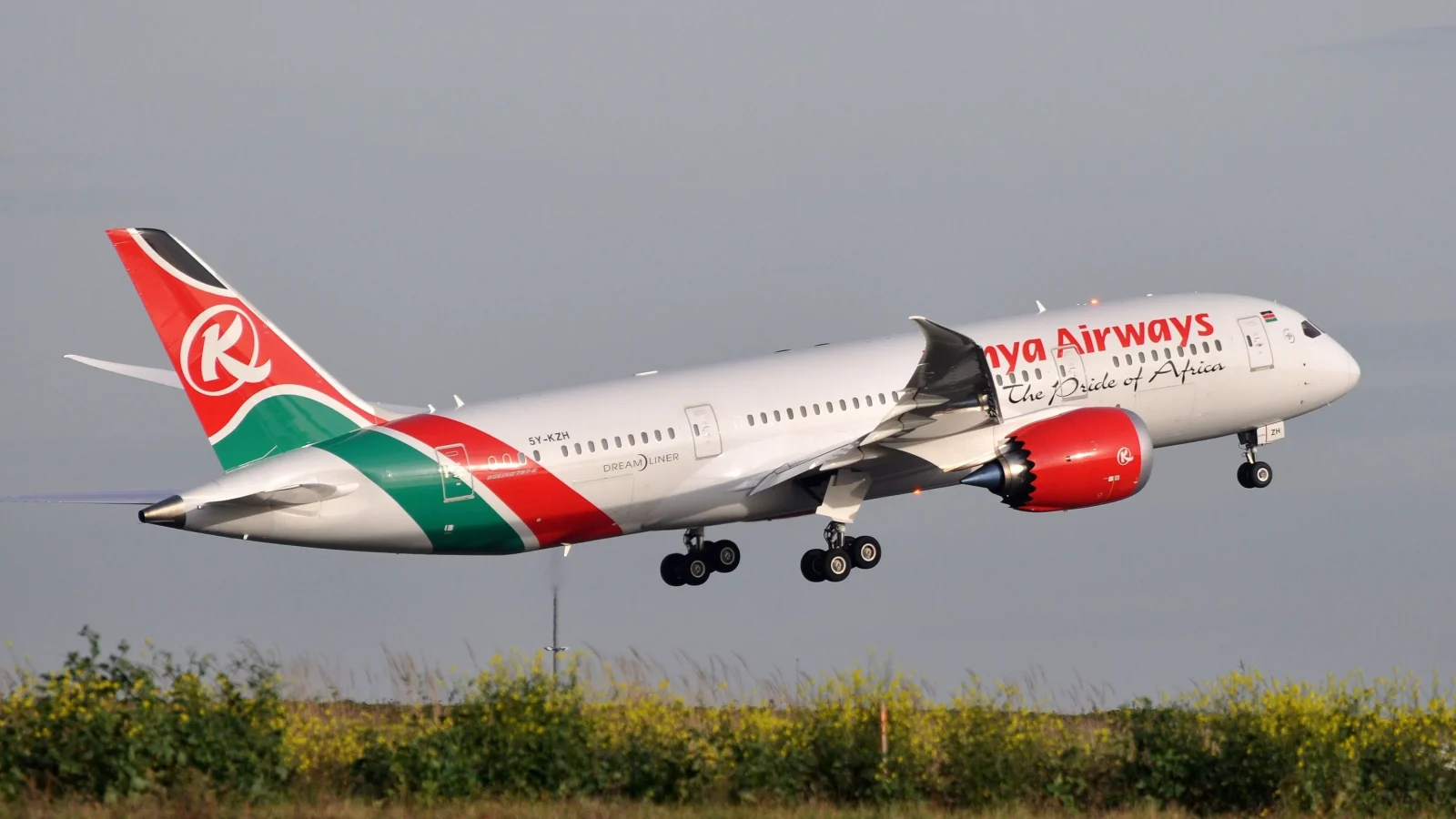
Kenya Airways is an unlikely beneficiary of the Middle East war between Israel and Iran following a surge in demand for its passenger tickets and cargo space since February by international travellers and businessmen keen to avoid the Middle East airspace.
The US-Israel assault on Iran has seen many global airlines with many raising fares, changing their flight routes or cancelling the flights over the Middle East all together.
Kenya Airways Acting CEO George Kamal told the media that demand for seats on its flights are now between 70% and almost 99% during what is usually a low season for the carrier.
In a travel alert to those flying into Middle East or from Middle East to Nairobi, Kenya Airways has published a schedule and advisories.
This unusual high demand for tickets is coming from Europe, Asia and the United States, contributing immensely to the Kenya Airways’ network.
Kenya Airways said if the Middle East war persists, it will be forced to hike ticket fares and continue to have its flights, if only to safeguard its market share against other competitors. With its jet fuel stockpile just enough to cover 50 days, this prospect now seems a reality.
Kenya Airways has also played a critical role by operating repatriation flights between Nairobi and Dubai to assist stranded passengers. The airline cancelled flights into United Arab Emirates due to airspace closure.
Kenya Airways has undergone significant C-Suite and Boardroom Changes
At the same time, Kenya Airways has been undergoing governance changes that has seen appointment of a new Board Chairman Joshua Kittony and a number of new directors joining the board.
Kenya Airways also let go into CEO Allan Kilavuka, who has now been replaced by George Kamal in an acting capacity.
Meanwhile the Middle East crisis has affected export of Kenya’s exports particularly flowers and vegetables, with authorities seeking alternative routes to Middle East markets and Europe.
Global air travel remains severely disrupted after the war in Iran forced the closure of key Middle Eastern hubs including Dubai, Doha and Abu Dhabi, stranding tens of thousands of passengers.
Below is the latest on global carrier that have cancelled flights to Middle East Cities:
AEGEAN AIRLINES
Greece’s largest carrier cancelled flights to Tel Aviv, Beirut and Amman until April 22, and to Erbil and Baghdad until May 24. Flights to Dubai were cancelled until April 19 and to Riyadh until April 18.
AIR BALTIC
Latvia’s airBaltic said all flights to Tel Aviv had been cancelled until April 5. All flights to Dubai have been cancelled until October 24.
AIR CANADA
The Canadian carrier cancelled all flights to Tel Aviv until May 2 and all flights to Dubai until March 28.
AIR EUROPA
The Spanish airline has cancelled all flights to Tel Aviv until April 10.
AIR FRANCE KLM
KLM said flights to Riyadh, Dammam and Dubai were suspended until March 28 and flights to Tel Aviv were suspended for the remainder of its winter season.
CATHAY PACIFIC
The Hong Kong airline said it had cancelled all passenger flights to and from Dubai and Riyadh, as well as cargo freighter flights to Dubai and Riyadh, until April 30.
DELTA
The U.S. carrier has cancelled flights from New York to Tel Aviv until March 31 and from Tel Aviv to New York until April 1. The restart of its Atlanta to Tel Aviv service has been delayed, with flights to Tel Aviv now paused until Aug 4 and flights from Tel Aviv paused until Aug 5.
EMIRATES
The UAE airline said it was operating a reduced flight schedule following a partial reopening of regional airspace. The airline has scheduled flights to Nairobi and is major competitor to Kenya Airways
ETIHAD AIRWAYS
The UAE carrier said it was operating a limited commercial flight schedule between Abu Dhabi and a number of key destinations.
FINNAIR
The Finnish carrier cancelled its Dubai flights until March 29 and Doha flights until April 2, continuing to avoid the airspace of Iraq, Iran, Syria and Israel.
FLYNAS
Saudi Arabian budget airline Flynas extended its suspension of flights to Dubai, Abu Dhabi, Sharjah, Doha, Bahrain, Kuwait, Iraq and Syria until March 31.
IAG
IAG-owned British Airways cancelled all flights to Abu Dhabi until later this year and all flights to Amman, Bahrain, Doha, Dubai and Tel Aviv until later in March.
INDIGO
The Indian airline suspended operations to Doha, Kuwait, Bahrain, Dammam, Fujairah, Ras Al Khaimah, Sharjah until March 28.
JAPAN AIRLINES
Japan Airlines suspended Tokyo-Doha flights scheduled from February 28 to March 31 and Doha-Tokyo flights until April 1.
LOT
The Polish airline said all flights to Dubai were cancelled until March 28 and to Tel Aviv until April 18. LOT also cancelled flights to Riyadh until March 24 and to Beirut from March 31 to April 30.
LUFTHANSA GROUP
The German airline group, which includes Lufthansa, Austrian Airlines, Swiss and Brussels Airlines as well as ITA Airways, suspended flights to Tel Aviv through April 2, and to Beirut, Dubai, Amman, Erbil, and Abu Dhabi until March 28. Flights to Tehran were suspended through April 30.
NORWEGIAN AIR
The Nordic airline plans to fly to Tel Aviv and Beirut from June 15, instead of April 1 and April 4, respectively, as it had previously planned.
PEGASUS
Pegasus Airlines had cancelled its Iran, Iraq, Amman, Beirut, Kuwait, Bahrain, Doha, Dammam, Dubai, Abu Dhabi and Sharjah flights until April 12. Flights to Riyadh were cancelled until March 23.
QATAR AIRWAYS
The carrier said its scheduled flight operations were still temporarily suspended due to the closure of Qatari airspace and that it would operate a revised limited number of flights from March 18 to March 28.
WIZZ AIR
The low-cost airline suspended flights to Israel until March 29 and to Dubai, Abu Dhabi, Amman and Jeddah from mainland European destinations until the middle of September.
ALSO READ: Kenya: How the Middle East Conflict Will Affect You












Leave a comment