

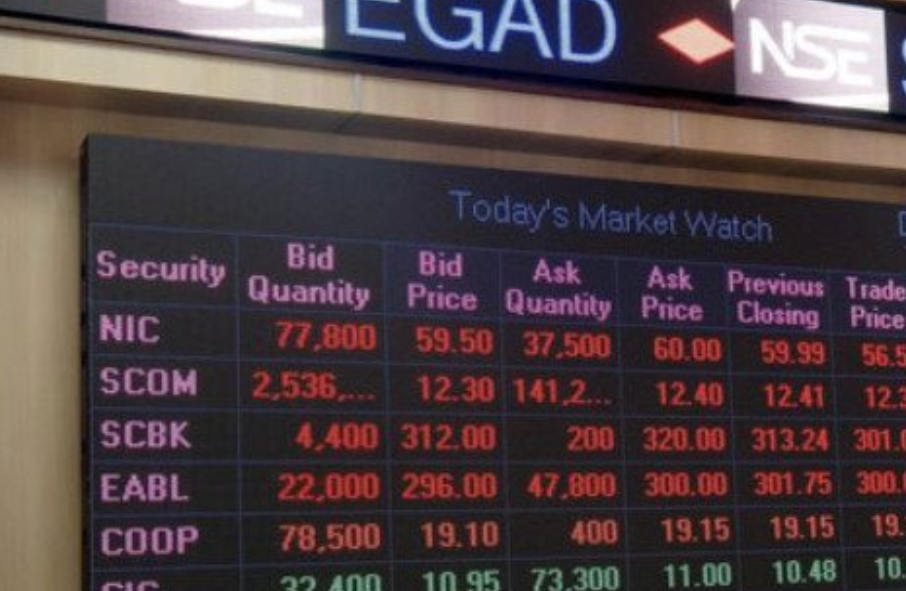
Investors at the Nairobi Securities Exchange(NSE) will soon benefit from a new way to trade at the stock exchange, including ability to make money even in a bear market when shares prices are falling.
This is as soon as FourFront Management Limited, a subsidiary of Standard Investment Bank, completes the live testing of its Securities Lending and Borrowing(SLB) Platform.
The new SLB platform, owned by FourFront in collaboration with the Central Depository & Settlement Corporation (CDSC), began a six-month pilot on 1 August 2026, enabling testing of securities lending and borrowing arrangements under the regulatory framework established by the Capital Markets Authority (CMA) and Central Depository & Settlement Corporation Limited (CDSC).
Donald Wangunyu, CEO of FourFront Management Limited and Executive Director at SIB said, “We didn’t just build another investment product. We’re helping build a new way to trade the Kenyan stock market, including the ability to profit when share prices fall. Investors will find a new way to trade, the step marking another new chapter for Kenya’s capital markets.
“Investors will now be able to make money when share prices fall, not only when they rise. It could also improve trading, liquidity and how quickly shares reflect their true value. The real test will be whether enough investors and shares are available for the system to work well,” said CFA Dedan Maina, an investment consultant at Ketu Capital.
What could go wrong here with investors?
He, however, warns that the biggest risks that investors could face include poor liquidity, manipulation or and investors taking positions they don’t fully understand.
For instance, if a heavily shorted stock suddenly rises, short sellers can be forced to buy back at much higher prices, creating a short squeeze and potentially large losses.
“For the Nairobi Securities Exchange, the bigger concern is whether the market has enough borrowable shares, strong risk controls and proper settlement systems, otherwise short selling could add volatility rather than improve price discovery,” said Maina.
He cautions that while volatility actually works well for fund managers, retail investors who might not possess knowledge on market dynamics, could face catastrophic losses.
At the NSE, some of the ideal counters that investors keen to be short sellers are those stocks that are highly liquid, widely held or have a clear valuation disconnect, weakening fundamentals as well as those counters that have enough shares available to borrow.
In this list, the first names to watch would be Safaricom, KCB, Equity, NCBA and Co-op Bank. This is because these stocks are highly liquid, making them more practical candidates for an SLB market.
Safaricom in particular is by far the most actively traded counter; trading upwards of 3 million shares on a normal trading day.
What is short selling?
Short selling is betting that a share price will fall. It is different from the normal trading where investors buy low, and sell high. Short selling is simply Sell high first, buy low later.
How it works on NSE:
An investor can borrow shares, say 1,000 KenGen shares from a broker at KSh 12.55 and immediately sell them and pocket KSh 12,550 cash.
This short seller then waits fort KenGen share price to drop – say KenGen share price falls to KSh 10.00 after announcing its financial results. The investor then engages in buy-back – buy 1,000 shares at 10.00 at a cost of KSh 10,000. The short seller then returns the 1,000 shares to the lender(stockbroker) after paying a small fee. The difference is Ksh12,550 minus KSh10,000 and the KSh 2,500 difference is the profit.
The risk is that the price of KenGen could up to KSh 13.10 instead, forcing the investor to buy back higher. The loss is unlimited. The short seller pays borrowing fees and forced to return shares early (short squeeze).
At present, the NSE allows regulated short selling but only for approved stocks via licensed brokers, with the investor and broker required to sign a securities lending agreement.
Most retail investors at the NSE have not taken up short selling and only sell if they think prices will fall.
It wasn’t driving KenGen today – today’s +14.6% weekly rally was long buying because revenue +6.4% showed core business is strong, even though PAT slipped 1.2%.
What if someone shorted KenGen last week?
Last week was brutal for short sellers of KenGen.
KenGen, whose end year financials showed a net profit dip of 1.2%, saw its share prices rise to KSh 12.55 from KSh 10.95 as the market ignored the net profit decline report. If an investor shorted KenGen on Monday at KSh 10.95 expecting the share price to dip and got KSh 10,950 for 1,000 shares.
This short seller had to buy back at KSh 12.55 leading to a loss of KSh 1,599 plus borrowing fees.
This is a classic short squeeze. Price went up, not down. If an investor shorted on Friday when the price was KSh 13.10, that short seller got KSh 13,100, covered Friday at KSh 12.55, cost KSh 12,550 and made a profit of KSh 550 minus fees.










Leave a comment