

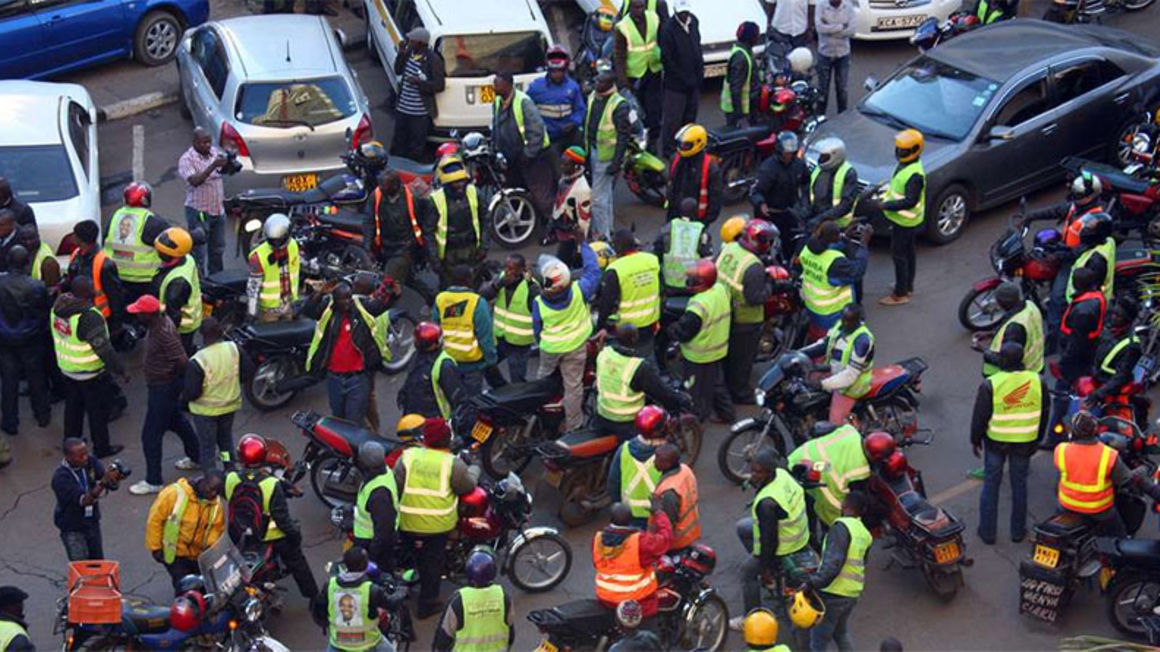
Kenya’s bodaboda sector, estimated to move millions of people daily and to employ hundreds of thousands, is at a crossroads. For years, it has been both a lifeline for affordable transport and a thorn in the side of law enforcement, frequently associated with accidents, crime, and even political violence.
Now, the government is signalling a decisive shift, one that seeks not only to regulate but also to harness the sector as an asset in the fight against insecurity.
Addressing journalists during the International Identification Day celebration and Jukwaa la Usalama forum in Homa Bay Town, Interior Cabinet Secretary Kipchumba Murkomen said the leadership of boda boda riders will be incorporated in security meetings in sub-counties.
“It is important to incorporate boda boda riders in security meetings at the sub-county level. This will enhance collaboration between riders and police to augment the fight against insecurity,” he said.
Murkomen says that police can not be left to handle security alone, especially on issues touching the boda boda sector.
“If we leave this purely to the police, the police can’t manage the sheer number of boda bodas in the country. It will be required that we reduce it to a smaller unit,” he said recently, underscoring the importance of organising riders into SACCOs and licensing them to ensure traceability.

Dr Omollo has also highlighted the role of technology in surveillance and accountability, noting that registration and digital monitoring will make it easier to identify rogue elements and curb misuse of motorcycles in crime.

Together, their statements point to a new strategy: shifting from reactive policing to a model that combines registration, organisation, technology, and incentives. The objective is to transform millions of riders into partners in community security rather than leaving them on the margins, where they are easily exploited by criminal networks or political actors.
The first pillar of this approach is formalisation. Registration through BIMS, combined with mandatory SACCO membership, would create a clear accountability chain linking each rider to an association and licence. This would make it easier to trace offenders while offering compliant riders access to benefits such as loans, insurance, and training. To succeed, however, registration must be affordable and accessible. Subsidised drives, mobile registration units, and grace periods would ensure that no rider is unfairly excluded.
The second is representation. Murkomen has called for boda boda leaders to be included in sub-county security meetings. By giving riders a seat at the table, government can convert them into stakeholders in security, opening channels for intelligence-sharing and reducing their vulnerability to political manipulation. This step would be critical in curbing the practice, repeatedly flagged by authorities, of politicians mobilising riders for partisan ends.
The third pillar is technology. Dr Omollo has stressed that surveillance and digital records are indispensable to enforcement. Simple tamper-proof registration stickers with QR codes linked to rider details, voluntary ride-logging apps, and integration of CCTV with the BIMS database could significantly improve accountability. Such measures, however, require legal safeguards to prevent abuse and to protect riders’ privacy. Transparency and oversight will be essential if the system is to gain legitimacy.
The fourth is incentives and sanctions. Riders who comply should enjoy clear benefits: access to cheaper insurance, affordable loans, and preferential permits for restricted areas like city centres. Conversely, unlicensed riders should face fair but firm penalties, such as impoundment of motorcycles or suspension of licences. Rehabilitation programmes, including retraining and community service, would allow offenders to reintegrate rather than be permanently excluded.
Finally, the strategy must invest in training and welfare. Riders who feel respected and supported are more likely to cooperate with authorities. Training programmes in road safety, conflict management, and even basic evidence preservation would not only improve public safety but also empower riders to contribute actively to security.
The benefits of this transformation are clear. Riders, who traverse every corner of Kenya’s cities and villages, could become the “eyes and ears” of law enforcement, providing invaluable intelligence on criminal activity. Formalisation would also help reduce the chaos on roads and unlock economic benefits through easier access to credit and insurance.
But risks remain. Heavy-handed bans, such as those suggested for Nairobi’s CBD, could push riders even further into informal operations, thereby undermining trust. Surveillance systems, if unchecked, could morph into tools of harassment. And without impartial enforcement, formalisation could be weaponised against political opponents.
For this vision to succeed, implementation must be gradual, inclusive, and transparent. Registration should be subsidised and phased in. Oversight mechanisms must protect privacy and rights. And above all, the state must balance regulation with recognition of the sector’s role in livelihoods.
The pronouncements by CS Murkomen and PS Omollo mark the beginning of what could be a groundbreaking partnership. If handled wisely, the bodaboda sector can evolve from being seen as a public menace into a formidable ally in securing Kenyan streets. But if mishandled, the attempt could deepen exclusion, fuel resentment, and push the sector further into illegality.
The challenge now lies in execution: to formalise without stifling, to regulate without excluding, and to secure without oppressing. Only then will Kenya’s bodaboda riders truly move from suspects to partners in building safer communities.
Read: NTSA New Rules for Boda Bodas
>>> Boda Boda to Provide First Aid During Emergencies














Leave a comment