

The Government has reaffirmed its commitment to strengthening Kenya’s food security, describing it as a critical pillar of national stability and self-reliance.
Speaking on the ongoing revitalisation of the Galana–Kulalu Irrigation Scheme, Internal Security and National Administration Principal Secretary Dr Raymond Omollo said food production is inseparable from the country’s broader security agenda.
“The Government remains firmly committed to strengthening Kenya’s food security as a core pillar of national stability and self-reliance,” Dr Omollo said.
He noted that as the State Department for Internal Security and National Administration continues to enhance the country’s security infrastructure, “food security is recognised as an integral component of that mandate, because a well-fed nation is a secure nation.”
Dr Omollo said it is within this context that the Galana–Kulalu Irrigation Scheme is being revitalised under a Public–Private Partnership (PPP) model.
According to the PS, the new approach is designed to “leverage modern agricultural technologies to safeguard livelihoods, reduce vulnerability and ensure sustainable food production.”
Galana–Kulalu, located along the Tana River basin in Kilifi and Tana River counties, is one of Kenya’s flagship irrigation projects and has in the past been repositioned as a key driver of large-scale food production and import substitution.
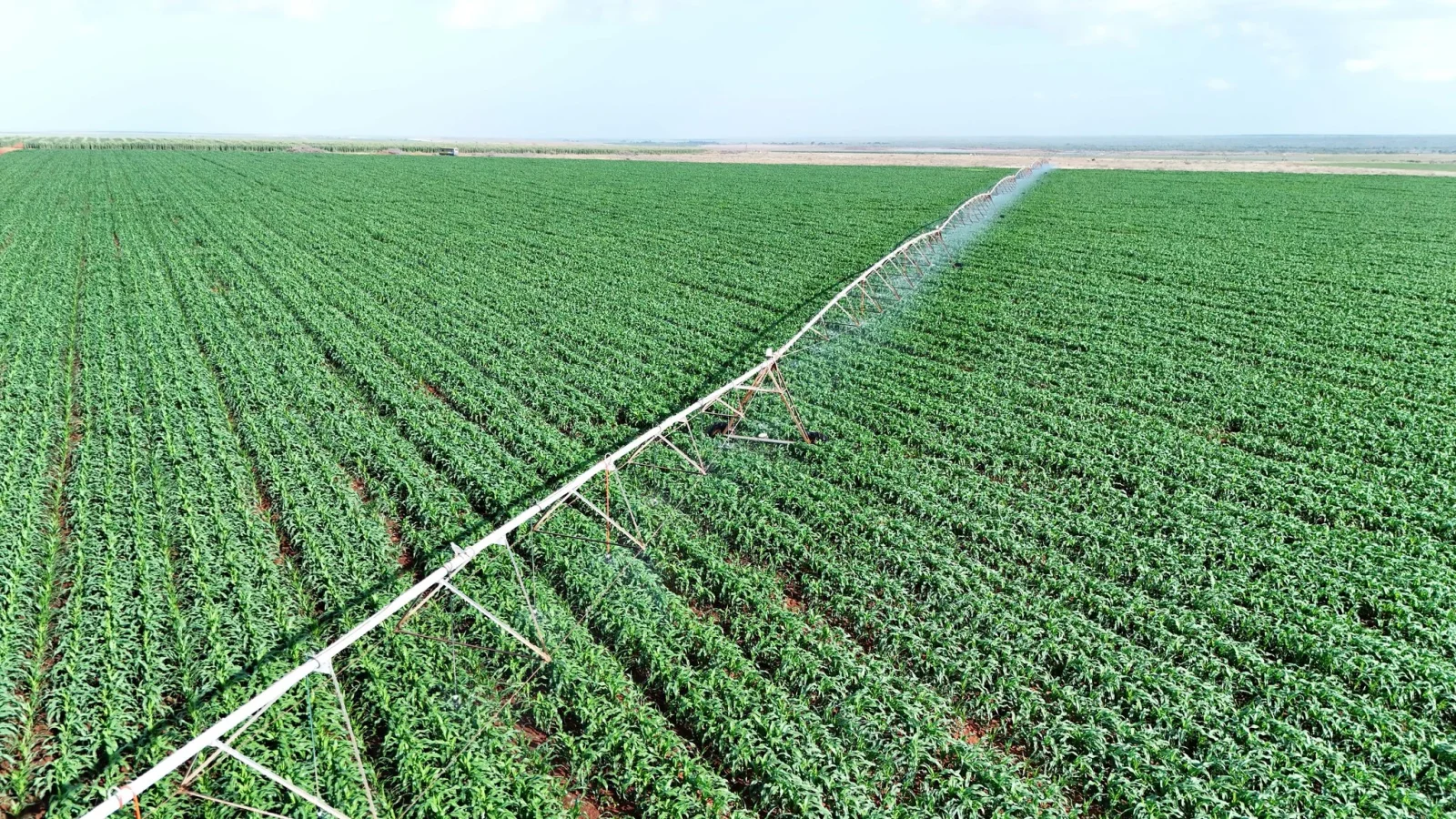
At the centre of the project’s revival is the use of advanced fertigation technology. Dr Omollo explained that fertigation involves “the application of water-soluble fertilizers through irrigation systems,” a process being implemented using modern centre pivot irrigation technology to maximise efficiency and yields.
“Currently, nine pivot systems are operational, with plans to increase to 23 pivots to initially cover 3,000 acres,” he said.
The PS added that the system supports the cultivation of key staple and commercial crops critical to national food supply.
“The system supports the cultivation of key staple and commercial crops, including maize, onions and cassava,” Dr Omollo noted, underscoring the project’s role in stabilising food availability while also supporting farmer incomes and agro-based value chains.
Expansion of the scheme is already underway, with Dr Omollo saying progress is moving at pace.
“Expansion is progressing rapidly, with acreage expected to reach 6,400 by June 2026 and scale up to 20,000 acres in the initial phase,” he said.
Through the adoption of “high-efficiency, technology-driven farming methods,” the Government projects that the scheme will significantly cut the country’s dependence on imported food.
“The project aims to reduce Kenya’s reliance on food imports by up to 40%, reinforcing national food sovereignty while contributing to long-term economic and security objectives,” Dr Omollo said.
He emphasized that strengthening domestic food production not only protects livelihoods but also reduces exposure to external shocks, positioning food security as a strategic national security priority alongside traditional safety and stability measures.
Read: Galana Energies Installs High-Flow Rate Fuel Dispensers to Enhance Efficiency
>>> Unmasking New Company Running Multi-Billion Galana Kulalu Food Project














Leave a comment