


The Central Bank of Kenya (CBK) has warned that rising global oil prices, driven by escalating conflict in the Middle East, are increasing pressure on the global economy and raising fresh concerns about inflation.
In its Weekly Bulletin released, CBK said international oil markets experienced sharp volatility during the week as geopolitical tensions intensified in the Gulf region.
“International oil prices remained volatile during the week with Murban crude oil trading at Ksh 11,896 per barrel on March 12, compared to USD 76.25 per barrel on March 5,” the bulletin read
The price of Murban crude rose from Ksh 9,859 per barrel a week earlier, reflecting growing fears that the ongoing conflict could disrupt oil production and transport routes across the Middle East.
The latest tensions involve hostilities linked to Iran, Israel, and the United States, with several incidents reported across the Gulf region in recent weeks. Security concerns have increased around the Strait of Hormuz, a vital global shipping corridor through which a significant portion of the world’s crude oil exports pass.
The strait, located between Iran and Oman, is considered one of the most strategically important oil transit routes in the world. Any disruption to traffic in the area can quickly trigger spikes in global oil prices.
Recent attacks targeting ships and energy infrastructure in the Gulf have heightened fears among traders that supply chains could be affected if the situation escalates further. Some oil tankers have reportedly altered their routes or delayed shipments due to security concerns.
The CBK noted that the uncertainty in energy markets is already feeding into wider economic risks.
“Inflation concerns persisted during the week, driven by volatility in international oil prices arising from the ongoing conflict in the Middle East,” the central bank said.
CBK on inflation globally
Despite the geopolitical tension, inflation data from the United States remained steady. Headline inflation held at 2.4 per cent in February, while core inflation stood at 2.5 per cent.
The U.S. Dollar Index rose by 0.4 per cent during the week as investors moved funds into safer assets amid the uncertainty caused by the conflict.
For Kenya, higher global oil prices could eventually translate into increased import costs and pressure on domestic fuel prices. Because the country relies heavily on imported petroleum products, fluctuations in global energy markets often affect transport costs, electricity prices and the overall cost of living.
However, the Kenyan shilling remained relatively stable during the week despite the global volatility.
“The Kenya Shilling remained relatively stable against major international and regional currencies during the week ending March 12, 2026. It exchanged at Ksh 129.30 per U.S. dollar on March 12, compared to Ksh 129.20 on March 5,” CBK stated.
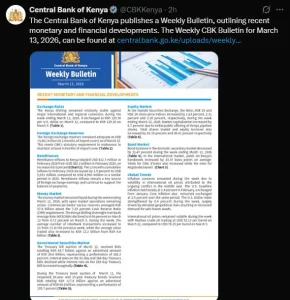
During the week, the currency traded within a narrow range between Ksh129.23 and Ksh129.30 against the dollar.
Kenya’s foreign exchange reserves also remained steady at about Ksh 1.87 trillion, which is equivalent to around 6.2 months of import cover, offering some protection against external economic shocks.
Meanwhile, Kenya’s stock market recorded positive performance during the week despite the global uncertainty. At the Nairobi Securities Exchange, the NASI, NSE 25 and NSE 20 indices all registered gains, while market capitalisation rose by 6.7 per cent.
The increase was partly supported by strong investor activity and developments around the Kenya Pipeline Company IPO. Equity turnover rose sharply during the week, signalling increased trading on the market.
Bond market activity, however, slowed, with bond trading declining by 11.47 per cent. Yields on Kenya’s Eurobonds rose as investors reacted to rising global yields and heightened geopolitical risks.
The developments in the Middle East continue to highlight how quickly global energy markets can react to geopolitical tensions. For countries that rely on imported oil, prolonged instability in the region could push fuel prices higher and place additional strain on economic growth and household spending.














Leave a comment