

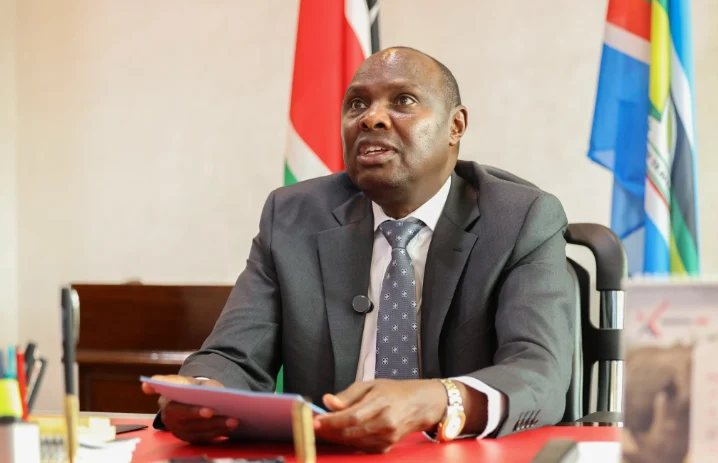
Fresh details have emerged of a high-level crisis meeting convened under the National Security Council Committee (NSCC), revealing the turning point behind recent policy decisions in Kenya’s petroleum sector.
Documents quoted by the Daily Nation show that the March 9, 2026 meeting, chaired by Chief of Staff and Head of Public Service Felix Koskei at the Office of the President, directed the State Department of Petroleum to explore alternative fuel sources outside the existing government-to-government supply framework.
In a communication following the NSCC meeting, Mr Koskei warned of far-reaching consequences for Kenya stemming from instability in the Middle East.
“Given the Middle East’s central role in global energy supply, international trade routes, and security dynamics, prolonged instability may affect Kenya through volatility in global oil prices and disruptions in maritime trade,” states Mr Koskei in the letter.
The NSCC instructed former Principal Secretary in the State Department for Petroleum Mohamed Liban “to explore and implement strategies to diversify petroleum import sources beyond a single region, reducing regional dependency and enhancing national energy security.”
The correspondence was copied to top security officials, including Noordin Haji, Chief of Defence Forces Charles Kariri, Inspector General of Police Douglas Kanja, and several Principal Secretaries, among them Patrick Mariru, Raymond Omollo and Korir Sing’oei.
The directive came just weeks after tensions involving the United States, Israel and Iran escalated into a broader conflict, raising fears of global energy supply disruptions.
“It is presumed that it is on the basis of these instructions” that Principal Secretary Mohamed Liban later wrote to the Kenya Bureau of Standards (Kebs) on March 26 seeking a temporary waiver on standard procedures to allow the importation of petroleum products originally destined for other markets.
In his letter to Kebs Managing Director Esther Ngari, Mr Liban stated:
“As you are aware, the ongoing conflict in the Gulf Region has affected marine traffic flow, especially those that have to pass through the Strait of Hormuz. The International Oil Companies (IOCs)/Suppliers under the Government-to-Government arrangement through their local counterparts i.e nominated Oil Marketing Companies (OMCs) must actively source for refined products to meet the delivery schedule to ensure security of supply.”
The Strait of Hormuz is a critical chokepoint for global oil shipments, handling roughly a fifth of the world’s petroleum trade. Any disruption along the route often triggers supply shortages and price volatility worldwide.
Kenya’s Fuel Supply System
Kenya relies heavily on imported refined petroleum products, with most supplies historically sourced through the Middle East under government-to-government agreements introduced in 2023. The arrangement was designed to stabilize fuel prices and shield the country from global market volatility by locking in supply deals with major oil producers.
However, the system has also made Kenya vulnerable to geopolitical shocks in the Gulf region. Disruptions in shipping lanes, particularly through the Strait of Hormuz, can delay deliveries and strain domestic supply chains.
Industry experts note that global oil markets are highly sensitive to conflict in the Middle East. Even temporary disruptions can lead to price spikes, increased freight costs, and supply uncertainty for import-dependent countries like Kenya.
Fuel Concerns
The March 9 NSCC directive appears to have set off a chain of events that reshaped Kenya’s fuel import strategy, including efforts to source petroleum from alternative markets under relaxed regulatory conditions.
What followed was a major oil import scandal that hit Kenya in April 2026, involving allegations of Ksh12 billion in fraudulent, substandard fuel importation, leading to high-level arrests, resignations, and the halting of fuel shipments at Mombasa.
Following the developments, Mohamed Liban resigned as Principal Secretary in the State Department for Petroleum, Joe Sang stepped down as Managing Director of Kenya Pipeline Company PLC and Daniel Kiptoo Bargoria resigned as Director General of the Energy and Petroleum Regulatory Authority.
Further administrative action has been initiated against Joseph Wafula, while disciplinary proceedings have begun against Joel Mburu, Supply and Logistics Manager at KPC.
Investigations
Following the allegations, President William Ruto ordered a sweeping investigation into alleged irregularities in Kenya’s petroleum supply chain, following claims that senior officials manipulated fuel stock data to justify an irregular and costly import.
In a statement on Saturday, April 4, 2026, the Executive Office of the President said the inquiry targets “primary duty bearers responsible for administering the petroleum supply chain” who are suspected of falsifying information to create “a false impression of an impending supply shortfall.”
The government defended the Government-to-Government (G2G) fuel supply framework introduced in 2023, saying it was a strategic intervention following the 2022 fuel crisis marked by long queues and unsafe handling practices.
“This framework was introduced as a strategic State intervention following recurrent petroleum product shortages experienced in 2022, characterised by long queues at filling stations and unsafe fuel handling practices,” the statement said.
Read: Liban, Sang and Kiptoo Resign as Ruto Orders Probe Into Oil Scandal
>>> At Nation Media, Telkom Buyback Scandal Lands Editor In Trouble











Leave a comment