

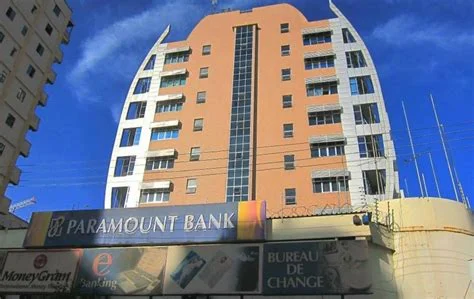
CBK (Central Bank of Kenya) is in talks with Nigeria’s Zenith Bank which is seeking approvals to acquire Paramount Bank. Zenith Bank’s entry into Kenya, Nigeria’s second largest lender, is expected to use its deep pockets to inject more competition in Kenya’s banking space, trigger heightened regional competition and create more possibilities for business and individual customers.
Paramount Bank was established in 1993 as Combined Finance Limited, a non-bank financial institution. It got a banking license in 1995 and became Paramount Bank Limited. In 2000, it merged with Universal Bank Ltd to form Paramount Universal Bank, before reverted to Paramount Bank Limited in 2005.
With Paramount getting out of woods, the clock is now ticking for the remaining smaller Kenyan banks whose capitalization levels fall below the new minimums as set by the CBK, as the December 31st 2025 deadline approaches.
CBK has increased the minimum core capital requirement for banks from KSh 1 billion to KSh 3 billion by December 2025, and further to KSh 10 billion by 2029. These new thresholds have forced small-sized banks to either recapitalise, merge, or sell to comply.
Nigeria’s Zenith Bank is Africa’s second largest lender by market capitalization and its entry into Kenya’s overcrowded banking business could trigger renewed competition, especially for East Africa’s banking business.
This region has now attracted interests from South Africa and Western Africa banking giants to challenge the long held dominance of European lenders.
Nigerian Banks in Kenya:

Zenith Bank will be the fourth lender to operate in Kenya’s banking space after United Bank of Africa(UBA), Guaranty Trust Bank (GT Bank), Access Bank which acquired National Bank of Kenya and Transnational Bank Plc.
Zenith Bank Nigeria planned entry into Kenyan is seen as a launching pad for the cash rich lender to push its presence in the East African region. Zenith Bank recently announcement plans to expand into Côte d’Ivoire and eight other Francophone African countries.
Speaking at the closing gong ceremony at the Nigerian Exchange (NGX) this October, Zenith Group Managing Director and CEO Adaora Umeoji said it will use the part of its recently raised cash to expand its footprints.
CBK New Capitalization Requirements and Deadlines
Apart from Paramount, other lenders that are on the CBK chopping board include M Oriental, ABC Bank Kenya, Premier Bank, CIB International Bank, Middle East Bank Kenya, Development Bank of Kenya (DBK), UBA Kenya Bank, Credit Bank PLC, Access Bank Kenya, and Consolidated Bank of Kenya.
CBK assessment of financial statements for these lenders, for the period ended June 2025, shows that most are still struggling to comply with the new capitalization standards.
According to CBK Governor Dr. Kamau Thugge, the new capitalization requirements for Kenyan banks are due to the sector’s significant risks that require a robust capital base to mitigate.
24 out of Kenya’s 38 commercial banks had core capital below the KSh10 billion target and were instructed to submit board-approved capital build-up plans by April 1, 2025, outlining specific measures, timelines, and milestones to meet the new requirements.
Lenders affected by the new CBK capitalization requirements are already taking corrective action. Nigerian-based UBA Kenya Bank is seeking additional capital from its parent company, United Bank for Africa (UBA) PLC in Nigeria.
Two other banks have approached the CBK for approval to sell stakes to potential investors, while others, particularly subsidiaries of foreign institutions, are relying on big brother support to stabilize their operations.
These efforts reflect the urgency to comply with the CBK’s stringent requirements that has threatened to revoke the license of non-compliant players.
In 2024, the CBK fined eleven banks for breaches set guidelines including lending, capital, and governance rules, with nine institutions cited for lending more than 25 percent of their core capital to a single borrower, violating the single obligor rule.
Three banks were also slapped with punitive sanctions for excessive insider lending and breaches of ownership caps, while others failed to meet the minimum 20 percent Liquidity Ratio.
ALSO READ: Kenyan Banks on the List of Africa’s Top 100 in 2025












Leave a comment