

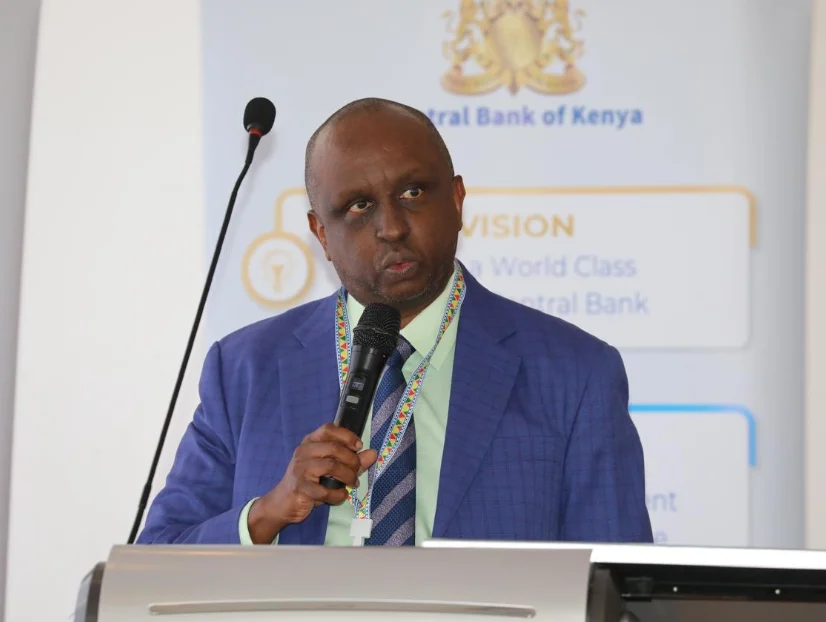
The Central Bank of Kenya (CBK) has placed responsible innovation at the centre of its vision for the country’s fast-evolving financial sector, signalling a careful but optimistic approach to the rise of artificial intelligence.
During the launch of the CBK Artificial Intelligence (AI) Hackathon 2025 in Nairobi on November 20, Director of Bank Supervision Matu Mugo said the regulator wants to encourage technological progress without exposing Kenyans to unnecessary risks.
Mugo noted that AI is already reshaping banking and payments in Kenya, but warned that its adoption must follow solid ethical and governance principles. He explained that the regulator welcomes modern tools, but only within a controlled environment that protects consumers and maintains confidence in the financial system.
“CBK’s philosophy is clear: we want to maximise the benefits of technology while minimising the risks,” he said.
According to him, innovation should expand access and opportunity, but never compromise safety or public trust.
“We support innovation that broadens opportunity and inclusion while protecting stability, consumers, and trust in the financial system.”
His remarks are backed by new data from a CBK survey, which shows that half of Kenya’s financial institutions have integrated some form of AI into their operations.
The most common uses include credit scoring models that process customer information faster, fraud-detection systems that alert banks to suspicious activity, and AI-driven customer service tools that respond instantly to queries.
Institutions that have experienced the most success with these tools are those that paired innovation with robust internal policies, including clear strategies, responsible data-handling practices, ethical guidelines and strong human oversight.
However, the survey also sheds light on the difficulties institutions are encountering as they adopt AI. A majority of respondents, 59 per cent, identified data quality and governance as the most pressing challenge, noting that poor or incomplete data can distort automated decisions. Cybersecurity was the next major concern, with 54 per cent saying AI introduces new vulnerabilities that must be addressed.
Gaps
Another 52 per cent cited the shortage of skilled professionals, a gap that continues to slow down Kenya’s AI ambitions.
Financial institutions are also becoming more cautious about using systems they cannot fully understand. The report found that many firms are moving away from opaque “black box” models and shifting toward explainable AI tools that allow them to trace decision pathways.
This trend is partly driven by the need to detect and minimise bias in automated processes, especially in sensitive areas like loan approvals.
The demand for clear regulation has grown steadily, with the overwhelming majority of surveyed institutions seeking direct guidance from the Central Bank.
“Ninety-three per cent of surveyed institutions have asked CBK to issue formal guidance on AI,” Mugo said.
“They want clarity on governance and compliance, risk management frameworks, and incident reporting.” Banks and fintechs want to ensure they are building systems that meet regulatory expectations before AI becomes even more deeply embedded in their operations.
In response to these calls, CBK is finalising a comprehensive Guidance Note on Artificial Intelligence. The document, which will be the first of its kind for Kenya’s financial sector, will outline the regulator’s expectations, recommended safeguards and good practices for adopting AI responsibly. Mugo said the upcoming guidance is meant to make innovation safer without slowing it down.
“Looking forward, CBK is committed to supporting safe and responsible use of AI. We are formulating a Guidance Note on Artificial Intelligence, which will provide clarity on expectations, risks, safeguards, and good practices.”
He reiterated that human oversight will remain essential, especially in situations where algorithmic decisions affect people’s livelihoods.
“Innovation thrives where there is clarity, trust, and accountability,” he said, emphasising that technology must remain a tool that strengthens, not replaces, human judgment.
Mugo said Kenya has a unique opportunity to shape the future of AI in Africa through careful regulation, collaboration and responsible experimentation.













Leave a comment