

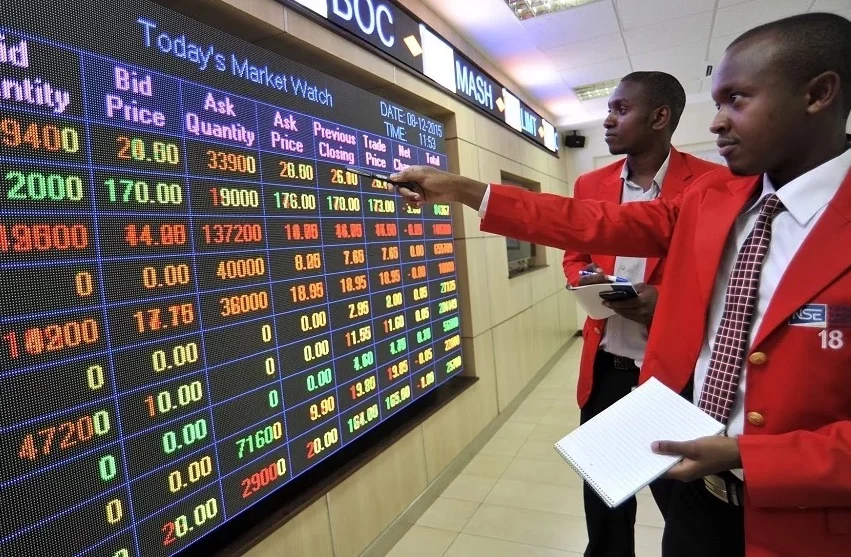
For years, the Nairobi Securities Exchange (NSE) has had something of an awkward relationship with Kenyan investors. Many people knew the NSE existed, but only a smaller group actively followed share prices, dividends and company results.
The market often appeared to be moving in a world of its own, while households were busy dealing with rent, food prices, school fees and the ever-reliable emergency called “please send me something small.”
That picture is changing.
Kenya’s stock market has staged a remarkable rally in 2026, pushing total market capitalisation to a record Ksh 4 trillion. The value of listed companies has risen sharply, with the market gaining more than 30 per cent this year according to the Nairobi Securities Exchange. NSE chief executive Frank Mwiti has said the market could reach KSh5 trillion by the end of the year if the current momentum continues.
The rally is significant because it comes at a time when the Kenyan economy is still dealing with high living costs, expensive credit and uncertainty in global markets. It also raises an important question: what exactly is pushing share prices higher, and can the rally last?
Banks have become the engine of the rally
One of the clearest explanations is the strong performance of banking shares.
Banking stocks have become increasingly important on the NSE, with the sector accounting for a record 42.5 percent of investor wealth on the exchange by June. The combined market value of listed banks had climbed to about KSh1.56 trillion, up from KSh913.4 billion a year earlier.
That is a substantial change in investor sentiment.
Banks such as Equity Group, KCB Group, Co-operative Bank, NCBA and Absa have attracted buyers as investors respond to stronger earnings, dividends and expectations of improved business conditions.
The attraction is not difficult to understand. A bank that is making more money, controlling bad loans and continuing to reward shareholders with dividends becomes particularly interesting when its share price has previously been considered cheap.
For investors, the combination of earnings growth and capital gains is a powerful cocktail.
Safaricom still carries enormous weight
Then there is Safaricom.
The telecommunications giant remains one of the most influential companies on the NSE because of its enormous market value and its importance to the Kenyan economy. Its share price has risen strongly during the rally, helping to lift the overall value of the market.
Safaricom has also demonstrated that it is much more than a company selling mobile airtime. Its M-Pesa business, telecommunications operations and expansion into financial services have made it one of the country’s most closely watched listed companies.
Recent market data showed Safaricom adding hundreds of billions of shillings to its market value, with its valuation reaching around KSh1 trillion during the rally.
This matters because when a heavyweight company rises sharply, it can move the entire market. The NSE is not an equal-weight basket where every company gets an identical vote. Large companies carry considerably more influence.
Investors are responding to better corporate earnings
The rally is not simply a case of investors waking up one morning and deciding to buy everything in sight.
Corporate performance has played an important role.
The first half of 2026 saw the NSE add about KSh817 billion in investor wealth, with the major market indices posting double-digit gains. Banking companies and Safaricom accounted for a large share of the wealth created.
This is important because a sustained stock market rally normally needs something underneath it.
If share prices rise while company profits remain weak, investors eventually start asking uncomfortable questions. But when profits, dividends and business prospects improve at the same time, higher share prices become easier to justify.
The market is therefore rewarding companies that have demonstrated stronger financial performance and the ability to return money to shareholders.
Falling interest rates are changing the investment equation
Interest rates are another important piece of the puzzle.
The Central Bank of Kenya reduced the Central Bank Rate to 8.75 per cent in February and maintained it at that level in June. The regulator said average lending rates had continued to decline while private sector credit growth was improving.
When interest rates decline, the investment landscape begins to shift.
Government securities and bank deposits remain important for conservative investors, but lower yields can make equities more attractive, particularly when companies are paying good dividends and their share prices are rising.
For businesses, cheaper credit can also support expansion and investment. For banks, however, falling rates can have a more complicated effect because cheaper loans may support demand while putting pressure on lending margins.
That is why investors are watching the banking sector closely.
Local investors are becoming more important
Another interesting feature of the current rally is the role being played by Kenyan investors.
Foreign investors have been selling some major NSE stocks even as local institutions and investors have stepped in to absorb the shares. Foreign investors recorded net sales of KSh10.17 billion in the five biggest listed companies in the year to April, while local institutional investors increased their holdings.
This suggests that the NSE is becoming less dependent on foreign money to support prices.
That is an important development. Foreign capital can leave quickly when global conditions change, currencies move or investors become nervous. A market supported by a deeper domestic investor base can potentially withstand such shocks better.
The economy still has plenty of challenges
The Ksh 4 trillion milestone should not be mistaken for a declaration that everything is suddenly wonderful in the Kenyan economy.
Households are still feeling the pressure of higher prices.
KNBS reported annual inflation of 6.4 per cent in June 2026, with food, transport and housing-related costs among the major contributors.
There is therefore an interesting contradiction. The stock market is celebrating while many households are still counting coins before the end of the month.
But the two realities can exist at the same time.
Share prices reflect expectations about the future profitability and value of companies. They do not necessarily measure how comfortable the average household feels today.













Leave a comment