

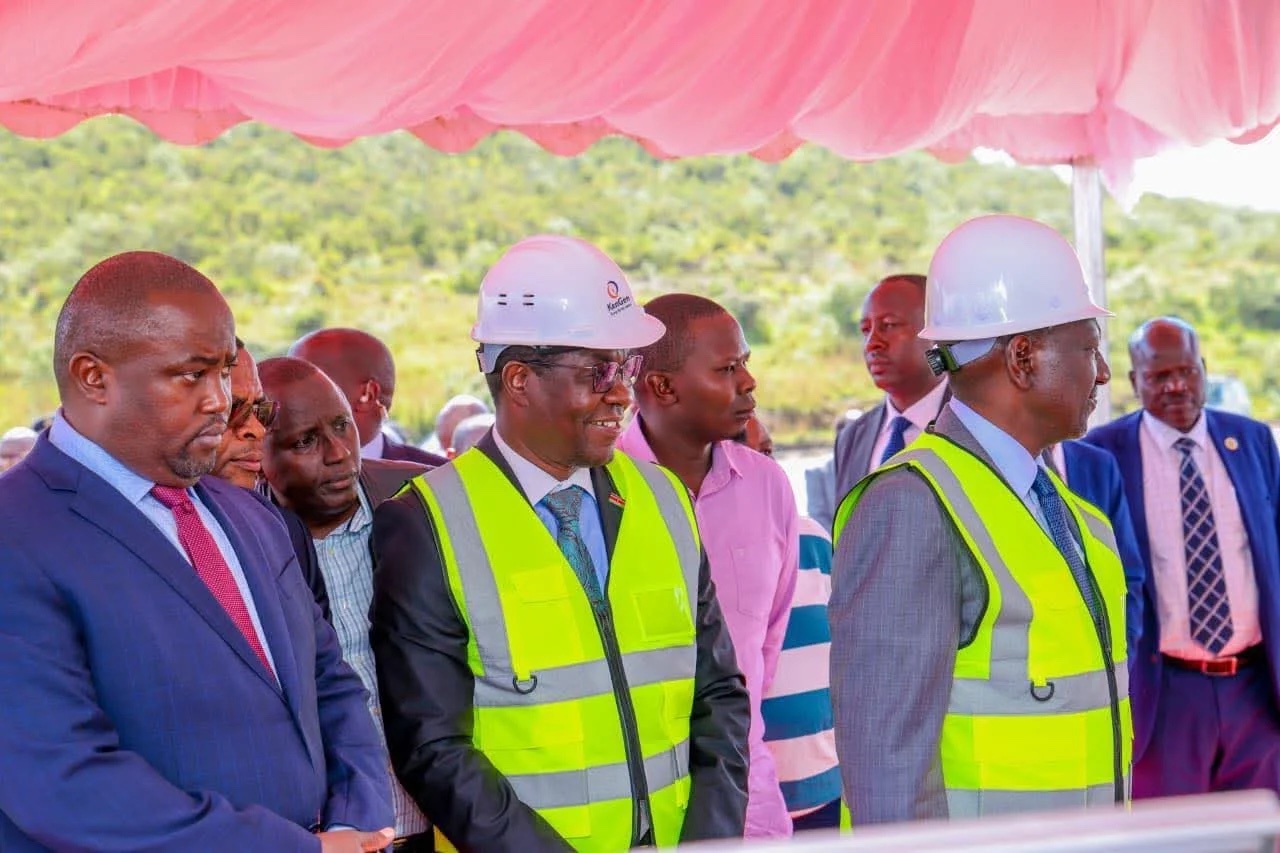
The Suswa Solar Park, a massive 120-MW (megawatt) photovoltaic project in Narok County, Kenya, which was being developed by a consortium of companies, has been cancelled due to what is believed to be massive corruption. The Suswa Park that includes Part of the broader $1 billion Masai Solar Project, featuring cutting-edge Battery Energy Storage Systems (BESS), has run into headwinds after the consortium’s partner company Chief Operating Officer was arrested at their offices on Monday morning – and taken in for questioning by the DCI (Directorate of Criminal Investigations).
Computers and phones were also seized, to enable the agency’s forensic department to follow email trails, and reconstruct the paper trail of certain funds. The CEO of the consortium company is also “constructively helping with the investigation,” and voluntarily presented himself to the agency yesterday (Tuesday) and gave a statement, as well as having his fingerprints taken.
Last November, the president was in Suswa, alongside CS Opiyo Wandayi, for the groundbreaking of the 120-megawatt engineering, procurement and construction project by the Suswa Solar Park corporation, whose cost investment was about $ 200 million, lighting the way for other consortia to invest in this kind of projects that provide clean and affordable energy, whose carbon credits can be harvested, across the continent.
Whilst in Qatar, also early last November, President William Ruto, accompanied by a delegation with Labour Minister CS Alfred Mutua, addressed both Kenyans and high-level foreign investors in Doha, and explained the power load-shedding that has been taking place in the country. “We have 2,300 megawatts for the entire country,” the president said at the time: “So, when we need 1,000 megawatts in one data center, we have to shut down some other part of the country for a few hours, especially in the evening yet we’ll need 5,000 megawatts (in Kenya’s drive for full industrialization) …”
Also Read >> President William Ruto’s Office Under Scrutiny Over Ksh14.5 Billion Bills
The State was seeking investments of about 10 to 12 billion dollars in Doha so that “we can have the capacity we need to make acute power shortages a thing of the past” and “provide for all our domestic and industrial needs as a nation,” the president said at the time, opening his preferred new playbook of “PPP” deals; as opposed to the World Bank loan models that he may be seeking this week in the G7 Summit in Paris, that is being hosted by French president Macron.
Kenya has taken on a bold green growth initiative that aims to achieve 100 per cent renewable energy by 2030and Suswa was a landmark project, whose goal is part of the universal 100 % transition to clean energy. The comprehensive larger Suswa project also includes promoting green manufacturing, sustainable agriculture, eco-friendly urbanization, and green transportation. Currently, Kenya’s grid is 92 percent renewable, but the Kenya Power & Lighting Company (KPLC) has confirmed that our capacity is 3,158 megawatts at peak hours, far less than is needed to satisfy domestic consumers and ramp up electric efficiency with industrial producers.
Nevertheless, the Head of State has said that in order for Kenya and the rest of the continent to achieve green industrialization based on renewables, investment, and financing are needed. “Energy production and access hold back the rise of the continent; on the other hand, Africa’s renewable energy potential is 50 times the global anticipated electricity demand in 2040.”
President Ruto has highlighted the continent’s significant potential for renewable energy, which he believes can support its development goals: “Africa is rich in solar, wind, geothermal, and hydro resources.” Ruto has spoken of the need for Kenya to build 50 mega dams like the High Grand Fort and Soyin-Koru dams, as a crucial first step to power the country towards industrialization, but the stalling of something like Suswa Solar is a serious setback.
The Grand Inga dam, which could potentially generate up to 40% of the electricity needed on the continent is still said to be in the works, so there’s hope. This underscores the immense scale of Africa’s renewable energy potential as a key driver of sustainable development and Kenya is a potential leader in the renewable energy sector.
The continent boasts 60% of the world’s best solar resources and this makes it an ideal location for solar power. In addition, 80 per cent of the new power generation capacity is renewable. “Africa accounts for over 40 per cent of global reserves of cobalt, manganese, and platinum – key minerals for batteries and hydrogen technologies,” President Ruto once pointed out at the African Union.
After China began using its monopoly of rare earth minerals as leverage in its tariff battles with the USA, the Americans have also began to show interest in countries like Kenya, and the DR Congo, as a source of these rare earths.
President Ruto has often expressed optimism about the continent’s potential to become a global leader in sustainable industrialization. “We, therefore, have an opportunity to lead the world and show that we can industrialise and prosper – and achieve this in a low carbon and sustainable manner, and make this century, an African Century.”
Kenya itself has clean energy resources and the potential to leapfrog the dirty energy practices of the past. As part of his party’s 2030 Manifesto, Ruto has emphasised the importance of Africa’s role in promoting sustainable equitable economic development, despite being among least responsible for climate change in the world – which is why Kenya could reap big from carbon credits.
Suswa Solar Park’s groundbreaking in November was that first small step to saying goodbye to the load-shedding, after sunset, in some swathes of the country.
“Although we Africans are least responsible for climate change the most at risk; we can lead the way in ensuring green growth as a critical pathway to a sustainable future and economic prosperity, decoupling economic development from carbon and the use of polluting energy,” President Ruto has said in the past.
See Also >> Public Monuments Now Being Used to Disrupt Child Domestic Labour Market
Suswa Solar Park’s groundbreaking in November was that first small step to saying goodbye to the load-shedding, after sunset, in some swathes of the country, but as often happens, grand corruption appears to be jamming up that project, and may plunge the entire deal into darkness; even as the DCI tries to shed light on the whole matter, and pursue funds in South Korea.
In a power related development, Kenya is on the doorstep of a historic energy transition, with the 2,000 MW nuclear power plant in Siaya as the foundational anchor of Kenya’s long-term energy security.
Speaking to BT, Justus Wabuyabo, the CEO of the Nuclear Energy and Power Agency (NEPA), said that as the country looks to complement its existing renewable energy sources and drive the nation’s bottom-up economic transformation agenda, “transitioning towards nuclear energy is a strategic necessity for our industrial future …”
By providing a reliable, cost-effective and zero-carbon power supply, “our upcoming nuclear infrastructure will drastically lower electricity costs for domestic consumers, while transforming Kenya into a highly competitive manufacturing hub – that will allow the country to set up industries, create jobs and become the ‘Singapore of the South’ by 2050,” the NEPA CEO added.












Leave a comment