

Vivo Energy Kenya, the distributor of Shell fuel and services across the country, has confirmed that some of its service stations are experiencing temporary fuel shortages due to unusually high demand.
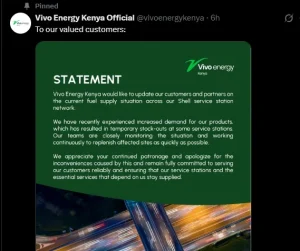
In a statement released on Thursday, the company said its teams are working around the clock to restock affected sites, and apologised to customers who have had to queue longer than expected or drive on empty.
“We have recently experienced increased demand for our products, which has resulted in temporary stock-outs at some service stations. Our teams are closely monitoring the situation and working continuously to replenish affected sites as quickly as possible,” the statement read in part.
The company reassured customers that it is fully committed to reliable service and ensuring that both its stations and the essential services that depend on them remain supplied.
“We appreciate your continued patronage and apologise for the inconveniences caused by this, and remain fully committed to serving our customers reliably and ensuring that our service stations and the essential services that depend on us stay supplied.”
The company’s reassurance comes as motorists in parts of Nairobi and other major towns have reported dry pumps or rationing at petrol stations branded Shell and other outlets.
Government authorities have also warned against artificial shortages and promised action against hoarding.
While Vivo Energy points to increased usage locally, analysts warn that the situation is not happening in isolation. Kenya, like most of the world, relies almost entirely on imported fuel. Experts say that global oil supply disruptions driven by escalating conflict involving Iran are rippling through the international energy market, pushing prices up and straining supply chains.
The vital Strait of Hormuz, through which roughly 20 % of the world’s oil moves, has been disrupted by Middle East tensions. Some reports suggest that tanker traffic has slowed dramatically as shippers reroute or delay shipments to avoid risk, trimming available fuel volumes on the global market.
This is the biggest disruption to global oil flows in decades and has seen crude prices jump to levels not seen in years. In simple terms, less oil leaving export ports means tighter supplies everywhere else, including here in Kenya.
Pressure on Kenya’s Supply Chain
Kenya does not refine its own oil; it imports nearly all of its petrol, diesel and kerosene through ports like Mombasa. That means any delay or price spike abroad can quickly show up on local forecourts.
20 % of Kenya’s roughly 3,100 fuel outlets have been affected by lower stocks, a figure that reflects challenges deeper than simple local demand.















Leave a comment