

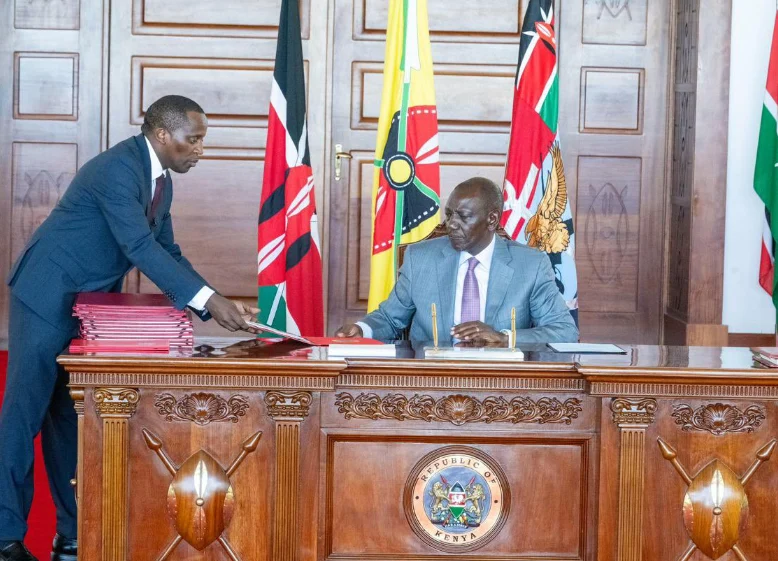
President William Ruto has signed into law the Coffee Act, 2023 (Kenya), a move that significantly reshapes how Kenya’s coffee industry is run and regulated.
The new law transfers key regulatory and commercial responsibilities in the coffee sector from the Agriculture and Food Authority to the Coffee Board of Kenya.
With the changes now in force, the Coffee Board will take charge of regulating the industry and promoting the development of Kenya’s coffee value chain.
Government officials say the reforms are aimed at revitalising the coffee sector, improving oversight and strengthening support for farmers across the country.
Coffee Board takes over regulation
Under the new law, the Coffee Board will handle licensing, registration and oversight of players in the sector, including dealers and other actors involved in the coffee trade.
The board will also advise the government on policies, strategies and funding models meant to strengthen the industry. In addition, it will collect and analyse industry data, conduct market intelligence and promote Kenyan coffee both locally and internationally.
The Act also directs the board to work with the Kenya Bureau of Standards to develop industry standards and codes of practice.

According to the law, the board will also support branding efforts such as the Kenya Coffee Mark of Origin, which is meant to strengthen the identity and global reputation of Kenyan coffee.
During parliamentary debates leading up to the law, legislators explained that the reforms were necessary because the earlier system had weakened the sector.
“Today we are unbundling coffee, removing it from AFA and setting up the Coffee Board of Kenya. I hope this is just the beginning,” one legislator noted during the discussions in Parliament.
New research institute created
The law also establishes a Coffee Research and Training Institute, which will take over coffee research functions that were previously handled by the Coffee Research Institute (Kenya) under the Kenya Agricultural and Livestock Research Organisation.
The new institute will focus on developing improved coffee varieties, fighting crop diseases and promoting modern production technologies to boost yields.
It will also provide training and technical support aimed at strengthening the sector and helping farmers improve productivity.
The reforms are part of broader efforts by the government to revive Kenya’s coffee industry, which has struggled for years due to declining production, poor governance structures and market challenges.
Other laws signed
At the same time, President Ruto also assented to the Miscellaneous Fees and Levies (Amendment) Act, 2026, which expands the scope of the Railway Development Levy.
Previously, the levy mainly financed the Standard Gauge Railway (Kenya), but the amendment allows the funds to support a wider range of railway infrastructure projects.
The law also creates a Railway Development Levy Fund where all proceeds from the levy will be deposited. A board will oversee the management of the fund, including programmes aimed at rehabilitating and expanding railway systems across the country.
In addition, the President signed the Meteorology Act, 2023 (Kenya), which establishes the Kenya Meteorological Service Authority.
The authority will regulate meteorological services in the country and coordinate weather forecasting, climate monitoring and early warning systems. It will also collect and analyse meteorological data and advise both national and county governments on weather-related issues.
Officials say the new authority will play a key role in strengthening disaster preparedness, particularly in areas prone to droughts, floods and extreme weather.













Leave a comment