


President William Ruto has ordered a sweeping overhaul of Kenya’s vehicle inspection and traffic enforcement systems, saying the country can no longer afford rising road deaths and a broken enforcement culture.
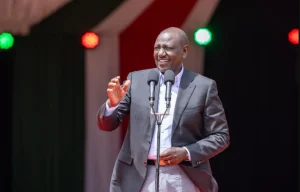
Speaking during a high-level road safety meeting under the National Council on the Administration of Justice (NCAJ), Ruto questioned why the government should spend Sh12 billion setting up inspection centres when private investors are willing to build and run them.
“Why are we looking for Sh12 billion to inspect vehicles using government money when the private sector can do it and give us revenue?” Ruto posed.
PPP model
The President directed the Ministry of Transport to fast-track a Public-Private Partnership (PPP) framework that will allow private firms to establish and operate motor vehicle inspection centres across the country under the supervision of the National Transport and Safety Authority.
Transport Cabinet Secretary Davis Chirchir confirmed that new regulations requiring inspection of all motor vehicles have already been gazetted, clearing the way for NTSA to begin licensing private operators.
The new system is expected to roll out from July 1, with investors given time to set up centres in counties to reduce long travel distances for motorists seeking inspection services.
Under the proposal, licensed private operators will build and run the centres, while the government earns revenue through licensing and oversight. Ruto argued that this approach would modernise inspection without burdening taxpayers and at the same time, improve roadworthiness standards.
He said proper inspection, combined with digital enforcement, could cut road crashes significantly.
“Proper inspection of vehicles and digital enforcement can reduce road carnage by up to 70 per cent,” the President said.
Instant fines and road cameras
At the same meeting, Ruto issued a one-month ultimatum to the Transport ministry and NTSA to implement the long-delayed instant fines programme and install surveillance cameras in at least five to six major towns.
“So I think we just must call it what it is. I have always wondered why we have taken us forever. Why don’t we enforce the instant fines program? Why haven’t we rolled out the cameras on our roads?” he said.
“It is my position, Waziri, that within the shortest time possible, let us roll out the cameras. We’ve been discussing this forever. You know, when can we have the cameras on the roads?” Ruto added, addressing CS Chirchir.
Under the proposed system, traffic offenders will receive fines directly on their mobile phones without having to appear in court. The cameras will capture offences and generate evidence automatically.
“When you have committed the offence, you will have a fine on your phone instantly,” Ruto said. “The cameras will provide foolproof evidence. We do not need to argue with offenders. We do not need to bother the Chief Justice in court.”
The President noted that Minor Traffic Offences Regulations were adopted by Parliament in 2016, saying the legal framework already exists.
“So the story is finished. We have the law, we have the cameras, let’s just roll them out,” he said.
He backed proposals to amend the Traffic Act to formally anchor instant fines and introduce a demerit point system for driving licences. The idea is to shift minor offences from the criminal justice system to administrative handling.
“I agree with the report and with the Chief Justice that some of these traffic offences need to be moved to the realm of administrative interventions,” he said.
Ruto argued that the current court-based system has encouraged bribery.
“If the fine is Sh1,000 and you spend a whole day in court to pay it, it becomes easier to pay a bribe. We must make it much more painful to pay the bribe and much easier to pay the legal fine.”
He also proposed a progressive penalty system where repeat offenders pay higher fines within the same year.
Accidents
Kenya continues to record one of the highest road crash rates in the region. Official figures show that more than 4,000 people die on Kenyan roads every year. In 2025, 5,009 deaths were recorded, 261 more than the previous year.
Road accidents are estimated to cost the economy about Ksh 450 billion annually, roughly five per cent of the country’s Gross Domestic Product. During the 2025 festive season alone, 415 deaths were reported, a 23 per cent rise from the previous year.
However, a pilot inter-agency traffic justice model conducted during the 2025–2026 festive season showed some progress. The initiative brought together 36 prosecutors, 40 officers from the Ethics and Anti-Corruption Commission and 121 NTSA officers in a coordinated enforcement operation.
Fatalities involving public service vehicles dropped by 10 per cent during that period due to tighter monitoring and faster case handling.
Ruto on E-transport
The report presented to the President recommends the creation of an integrated e-transport and traffic case management system linking police, prosecutors, the judiciary and prisons. The goal is to improve transparency and reduce corruption in traffic enforcement.
Ruto said digitisation has worked in other sectors and can clean up traffic management.
“The cameras will do the job of the traffic policeman and also the job of the judiciary instantly,” he said.
Other proposals include body-worn cameras for traffic officers, stronger integrity testing, and tighter anti-bribery controls.
The report also calls for urgent identification and redesign of accident black spots, especially along the Northern Corridor and the Mombasa–Nairobi Highway. It recommends expansion of pedestrian walkways, construction of more dual carriageways, and adoption of safety-by-design principles in new road projects.
Additional measures include digital fatigue monitoring systems for commercial vehicles, mandatory defensive driving certification for public service vehicle operators, and more trauma centres and ambulance response units along major highways.
“Road safety must move from pilot phase to full national transformation,” Ruto said, urging the operationalisation of the National Road Safety Fund to secure sustainable financing for the reforms.










Leave a comment