


Snitches?
From a journalistic point of view certainly not, but in the opinion of toiling Kenyans, the report might just put a person trying to make ends meet out of work and straight into the hands of overzealous authorities that might make him a sacrificial lamb while prominent individuals continue to escape with worse crimes.
Citizen TV Investigative Reporter Purity Mwambia is on the spotlight for her report Virus Safaris & Virusi Safarini (the Swahili version) broadcasted on Sunday exposing how Kenyans are flouting cessation of movement orders to travel to various parts of the country with reckless abandon.
To tell her story, Mwambia and camera operator Amos Amdani sought to travel to Eldoret from Nairobi after getting help from their fixer identified in the story as “Joe”. The idea was to interrogate how effective the cessation of movement orders are and if there are loopholes being exploited that could endanger the lives of Kenyans.
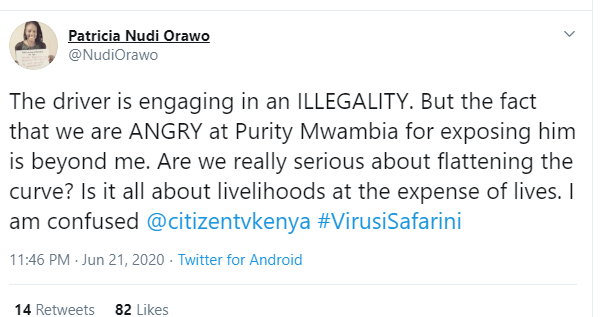
But come Monday morning the story was not well received by Kenyans, Mwambia was among the top trends on twitter mostly for exposing the driver and the number plate of his car, a Nissan March.
Alternative Views
In the report, Mwambia and Amos pay Ksh3,000 each for the journey to Eldoret but they don’t end up getting what they have paid for (more on that later).
They board the vehicle at Tom Mboya avenue and leave Nairobi Central Business District (CBD) at around 6am in a journey that involves cutting corners to evade road blocks erected by the police “enforcing the government’s cessation of movement directives”.
Beteen Niarobi and Eldoret, the destination there are numerous road blocks erected including at Kikuyu, Kijabe Town, Maai Mahiu Town, Nakuru Town, Kapsabet Junction and others.
The driver exposed in the report has a plan to evade each roadblock and that involves him telling his passengers exactly what to do once they approach each roadblock, he might tell them to alight and walk past the police barrier and pick them ahead or ask them to board motorcycles and pick them ahead or alternatively all of them including the driver himself alight the car and a different person altogether in the illegal business circles takes the car and drives it past a police roadblock and hands it back to the traveling party right ahead.
The reason for passengers to alight the vehicle when approaching a road block? The driver is heard saying in the report saying, “”A personal vehicle carrying too many passengers is immediately suspected by the police,”
The driver appears to know the trade well and knows exactly where police are placed and calls his colleagues on multiple occasions to ask what lies ahead.
Despite paying Ksh3,000 for the journey to Eldoret, the driver reneges on the agreement once at the diversion to Kisumu and asks the passengers for another Ksh300. The passengers protest and are left to complete the journey on their own through boarding multiple Public Service Vehicles (PSVs).
They finally complete the journey in 8 hours when it would have taken 6 hours under normal circumstances.
Implications
From the report, it is clear that guidelines put in place by the government are being flouted recklessly and in the event multiple COVID-19 positive persons are “smuggled” out of Nairobi using the same method then it means that Kenya has a huge potential health risk on its hands.
Conversely, from the other spectrum, this is a Kenyan trying to earn a living and the interests of Kenya would be best served by exposing the politicians and the government for failing to help Kenyans adequately despite receiving more than enough funding from development partners. According to this line of thought, the driver was a “very small fish” and an “easy target” for the Citizen TV team.
But what cannot be masked is that the driver’s “hustle” is illegal and a health time bomb.
When extending the nationwide curfew on June 6, President Uhuru Kenyatta cautioned that the government would only lift the travel restrictions when COVID-19 cases in the country start going down.
“We must accept that we are not dealing with a right or wrong opinion we are caught in between two rights. Those who want to open the economy are right and those opposed to opening the economy are also right,” said President Kenyatta.
“Had we not taken the stringent measures that we did in March 2020, the rate of infections in Kenya would have peaked to 800,000 people by July. The number would have hit 2.1 million people if we operated under the guise that 1 infected person can infect two people and by the end of August approximately 75,000 Kenyans would have lost their lives,” said the Head of State.
But with such activities taking place it is possible that the restrictions will remain in place for quite a while.












Leave a comment